
Table of Contents
The Shift from Chat to Agency
I remember the exact moment I stopped “using” AI and started leading it. It was a Tuesday morning in early 2026. While I was still making my first cup of coffee, my agentic AI for small business system wasn’t just waiting for a prompt. On the contrary, it had already cross-referenced three overdue invoices. Furthermore, it drafted personalized reminders and even flagged a potential cash flow dip for July.
This shift toward autonomous business agents represents a fundamental change in how we operate. Consequently, we are moving beyond reactive chatbots. We are entering the era of proactive AI coworkers. These systems execute complex workflows without constant human interference. For years, I felt like I was babysitting my software, but now, I am orchestrating a team of independent digital workers that understand my goals.
The Death of the Manual Task
The transition to an independent AI workforce didn’t happen overnight. Instead, it started when I realized that my time was being swallowed by administrative noise. Every small business owner knows that “squeezed” feeling. Specifically, you have enough growth to be busy, but not enough revenue to hire five assistants.
This is where the true power of agency shines. For instance, instead of me manually triggering a marketing campaign, my agents sense a dip in engagement. Consequently, they don’t just “suggest” a change—they prepare the assets. They check the budget against my current ROI goals. Then, they simply wait for my one-click approval to launch.

Reclaiming the Founder’s Cognitive Load
In the old world of automation, I had to be the brain for every machine. I had to build every “If-This-Then-That” bridge myself. However, if a single variable changed, the whole bridge collapsed. Today, with self-governing AI systems, the “how” is handled by the agent. Therefore, I only provide the “what” and the “why.”
This reclamation of cognitive load is the single greatest competitive advantage of 2026. By offloading the mental labor of project management to my proactive AI coworkers, I can stay in my “Zone of Genius.” As a result, I spend my energy on high-level strategy and creative vision. The agents handle the linear, repetitive execution that used to burn me out by noon.
Defining the Autonomous SMB
For a long time, I confused simple automation with true agency. Traditional automation is a rigid sequence. Moreover, it is fragile and requires me to predict every possible variable. Agentic AI for small business is different because it possesses reasoning capabilities. These systems don’t just follow a script; rather, they navigate toward an objective.
When I integrated intelligent autonomous agents into my workflow, the business changed from a machine to an organism. For example, if a supplier is out of stock, a traditional bot just fails. An agentic system researches an alternative instead. It compares pricing and drafts a pivot plan. Essentially, it treats my business goals as a compass rather than a map.
The Intelligence Layer of 2026
We are now seeing the rise of the “Small-Scale Sovereign” business. This is a company that stays lean in headcount but massive in output. By utilizing smart business agents, I can compete with firms ten times my size. Consequently, the agents handle the heavy lifting of data analysis and pattern recognition.
This allows me to remain in the “High-Value Zone.” While I spend my days on strategy and relationship building, the agentic layer handles the “Linear Zone” of repetitive logic. This isn’t just a new tool. In fact, it is a new architecture for the modern enterprise. We are building systems that think, not just systems that store.
Moving Beyond the “Prompt Box”
In 2024, we were obsessed with “the perfect prompt.” However, in 2026, prompts are secondary to “Environment Design.” I no longer spend my day typing into a chat box. Instead, I spend my time defining the “World Model” for my agents. To achieve this, I give them access to my files, my goals, and my brand voice.
Once they have the context, they operate autonomously. They don’t need me to tell them to “write an email” specifically. Instead, they see a customer is frustrated and they act. This shift from Generative AI (making things) to Agentic AI (doing things) is the most significant leap in business history. It turns every solo founder into a CEO of a digital department.
The Multi-Agent Workforce
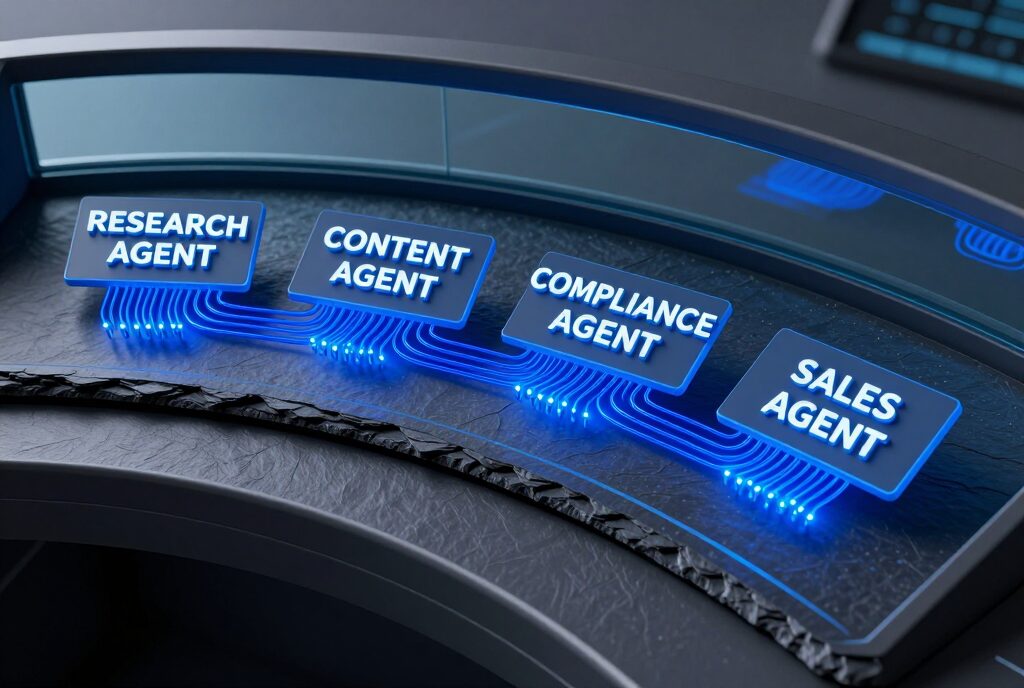
The real magic happened when I stopped using a single AI for everything. To fix this, I started building a cooperative AI network. This is where specialized agents talk to each other. In my setup, my “Research Agent” finds leads. Subsequently, it passes them to the “Content Agent.” The “Content Agent” then drafts a proposal. Finally, it sends it to the “Compliance Agent” for a check.
This multi-agent orchestration mimics a high-performing department. Each agent has a specific “persona.” Furthermore, they have a restricted set of tools. This division of labor prevents the AI from getting confused. By narrowing their focus, I increased their accuracy to near-human levels.
Inter-Agent Communication Protocols
Watching my agents collaborate is like watching a well-oiled pit crew. They use shared memory buffers to stay aligned. For instance, if the “Sales Agent” learns a customer prefers emails over calls, that data updates the “Support Agent.” This happens instantly.
This level of automated team synchronization used to require expensive managers. Now, however, it happens in milliseconds behind the scenes. My role has shifted from “Doer” to “Editor-in-Chief.” As a result, I review the final outputs of their collaboration. This ensures everything aligns with my core vision and long-term strategy.
The Power of Specialized Knowledge Bases
Each agent in my independent AI workforce is fueled by a specific knowledge base. My “SEO Agent” has a 200-page document on niche search trends. Meanwhile, my “Finance Agent” has my last five years of tax returns. They aren’t just “smart”—they are “contextually informed.”
When an agent has deep context, its utility triples. It stops giving generic advice and starts giving specific business intelligence. I have found that spending 10 hours building a high-quality knowledge base saves 1,000 hours of manual correction later. Therefore, it is the best investment a 2026 business owner can make.
Safety, Guardrails, and Ethics
As I scaled my agentic AI for small business system, I realized trust must be earned through architecture. Giving an autonomous agent access to your bank account without restrictions is a disaster. To prevent this, I had to implement controlled AI autonomy. I set strict boundaries on what each agent can see and do.
I follow the “Principle of Least Privilege.” My “Social Media Agent” can draft posts. However, it has zero access to my customer database. My “Accounting Agent” can flag unpaid invoices, but it cannot move funds without my biometric approval. These secure AI guardrails ensure that if one agent malfunctions, the damage is localized.
The Necessity of Human-in-the-Loop (HITL)
No matter how advanced my independent digital workers become, I never remove the “Human-in-the-Loop” requirement. For any action involving a spend over $100, the agent must pause. Subsequently, it must request my direct authorization. This creates a safety net of supervised machine agency.

This isn’t just about preventing errors. Instead, it’s about maintaining the soul of the business. Agents are excellent at logic, but they lack the “gut feeling” of a founder. They don’t understand the nuance of a 10-year client relationship. By keeping myself as the final gatekeeper, I ensure the technology serves the mission.
Designing Ethical Constraints
In 2026, your “Values” are actually your “Code.” I have a specific “Ethics Module” that every agent must query before communicating. For example, it forbids aggressive sales tactics. It mandates transparency about being an AI. It protects user privacy by default.
If an agent proposes a growth hack that violates my ethics, the “Compliance Agent” flags it. This internal checks-and-balances system is vital. Consequently, it prevents my company from becoming a cold, algorithmic entity. We use agentic AI for small business to enhance our humanity, not replace it.
Implementation Roadmap
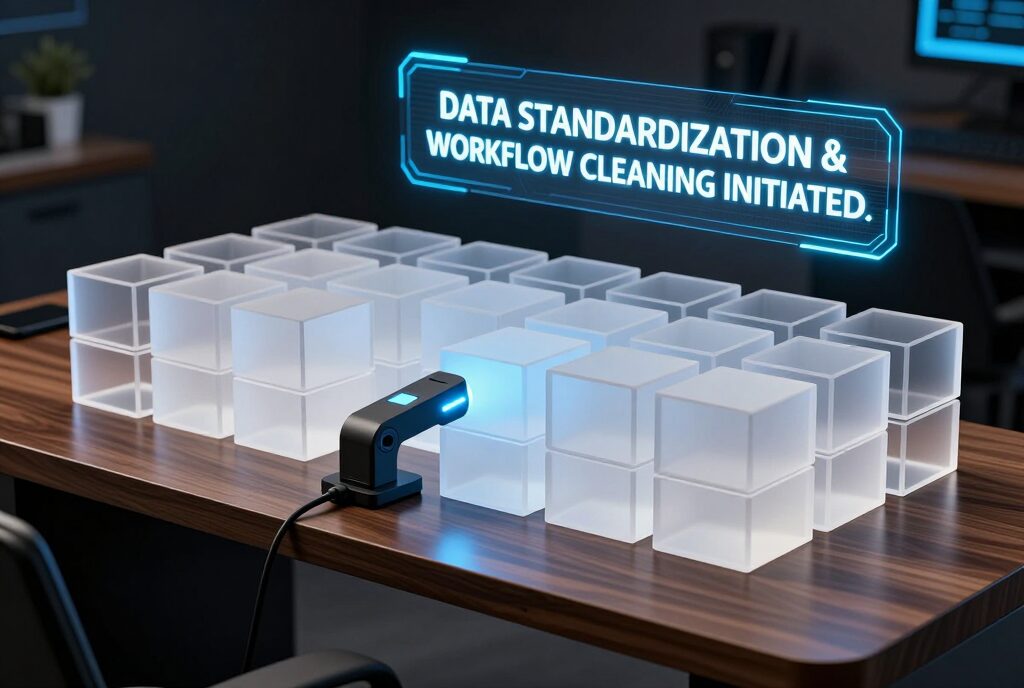
The biggest mistake I made was trying to “agentize” a mess. Naturally, if your business processes are chaotic, your autonomous growth agents will just automate that chaos at scale. Before I could deploy a single agent, it was necessary to treat my business like an API. To achieve this, I documented every workflow meticulously. Furthermore, I cleaned my spreadsheets and standardized my filing systems to create a readable data foundation.
Effective AI agent deployment requires a foundation of structured data. Specifically, I spent weeks creating “Knowledge Bases.” These are simple files that explain my brand voice and pricing. They act as the “Employee Handbook” for my agents. Without this digital infrastructure for AI, your agents are just guessing.
The “Vertical Pilot” Strategy
I didn’t try to automate my entire company on day one. Instead, I started with a “vertical pilot” in my customer support department. Once that specialized AI agent hit a 95% accuracy rate, I moved to the next department. This modular approach allowed me to learn the nuances of agent memory management.
Success in 2026 isn’t about having the “smartest” AI. Rather, it is about having the best-prepared environment. By the time I reached the final module of my rollout, the first four agents were already paying for the rest. Consequently, they saved me enough time to focus entirely on the expansion.
Documenting the “Reasoning Path”
When setting up your independent AI workforce, you must require them to “show their work.” My agents are programmed to provide a “Reasoning Summary” for every major action. For instance, if they decide to pivot a marketing campaign, they must list the three data points that led to that decision.
This transparency allows for rapid debugging. If an agent makes a mistake, I can see exactly where its logic failed. Was it the data? Was it the instruction? Ultimately, this transparent AI reasoning is the only way to build long-term trust in an autonomous system.
The ROI of Autonomy
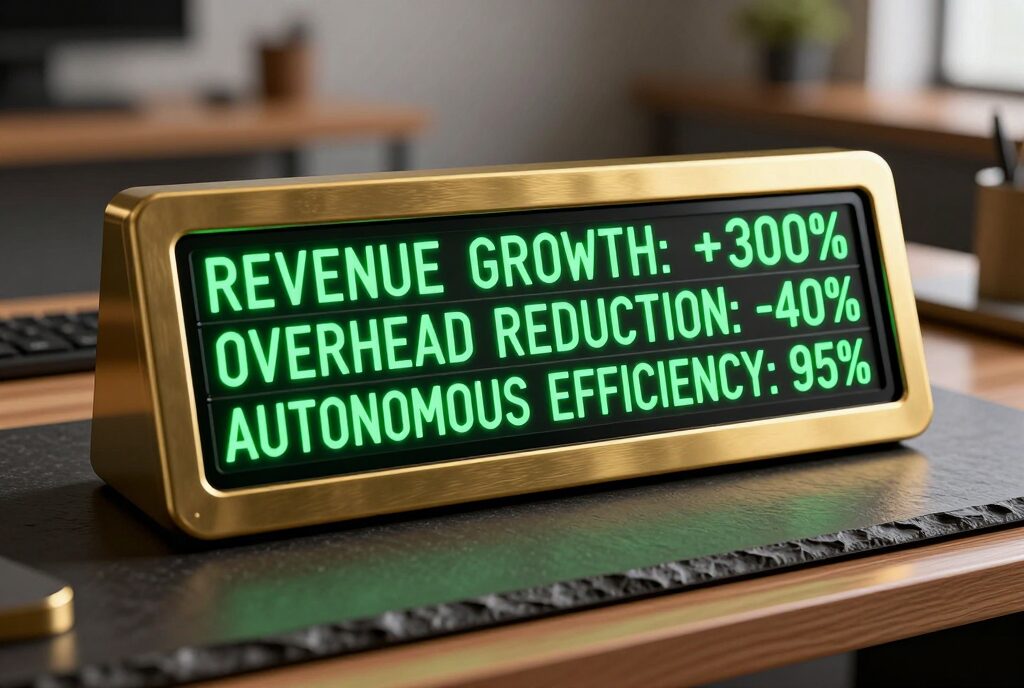
The question I get asked most is, “How do you know it’s working?” In the world of agentic AI for small business, ROI isn’t just a number. Instead, it is a fundamental shift in my capacity to scale. Within six months, I saw a 40% reduction in overhead. Furthermore, I saw a 300% increase in lead response speed.
We measure success through autonomous efficiency metrics. Specifically, I look at “Time-to-Resolution” and the “Agent-to-Human Handover Ratio.” If my agents are handling 90% of the workload without me, the system is profitable. I am no longer paying for hours. Consequently, I am paying for outcomes. This is the goal of AI-driven revenue growth.
Reclaiming the Founder’s Spirit
The most profound ROI is the mental clarity I’ve regained. Before I had an independent digital workforce, I was a “Bottleneck Founder.” Every decision had to pass through me. That meant I was the slowest part of my company. Today, however, I am the “Architect.” I build the systems that build the business.
This freedom allows me to explore new markets. It lets me innovate in ways that were previously impossible. The ROI of agentic business transformation is the ability to stay small enough to care, but big enough to win. We are entering a decade where the most successful entrepreneurs won’t have the most employees. Instead, they will have the most effective agents.
The Future: Autonomous Scaling
As I look toward the rest of 2026, my goal is “Infinite Scale.” My agents are now training their own sub-agents. They are optimizing their own workflows. My business has become a self-improving engine. This is the final stage of agentic AI for small business.
The “Startup of One” is now a reality. You can run a multi-million dollar enterprise from a laptop at a coffee shop. This isn’t because you are working 100 hours a week, but because your autonomous growth agents are. The era of the “Hustle” is being replaced by the era of the “Architecture.”