

Table of Contents
The Hybrid Intelligence Revolution
I remember the day I realized my agency couldn’t scale by just hiring more people. Our overhead was climbing, but our output remained stagnant. That was my first encounter with Hybrid Intelligence. In 2026, building hybrid intelligence team structures is the only way for remote agencies to maintain a competitive edge.
The old model of “remote vs. office” is dead. We are now in the era of “human vs. digital” collaboration. Hybrid Intelligence (HI) isn’t about replacing your team; it is about amplifying their strengths. By integrating autonomous agents into your daily operations, you allow your human experts to focus on what they do best: strategy and creativity.
I have seen firsthand how this shift transforms agency morale. When you remove the “work about work”—the scheduling, the status updates, the data entry—your team actually enjoys their jobs again. We aren’t just working faster; we are thinking smarter. Let’s explore how to redesign your agency for this high-performance future.
Designing the “Agent-Human” Workflow
When I first attempted to integrate automation, I made the classic mistake of treating AI like a calculator. I gave it a task and waited for a result. But in 2026, high-performance agencies treat AI like a teammate. Designing an effective “Agent-Human” workflow requires a fundamental shift from task-based management to role-based orchestration.
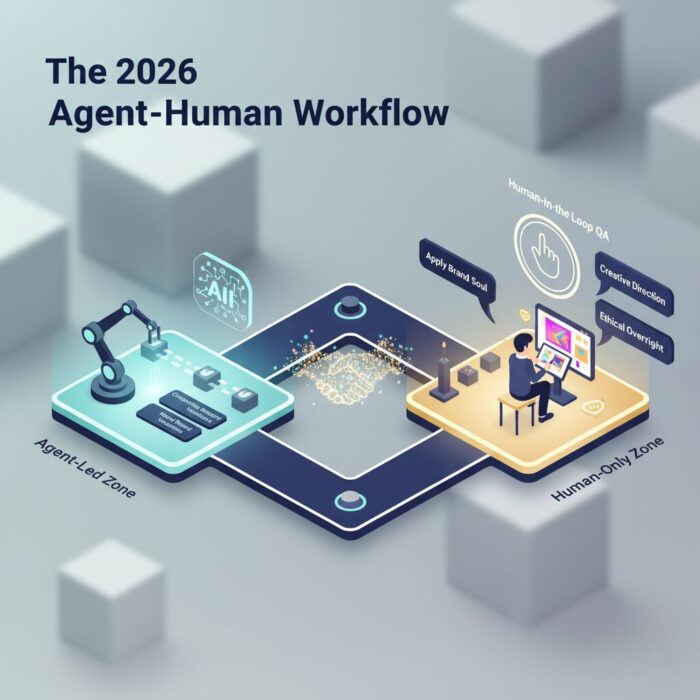
The secret lies in identifying your “Human-Only” and “Agent-Led” zones. Humans excel at high-context decision-making, empathy, and ethical oversight. Conversely, AI agents are unparalleled at processing massive datasets, pattern recognition, and 24/7 responsiveness. When you map your agency’s processes, you must clearly define where the “handshake” happens between these two entities.
Defining the Handshake Points
I start by looking for bottlenecks in our creative pipeline. For example, during a rebranding project, I let our AI agents handle the initial competitive research and mood board variations. This isn’t the final product, but it gives my human designers a “warm start.” The human then steps in to apply the brand’s unique soul—something an agent can’t yet replicate.
This collaborative loop creates a feedback system where the AI learns from the human’s refinements. By setting up these clear touchpoints, you ensure that the AI is always serving the human’s vision, rather than the other way around. It’s about building a workflow where the human acts as the “Director” and the AI acts as the “Production Crew.”
Implementing a “Human-in-the-Loop” Quality Control
Quality control in a hybrid team is non-negotiable. I never let an agent-generated deliverable reach a client without a human signature. We use a “Review-Adjust-Approve” protocol. The agent produces the bulk of the technical work, but a senior strategist must review it for nuance and brand alignment.
This approach mitigates the risk of “hallucinations” or generic outputs. It also keeps your team engaged with the work. They aren’t just copy-pasting; they are curating and perfecting. This balanced workflow is the foundation of a scalable, resilient remote agency in 2026.
The Rise of Agentic AI in Remote Operations
I recently observed a remote agency struggle to manage its project intake. They were using traditional automation—the kind that stops the moment it hits a typo or a missing field. In 2026, that “break-fix” cycle is a relic. We have moved into the era of Agentic AI, where digital workers don’t just follow scripts; they own outcomes.
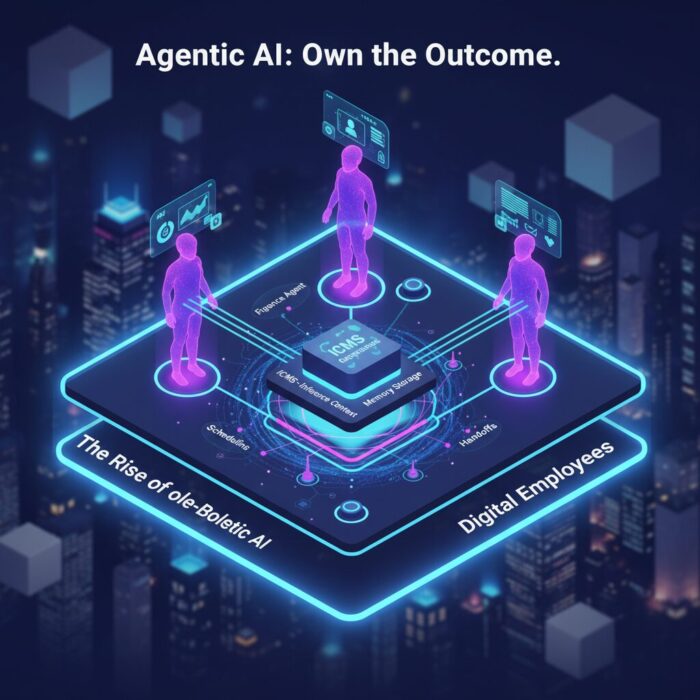
The distinction between a “chatbot” and an “agent” is profound. A chatbot waits for your command to summarize a meeting. An agentic system, however, notices a meeting has ended, identifies the action items, checks your team’s availability in the CRM, and proactively drafts follow-up emails for your approval. It doesn’t wait to be told; it observes its environment and plans the next logical step.
Why Autonomy is the New Scalability
The primary benefit of agentic systems in a remote setting is the reduction of “coordination tax.” I’ve found that as remote teams grow, the time spent on handoffs often grows faster than the work itself. Agentic AI acts as the connective tissue. For instance, a “QA Agent” in a creative agency can autonomously run accessibility checks, verify outbound links, and flag brand inconsistencies across multiple time zones while the human team is asleep.
Moving from Tools to Digital Employees
In 2026, we are seeing the rise of Role-Based Digital Employees. Instead of hiring for every small administrative gap, agencies are deploying specialized agents for finance, HR, and IT operations. These agents have “memory” and “learning” layers, allowing them to improve based on your past feedback.
I recommend starting with a narrow-scope agent, such as an “Intake Concierge.” This agent can receive a client request, pull relevant data from your archives, and present a senior strategist with a “pre-filled” scope of work. By the time I log in, 40% of the cognitive lifting is done. This isn’t just efficiency; it’s a fundamental reimagining of what a “team” looks like in the digital age.
Cultural Glue in a Distributed HI Team
When I first transitioned my agency to a “remote-first” model, I feared we would lose our “soul.” I worried that as we integrated AI agents, my team would start feeling like cogs in a machine. However, in 2026, I’ve realized that the opposite is true. When used correctly, Hybrid Intelligence (HI) acts as a catalyst for deeper human connection. It frees us from the administrative “noise” so we can focus on the relationships that actually build a business.
The challenge is creating “cultural glue” in a team where some members don’t have a pulse. I’ve found that trust in a hybrid team is built through transparency and role clarity. Your human teammates need to know exactly what an AI agent is responsible for, just as they would with a human colleague.
Reintroducing Meaningful Rituals
To maintain this connection, I’ve implemented “AI-Free Zones.” These are weekly strategy sessions or brainstorming huddles where all generative tools are turned off. We focus purely on raw human intuition and creative debate. These rituals signal to the team that while agents handle the execution, the “human touch” is still our most valuable currency.
Onboarding Your Digital Teammates
I treat our AI agents like new hires. When we deploy a new “Research Agent,” I give it a “bio” in our shared workspace. I list its specific data sources, its strengths, its limitations, and—most importantly—the human it reports to. This removes the “black box” mystery.
By humanizing the integration process, you reduce the underlying anxiety of job displacement. My team doesn’t see “the AI” as a threat; they see “Artemis,” the agent that handles their technical audits so they can spend more time on client strategy. This clarity is the secret to a psychologically safe and high-performing distributed culture.
Rewarding Connection, Not Just Output
In 2026, output is increasingly subsidized by AI. Therefore, I’ve shifted our recognition programs to reward “soft skills.” I publicly celebrate team members who mentor others, resolve complex client conflicts with empathy, or contribute to our collective knowledge base.
We use AI to track our efficiency, but we use human judgment to define our success. By celebrating the things a machine cannot do, you reinforce the value of your human talent. This creates a resilient culture where people feel seen, valued, and empowered to work alongside their digital counterparts.
Managing “Cultural Debt” and AI Bias
In the rush to automate, many agencies are unknowingly accruing a new kind of liability: Cultural Debt. Much like technical debt, cultural debt is the long-term cost of choosing short-term efficiency over the health of your team’s “human fabric.” In 2026, 80% of workers are concerned their colleagues are using AI to appear more productive than they actually are, according to recent Deloitte research. When trust erodes, so does your agency’s output.
The Danger of the “Black Box”
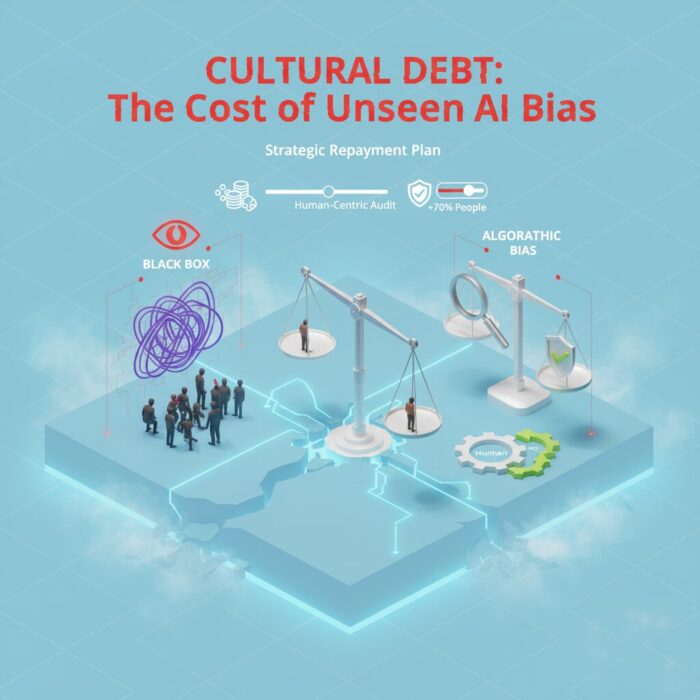
Cultural debt often starts with the “Black Box” problem. When an AI agent makes a decision—like flagging a resume or prioritizing a client ticket—without a clear rationale, it creates a sense of unfairness. If your team doesn’t understand why the AI made a choice, they stop trusting the system.
To pay down this debt, you must prioritize Explainability. I require my AI leads to document the logic behind every automated workflow. We move from “The AI said so” to “The agent prioritized this based on these three specific KPIs.” This transparency is the only way to maintain a culture of accountability in a hybrid environment.
Mitigating the Bias Feedback Loop
The most dangerous form of cultural debt is Algorithmic Bias. AI tools are mirrors; if your historical data contains biases—whether about gender, race, or even preferred communication styles—the AI will amplify them. This isn’t just an ethical issue; it’s a legal one. In 2026, the “4/5ths rule” has become a regulatory benchmark: if an AI’s selection rate for a protected group is less than 80% of the most favored group, you face immediate liability.
Strategic Repayment Plans
Managing these risks requires a proactive “Human-Centric” audit process. Here is how I manage this in my own operations:
- Diverse Data Ingestion: We actively seek out diverse datasets to “stress test” our agents, ensuring they don’t default to majority viewpoints.
- The 10/20/70 Rule: We allocate 10% of our resources to the AI models, 20% to the infrastructure, and a massive 70% to the people and processes that oversee them.
- Meaningful Human Review: We’ve moved past “checkbox compliance.” Our reviewers have the explicit authority (and the raw data access) to override an AI recommendation without penalty.
By intentionally designing your culture to handle these frictions, you turn AI from a source of distrust into a tool for equity. You aren’t just building a faster agency; you are building a more sustainable one.
Scaling Without Headcount: The 2026 Growth Blueprint
In early 2026, I met an agency owner who was terrified of “The Capacity Crunch.” Her team was at a breaking point, but her margins couldn’t support five new senior hires. We sat down and looked at her “Digital Assembly Line.” Within three months, she scaled her output by 40% without adding a single human to the payroll.
This is the promise of Scaling Without Headcount. It’s not about doing less with more; it’s about decoupling your revenue from your hourly labor. In 2026, the organizations seeing 10x growth are those moving from “pilot” projects to “agentic orchestration” at scale.
The Agentic Growth Stack
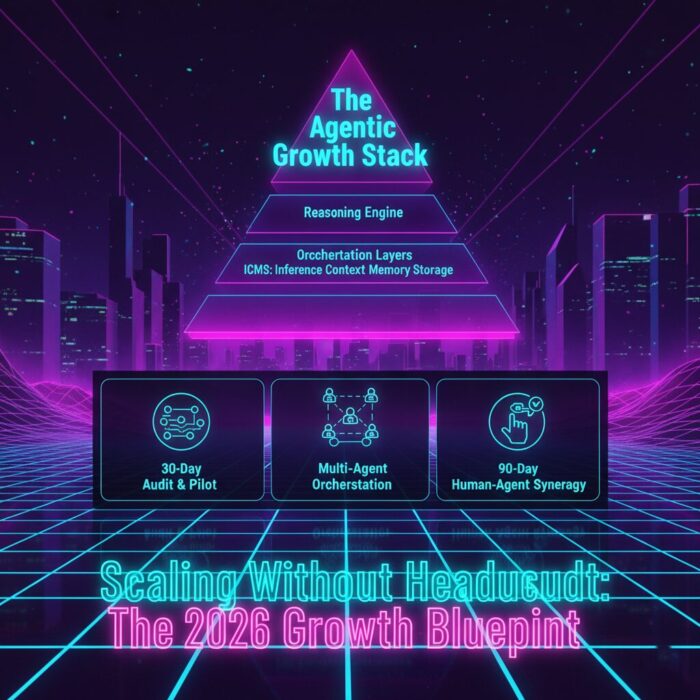
To build your own growth blueprint, you need to transition from simple chatbots to a multi-agent ecosystem. According to recent 2026 industry reports, productivity growth in AI-exposed sectors has nearly quadrupled since 2022. The winners are using a specialized stack:
- The Reasoning Engine: LLMs like Llama 4 or Gemini 2.0 Pro serve as the “brain.”
- Orchestration Layers: Tools like CrewAI or LangGraph allow multiple agents to “talk” to each other, passing tasks back and forth like a relay team.
- Inference Context Memory Storage (ICMS): A 2026 technical standard that allows agents to “remember” complex, multi-day workflows without the massive latency or cost overhead of older systems.
Your 30-60-90 Day Blueprint
If you want to transition your remote agency into a Hybrid Intelligence powerhouse, follow this phased approach:
- Days 1-30: The Audit & Pilot. Identify one repetitive, high-volume process (e.g., lead qualification or technical auditing). Deploy a single agentic workflow. Focus on Data Hygiene—garbage in means your agent will make confident, high-speed mistakes.
- Days 31-60: Multi-Agent Orchestration. Introduce a second agent. Create a “handover” protocol where Agent A (Data Retrieval) feeds into Agent B (Analysis). This is where you begin to see “seat compression”—the ability to do more work with fewer software licenses and less manual oversight.
- Days 61-90: The “Human-Agent” Synergy. Formalize your AI Ethics & Governance board. Ensure every automated outcome has a clear “Human-in-the-Loop” trigger for high-stakes decisions.
By the end of this cycle, your human team should be spending 56% more of their time on high-value strategy—the kind of work that commands premium agency rates. You aren’t just surviving the 2026 market; you are architecting a business that grows even when you’re offline.