Table of Contents
For a long time, I didn’t actually own a business. I owned a very demanding, high-stress, 24/7 job where I happened to be both the CEO and the person who made sure there was toilet paper in the office bathroom. Scalability Engineering
I remember the exact moment I realized my life was unsustainable. It was 3:15 AM on a rainy Tuesday. I was hunched over my kitchen table, the blue light of my laptop screen searing into my tired eyes. I was manually copying data from one spreadsheet to another, responding to a customer complaint about a $20 order, and trying to figure out why our website’s checkout button had stopped working.
My back ached, my coffee was cold, and my phone was buzzing with a notification from an employee who couldn’t find a file they needed. I was successful by most standards—the revenue was climbing—but I was a prisoner to my own success. I realized that if I stopped working for even forty-eight hours, the whole machine would grind to a violent, expensive halt. That wasn’t freedom; it was a cage I had built with my own hands.
The Great Realization: A Job vs. A Business
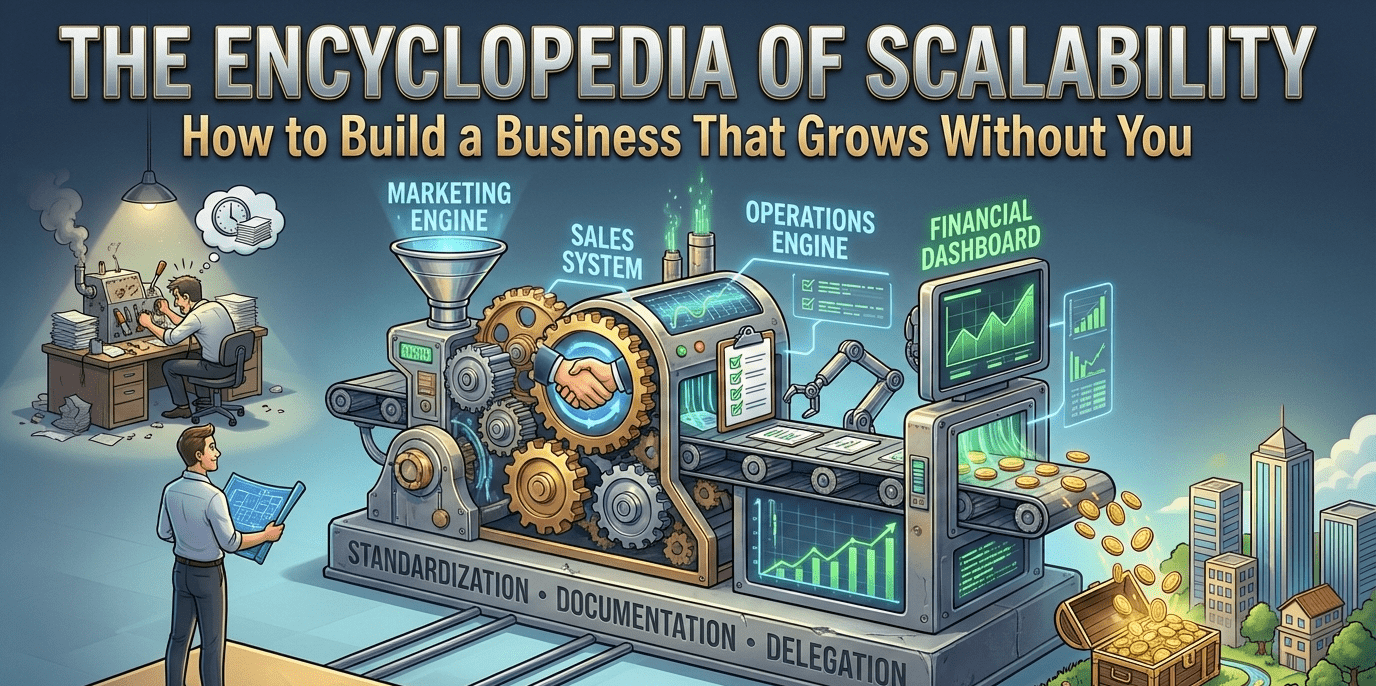
The first thing I had to accept was a hard, cold truth: If your presence is required for your income to generate, you don’t have a business—you have a job. A true business is a set of repeatable, reliable systems that produce a specific result regardless of who is pulling the lever. Think of it like a grandfather clock. Once the gears are built, the oil is applied, and the weights are set, it tells time whether you are in the room or halfway across the world. Scalability is simply the ability to add more “clocks” to your collection without having to manually move the hands of every single one yourself.
To move from “The Doer” to “The Owner,” I had to stop obsessing over my own productivity and start obsessing over my company’s Scalability.
Phase 1: The War on “The Genius with a Thousand Helpers”
To scale, I had to stop being the “genius” and start being the “system designer.” I focused on three specific pillars that changed everything.
In the early days, I felt like a genius. I knew every client’s name, every line of code, and every marketing trick. I hired “helpers” to do the boring stuff, but they always had to come to me for every decision and I was the bottleneck.
1. Standardization: Killing the “Custom” Monster
I used to take pride in being “flexible.” I would do anything for any client. If they wanted a “special” version of my service, I’d spend all night figuring it out.
I soon realized that flexibility is the mortal enemy of scale. Every time I did something “custom,” I was creating a new process that lived only in my head. I was a craftsman, not a business owner.
I had to prune the garden and I looked at everything I did and asked: “What is the 20% of my work that provides 80% of the value?” I cut everything else and I narrowed my focus until I could create a “factory line” where the inputs and outputs were predictable. Once the work became predictable, it became teachable.
2. Documentation: Building the “External Brain”
Once I had a standardized process, I had to get it out of my skull. I started a habit that felt tedious at first but saved my life: I recorded my screen or my voice every time I did a recurring task.
Whether it was onboarding a new client, running a weekly financial report, or even just formatting a blog post, I documented it. These recordings and checklists became my Standard Operating Procedures (SOPs). An SOP is more than just a list of instructions; it’s the DNA of the company. I told my first real manager: “If the SOP is followed and the result is bad, it’s a system failure (my fault). If the SOP is ignored and the result is bad, it’s a people failure (your fault).” This clarity removed the “guesswork” that was keeping me tethered to my desk. Suddenly, I wasn’t needed to answer every tiny question because the “External Brain” had the answers.
3. Delegation of Outcomes (Not Tasks)
This was my biggest mental hurdle. For years, I hired people to “help me with my tasks.” I’d say, “Go post these three images to Instagram.” But then I’d still have to check the captions, approve the timing, and monitor the comments. I had just added “Manager” to my already overflowing plate.
Scalable owners ask, “Who is the best person to own this outcome?”
I stopped giving tasks and started giving responsibility for results. Instead of telling someone to post on social media, I said: “You are now responsible for our community engagement growth. Here are the tools and the budget. Come to me once a week with the numbers.” When you give someone a task, you create a follower. When you give someone an outcome, you create a leader who begins to improve the system for you.
Phase 2: The Infrastructure of Freedom
To build a business that grows without you, you need to look at your “Infrastructure.” I broke my business down into four “buckets” that needed to run on autopilot.
The Marketing Machine
If you have to personally go out and “hunt” for every new customer, you will never scale. You are just a salesperson with a fancy title. I spent a year building a marketing engine—content that lives forever, automated email sequences, and paid ads that predictably bring in leads. My goal was to make sure that the phone rang even if I was asleep.
The Sales System
I used to be the only person who could “close” a big deal and I thought I was special and I wasn’t. I just hadn’t written down the “Sales Script” or the “Objection Handling Guide.” Once I turned my “intuition” into a repeatable sales process, I could hire someone with a great personality and train them to close just as well as I could.
The Operations Engine
This is where the SOPs live. This is the fulfillment of the promise you made during the sales process. If your operations rely on your “magic touch,” you are stuck. We built a project management system where every new client triggered a pre-set list of 50 tasks for the team. No one had to ask “What’s next?” because the system told them.
The Financial Dashboard
I stopped checking my bank account every morning and started looking at a “Scorecard.” This scorecard tracked five key numbers: Lead volume, Conversion rate, Cost to acquire a customer, Customer lifetime value, and Net profit. If those five numbers are in the green, I don’t need to know the drama of the day-to-day.
Phase 3: The “Four-Week” Litmus Test
How do you know if you’ve actually built a scalable business? I developed what I call the Four-Week Test. I decided to leave my business for four weeks. No laptop. No “quick check-ins” and No “emergency” Slack messages.
The first time I tried this, I made it exactly four days before a “catastrophe” occurred that forced me to jump back in. But I didn’t see that as a failure; I saw it as a diagnostic report. That “catastrophe” happened because I hadn’t built a system for that specific problem.
I spent the next six months plugging those holes. The next time I took the test, I returned after a month to find that the business hadn’t just survived—it had actually grown by 5% while I was gone. That was the day I finally felt like a true entrepreneur.
The Psychological Barrier: Firing Yourself
The hardest part of scalability isn’t the software or the hiring—it’s the ego. You have to accept that someone else might do a task differently than you. They might even do it “80% as well as you.” For a perfectionist, that hurts. But “80% as well as you,” when performed by ten different people, is 800% more output than you could ever achieve alone.
You have to trade the “hero’s high” of saving the day for the quiet satisfaction of a phone that doesn’t ring. You have to be okay with not being the most important person in the room anymore. When your team stops coming to you for answers, you haven’t lost your power—you’ve gained your freedom.
Are you currently a “Doer” (strapped to the engine) or an “Architect” (designing the machine)?
Let me know where you stand—and what your first step toward freedom is—in the comments below!