
Table of Contents
I remember the “Prompt Engineering” craze. It was only a couple of years ago, but it already feels as quaint as using a rotary phone. We used to spend our mornings meticulously crafting paragraphs—“Act as a senior marketing executive,” “Use a professional yet friendly tone,” “Do not mention the competition”—just to get a chatbot to spit out a decent email draft. We were the labor, and the AI was the dictionary.
That world ended this week.
With the latest reports from Gartner confirming that 15% of all daily global work decisions are now made autonomously, we have officially crossed the rubicon from Generative AI to Agentic AI. We have stopped asking AI to write poems and started authorizing it to execute workflows. We have moved from the “Chatbot” era to the “Digital Workforce” era.
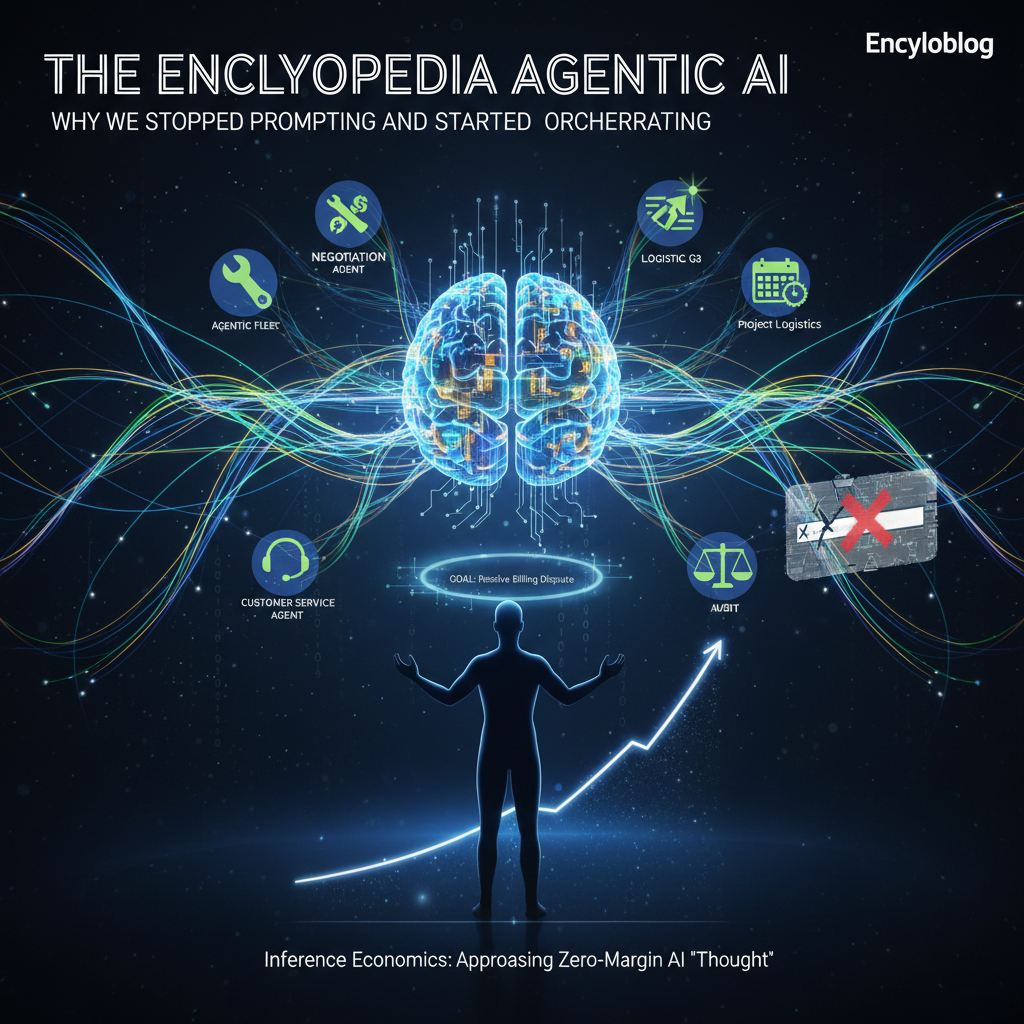
If you are still “prompting,” you are working too hard. The modern professional is no longer a writer; they are an AI Orchestrator. Your job is no longer to do the work, but to manage the “fleet” that does it for you. Here is your definitive guide to the agentic revolution and the new laws of Inference Economics.
1. The Death of the Prompt, The Birth of the Goal
Agentic AI differs from Generative AI in one fundamental way: Agency. A generative model is a passenger; an agent is a driver.
In the old model, if you wanted to resolve a customer dispute, you prompted the AI to write a refund email. In the Agentic model, you simply set a Goal: “Resolve all shipping-related tickets for under $50 by cross-referencing our logistics API and issuing credits automatically.”
The agent doesn’t just write the email. It:
- Logs into the CRM to check the customer’s history.
- Accesses the Logistics Portal to verify the delay.
- Negotiates with the shipping partner’s bot to claw back the shipping fee.
- Issues the refund through the payment gateway.
- Closes the ticket.
You didn’t prompt a response; you orchestrated a resolution.
2. The New Professional: The AI Orchestrator
As businesses move toward “Agentic Fleets,” the most valuable job title on the market is the AI Orchestrator. This role is less about technical coding and more about “Systemic Management.”
Being an Orchestrator requires three specific skills:
- Capability Mapping: Knowing which “specialist agents” to deploy for a specific task. You wouldn’t use a “Legal Auditor” agent to handle “Creative Social Media” workflows.
- Guardrail Engineering: Setting the boundaries. An Orchestrator’s primary job is to ensure the agent stays within the “Logic Fence”—for example, ensuring a negotiation agent doesn’t accidentally offer a 90% discount just to close a deal.
- Conflict Resolution: When two agents disagree—say, your “Budget Agent” blocks a purchase requested by your “Inventory Agent”—the Orchestrator acts as the human tie-breaker.
3. Inference Economics: Why This is Inevitable
You might wonder why every small business is suddenly deploying a fleet of digital workers. The answer lies in Inference Economics.
In the early days of AI, “thinking” was expensive. Running a complex model required massive server power and cost dollars per query. Today, the cost of “inference” (the AI’s processing of a thought) has plummeted.
The Hook: We are approaching “Zero-Margin Inference.” When it costs $0.0001 for an agent to spend an hour “thinking” about your calendar optimization, it becomes more expensive not to use it.
By 2027, the cost of an “Agentic Fleet” for a small business will be lower than the cost of a high-speed internet subscription. This is the great democratization of labor. A solo entrepreneur can now operate with the operational complexity of a Fortune 500 company because their “staff” is a collection of high-speed, low-cost agents.

4. Sovereignty and the ‘Agentic Mesh’
The next frontier for the Orchestrator is the Agentic Mesh. This is where your agents talk to other people’s agents.
Imagine your “Office Manager” agent needs to book a team retreat. It doesn’t browse a website. It reaches out to the “Property Manager” agents of various hotels. They negotiate prices, verify dietary restrictions, and sign a contract in milliseconds.
This raises the stakes of AI Sovereignty. In this encyclopedia of the new era, the most important entry is “Permissioning.” As an Orchestrator, you must manage your Identity Keys. You are giving these agents the power to spend your money and sign your name. The “Digital Workforce” needs a “Human Boss” who understands the weight of a digital signature.
5. Transitioning from “Worker” to “Boss”
If you’re feeling overwhelmed by the shift, start small. You don’t build a fleet overnight; you hire your first intern.
- Step 1: Identify the “Loop”: Find a task you do every day that involves moving data between two apps (e.g., taking info from a PDF and putting it into an Excel sheet).
- Step 2: Assign an Agent: Use an agentic platform to handle that specific loop.
- Step 3: Orchestrate the Hand-off: Don’t just let the agent run wild. Set a “Review Step” where the agent must show you its work before it hits “Send.”
The transition from “Prompting” to “Orchestrating” is essentially the transition from being a tool-user to being a system-builder. The machines are no longer just answering our questions; they are fulfilling our intentions. Welcome to the era of the autonomous office.
The first time I watched my “Budget Agent” successfully argue down a cloud-storage bill without me even knowing there was a dispute, I realized I’d never go back to “manual” digital life. It’s like having a chief of staff who never sleeps and costs less than a latte.
I’d love to hear from you: If you could hire an “AI Agent” for eight hours tomorrow to handle one specific, boring part of your job, what would you have it do?