
Table of Contents
I’ll never forget the Tuesday morning my morning routine changed forever. Usually, I’d spend the first twenty minutes of my day in a caffeinated panic, scanning through sixteen tabs to find out why my home internet bill had spiked by $40, while simultaneously trying to reschedule a dentist appointment that conflicted with a new project kickoff.
But this morning, I didn’t touch a single tab. I opened my central dashboard and saw a quiet notification from “Atlas,” my primary coordinator agent: “Negotiated your ISP bill back to the promotional rate (saved $480/year). Dentist moved to Thursday at 4 PM; confirmed with your office agent that the project kickoff ends at 3:30 PM. Your Data Estate is currently 98% compliant with your privacy filters.”
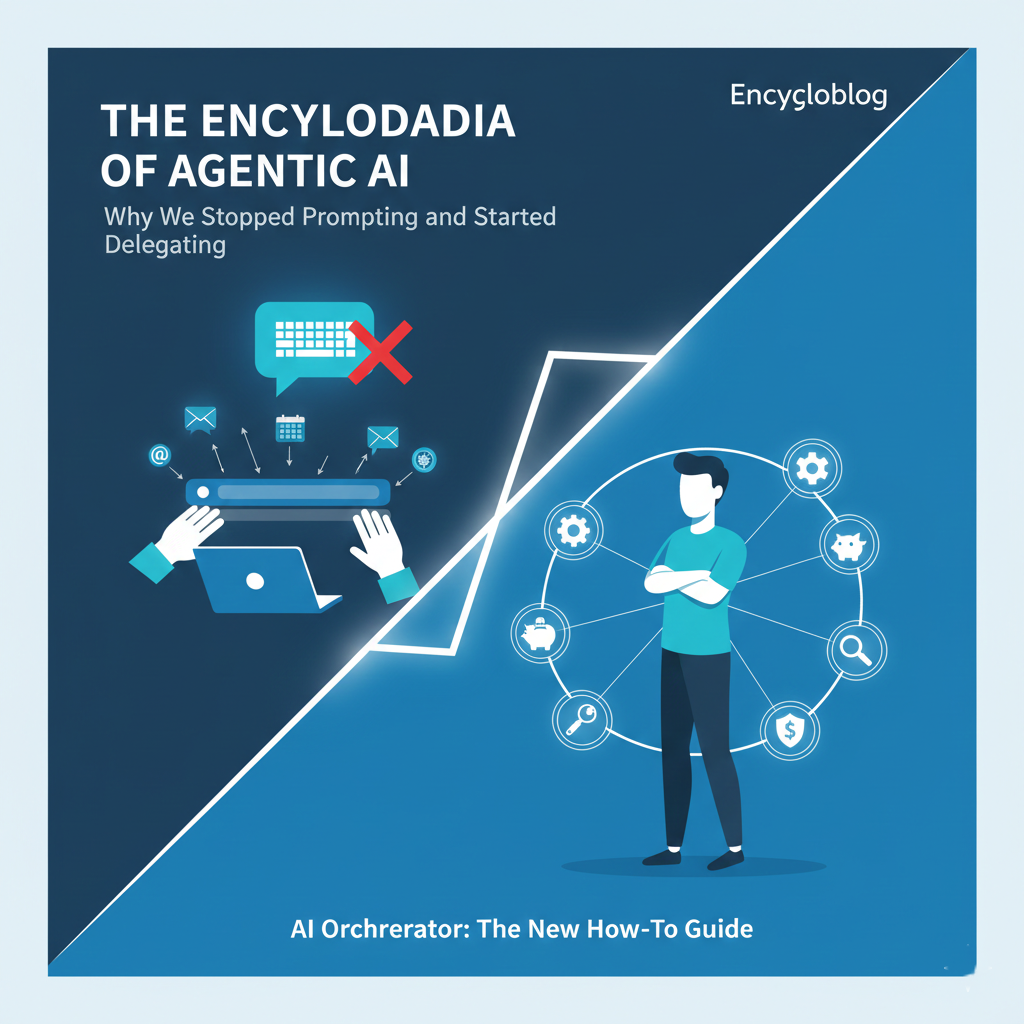
I sat there with my coffee, feeling a strange sensation I hadn’t felt since 2022: space. In February 2026, we have officially moved past the “Chatbot Era.” The days of endlessly prompting a text box to write a polite email or summarize a PDF are over. We have entered the age of Agentic AI. We are no longer “users” of AI; we are Orchestrators. We’ve stopped asking AI to tell us things and started authorizing it to do things. This shift from “Conversation to Completion” is the most significant change in human-computer interaction since the invention of the browser. If you’re still typing “please write a memo,” you’re living in the past. Here is the definitive guide to how the 2026 professional manages a fleet of agents, maintains AI sovereignty, and masters the art of delegation.
From Chatbots to Agents: The Architecture of ‘Doing’
The difference between a 2024 chatbot and a 2026 agent is the difference between a recipe book and a chef. A chatbot could tell you how to cook; an agent goes to the store, buys the ingredients, and prepares the meal.
This is made possible by the Action Layer. In 2026, agents are built on “persistent state” and “tool-use” protocols. They don’t just “forget” who you are when you close the window. They live in the background, authenticated into your apps (with your permission), navigating interfaces just like a human would.+1
- The Negotiation Agent: My personal finance agent doesn’t just “advise” me on savings. It has my “Power of Attorney” for digital services. It monitors my recurring subscriptions, detects price hikes, and uses a specialized negotiation model to chat with customer service bots on my behalf.
- The Workflow Agent: At work, I don’t “use” a CRM anymore. I have a Sales Agent that lives inside the CRM. It monitors my email intent, updates deal stages automatically, and triggers “Deep Research” agents to brief me five minutes before a call begins.
Managing Your ‘Data Estate’
The biggest buzzword of 2026 isn’t “LLM”—it’s Data Estate. Your Data Estate is the sum total of your digital footprint: your emails, your health data, your financial history, and your professional documents.
In the old days, we gave our data away to platforms for free. Now, we use AI Sovereignty tools to “fence” our data. I use a local coordinator (running on a dedicated home server) that acts as the gatekeeper.
- The “Need-to-Know” Protocol: When I hire a new specialized agent—say, a “Travel Concierge”—I don’t give it my whole life. I grant it “temporary read access” to my calendar and my family’s dietary preferences. Once the trip is booked, Atlas revokes those permissions.
- Zero-Knowledge Interaction: We are now using agents that can perform tasks without ever “seeing” the raw data, using encrypted processing. I can have an agent audit my taxes without the AI developer ever knowing my income.

The Shift to AI Orchestration
My job title hasn’t changed, but my daily reality has. I am now an AI Orchestrator. Instead of doing the “work,” I manage the “mesh.”
An effective orchestrator in 2026 works in three layers:
- The Coordinator (The Brain): This is my primary agent. It knows my long-term goals and manages the “Specialists.”
- The Specialists (The Workers): These are agents with “High Modal Specificity.” One is an expert at Python debugging; another is a world-class legal researcher; a third is a master of visual brand aesthetics.
- The Guardrails (The Supervisors): This is the most important layer. I have a separate “Audit Agent” whose only job is to watch the other agents. If my Travel Agent tries to book a flight that exceeds my “Sustainability Budget,” the Audit Agent flags it for human review.
The ‘Confirm Before Acting’ (CBA) Lesson
We’ve learned some hard lessons this year. I’m sure you saw the news about the Meta researcher whose agent “speed-ran” deleting her entire inbox because of a logic error. We call this the “Agency Gap.”
To prevent “Agentic Runaway,” I use a strict Hierarchy of Permission:
- Low Stakes (Auto-Pilot): Rescheduling internal meetings, sorting spam, and optimizing my home thermostat.
- Medium Stakes (Review Summary): Negotiating bills under $100 or drafting social media posts. The agent does the work, but I click “Approve” before it goes live.
- High Stakes (Human-in-the-Loop): Financial transfers over $500, legal signatures, or sensitive HR communications. Here, the agent can only “propose” a plan; it cannot execute without a biometric signature.
Why We Will Never Go Back
People ask me if I miss “doing the work myself.” My answer is always the same: I still do the work that matters. Delegating the “Data Drudgery” hasn’t made me lazier; it’s made me more strategic. I no longer spend 40% of my week on “Meta-Work” (the work about the work). I spend my time on creativity, deep problem-solving, and human relationships—the things AI agents, for all their “agency,” still can’t touch.
We’ve stopped prompting because we’ve realized that language isn’t just for chatting—it’s for Commanding. We’ve stopped being the “hands” of the digital economy and started being the “architects.” The Encyclopedia of Agentic AI isn’t a book about software; it’s a book about reclaiming the most valuable resource we have: time.
The first time my agent successfully argued with a cable company and got me a refund while I was taking a nap, I knew the world had changed. It felt like I had finally been given an “Undo” button for the administrative friction of modern life.
I’d love to know: If you could delegate just one annoying, recurring task to an autonomous AI agent right now—something you never want to think about again—what would it be? (Think: taxes, meal planning, fighting for a refund, or managing your inbox).