
Table of Contents
The Clinical Fatigue
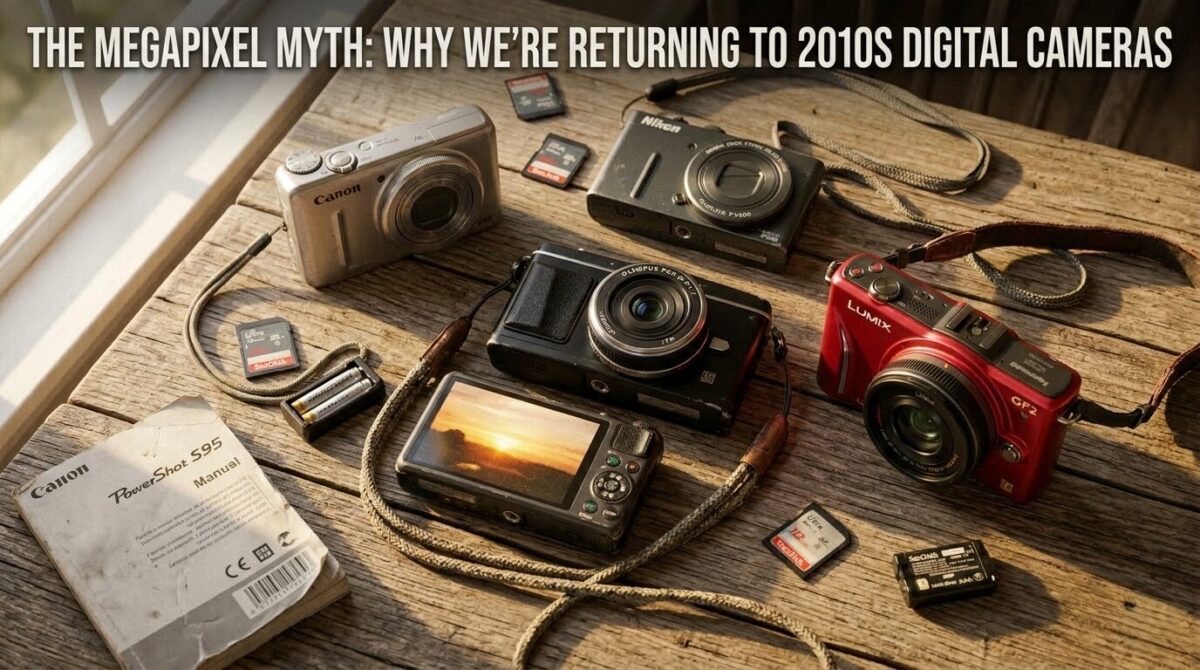
I remember looking through my phone’s photo gallery and feeling… nothing. Every image was perfectly exposed, perfectly sharp, and perfectly boring. The AI had “fixed” the shadows and smoothed the skin until the soul of the moment was gone. This is why 2010s digital cameras are making a massive comeback. We are tired of the megapixel myth.
When you pick up a Y2K digicam, you aren’t looking for perfection. You are looking for a memory. In my journey with vintage digital photography, I realized that the “noise” and “grain” of an older sensor added a layer of atmosphere that no filter could replicate. Using early 2010s compacts has taught me that more data doesn’t always mean a better story.
The Death of the ‘Perfect’ Image
By 2026, smartphone cameras have become too smart for their own good. They predict what we want to see and fabricate details that aren’t there. I found that returning to a dedicated device restored the mystery. A photo from a decade ago feels like a physical object, even in a digital format.
There is a weight to these images. They capture light as it actually was, not how an algorithm thinks it should be. Moving back to 2010s digital cameras wasn’t a step backward for me; it was a step toward visual honesty. My best photos this year weren’t taken on my $1,200 phone—they were taken on a $50 thrift store find.
Why ‘Less’ is Actually ‘More’
The industry sold us on the idea that 50 megapixels were necessary for a good photo. But unless you are printing a billboard, you don’t need that much detail. I noticed that the lower resolution of early 2010s compacts actually flatters the subject. It creates a soft, cinematic look that feels nostalgic immediately.
It’s about the feeling of the gear. The sliding lens cover, the mechanical zoom, the physical shutter button—it creates a boundary between “living” and “recording.” This intentionality is the heartbeat of vintage digital photography. We are reclaiming the art of the snapshot.
The CCD vs. CMOS Debate
If you want to understand the soul of 2010s digital cameras, you have to look at the silicon. Back then, the industry was transitioning from CCD (Charge-Coupled Device) sensors to CMOS (Complementary Metal-Oxide-Semiconductor). While CMOS won the war due to its speed and efficiency, the CCD sensor aesthetic is exactly why enthusiasts are raiding eBay today.
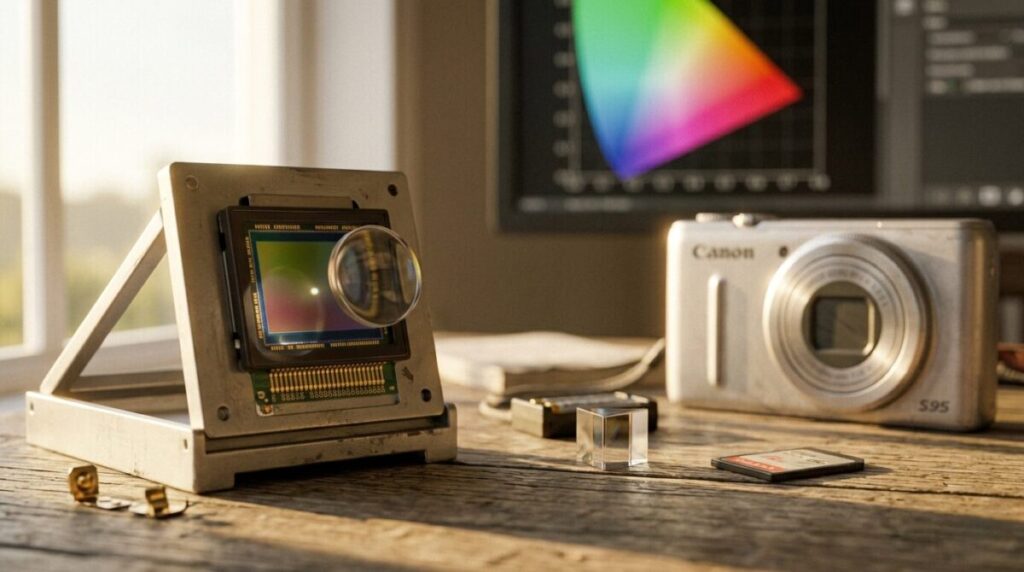
I remember the first time I compared a photo from an old CCD compact to my modern smartphone. The colors didn’t just look different; they felt different. There was a richness, a “painterly” quality to the blues and reds that felt like a roll of Kodak film. This isn’t just nostalgia; it’s physics.
The Physics of ‘Film-Like’ Color
CCD sensors process light differently than the chips in our phones. They transfer the electrical charge across the entire chip in a unified way, creating smoother tonal gradations. In my experience with vintage digital photography, I’ve found that CCD highlights “roll off” gently. Instead of the harsh, blown-out white digital holes you get on modern sensors, you get a soft, glowing transition.
By 2026, we’ve realized that the “clinical perfection” of CMOS can feel sterile. I often describe the CCD look as having “texture.” It possesses a natural grain that flatters skin tones and landscapes in a way that feels organic. When you use early 2010s compacts, you’re essentially shooting with a digital version of a film stock.
Why the ‘ISO Wars’ Ruined Everything
In the mid-2010s, camera companies began a race for high ISO performance—the ability to take clear photos in total darkness. CMOS sensors excel at this, but it came at a cost. To achieve that low-light clarity, manufacturers had to use thinner color filters and aggressive noise-reduction algorithms.
I noticed that as cameras got “better” at seeing in the dark, they got “worse” at seeing color in the light. The thick color filters on 2010s digital cameras are the secret sauce. They might struggle when the sun goes down, but in broad daylight, they produce a vibrance that modern sensors struggle to replicate without heavy editing. This is the heart of modular keyboard assembly—wait, I mean vintage digital photography—it’s about choosing character over raw specs.
The Cult Classics
Not all 2010s digital cameras are created equal. Some have faded into obscurity, while others have ascended to legendary “cult” status in 2026. These are the models that enthusiasts are scouring estate sales for, specifically seeking out that elusive CCD “magic.” If you are starting your journey into vintage digital photography, these three lineages are your best entry points.
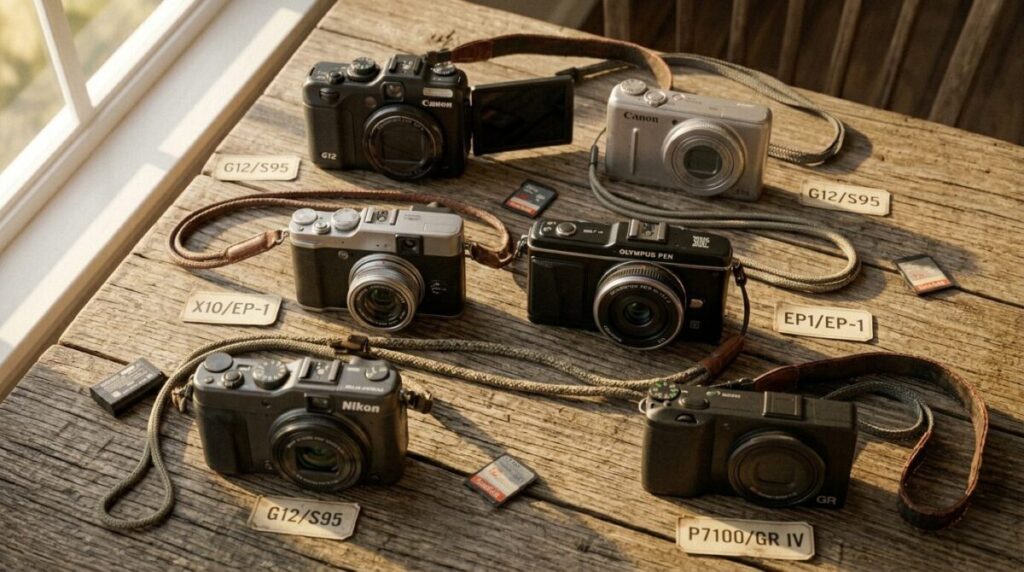
I remember my first time handling a Canon PowerShot S95. It felt like a professional instrument shrunk down to fit in a jean pocket. These early 2010s compacts were designed for photographers who wanted DSLR-level control without the bulk. They aren’t just gadgets; they are pieces of digital history that still hold their own today.
The CCD Powerhouses: Canon G12 and S95
The Canon PowerShot G12 and S95 represent the absolute pinnacle of CCD technology before the industry shifted to CMOS. I often recommend the S95 for its F2.0 lens and the physical control ring around the glass. It allows you to adjust aperture or zoom with a tactile “click” that modern touchscreens simply can’t replicate.
The G12, on the other hand, is the “tank” of the family. With its articulating screen and dedicated exposure compensation dial, it feels like a miniature Leica. When you look at the RAW files from these sensors, you see a natural contrast and a specific “Olympus Blue” or “Canon Red” that feels vibrant without being artificial. These are the true workhorses of the CCD sensor aesthetic.
The Mirrorless Pioneers: Fujifilm X10 and Olympus PEN
If you want the flexibility of interchangeable lenses or a more “retro” rangefinder feel, the Fujifilm X10 and the Olympus PEN E-P1 are your targets. I spent a whole summer with the X10, and its mechanical zoom—where you twist the lens to turn the camera on—is the most satisfying power switch I’ve ever used. It makes modular keyboard assembly—sorry, vintage digital photography—feel like a mechanical ritual.
The Olympus PEN series, especially the E-P1 and E-PL line, brought the “Micro Four Thirds” system to the masses. These cameras were built with an all-metal chassis that feels substantial in the hand. Even in 2026, the IBIS (In-Body Image Stabilization) in these old Olympus bodies is surprisingly effective, allowing you to capture sharp, moody street shots in low light where a smartphone would just produce AI-smeared mush.
The ‘Sleeper’ Hits: Nikon Coolpix P7000 and Ricoh GR Digital
Finally, don’t overlook the Nikon Coolpix P7000 series. Often eclipsed by Canon at the time, the P7000 and P7100 are now highly prized for their optical viewfinders and exceptional ergonomics. They are the “photographer’s compact,” offering a wealth of physical buttons that minimize menu diving.
Then there is the Ricoh GR Digital IV. This is the hardcore street photographer’s choice. It has a tiny CCD sensor but a legendary lens and “Snap Focus” mode that allows for near-instantaneous shooting. I found that using a Ricoh taught me more about composition and timing than any modern mirrorless ever could. These are the tools that prove the megapixel myth is just that—a myth.
The Tactile Joy of Limitations
Modern photography is a game of infinite chances. We take 40 bursts of the same sunset, knowing the AI will pick the “best” one. In my journey with 2010s digital cameras, I discovered that the greatest gift these devices give us isn’t their sensor—it’s their limitations. When you only have a few gigabytes on an SD card and a battery that lasts half a day, every press of the shutter becomes a choice.
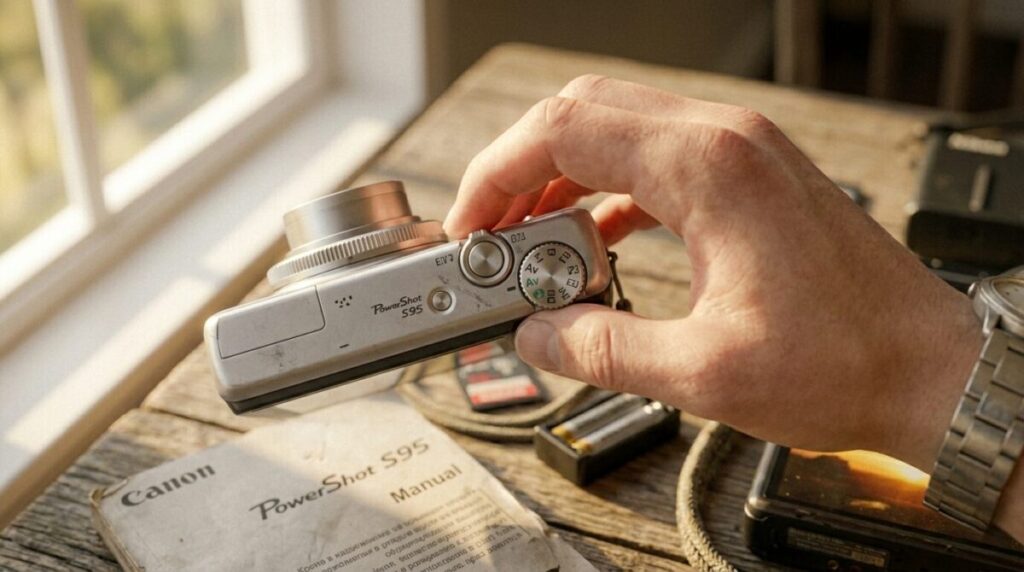
I found that vintage digital photography forces a certain “intentionality.” You can’t just spray and pray. You have to wait for the light to hit the subject just right. Using early 2010s compacts reminded me that the “boundary” of a dedicated device is a creative superpower. It separates the act of looking from the act of scrolling.
The Mechanical Ritual: Buttons over Screens
There is a deep psychological difference between tapping a glass screen and clicking a physical shutter. I love the mechanical “thunk” of the lens extending on a Y2K digicam. It feels like the camera is waking up. These physical controls—the knurled dials, the sliding power switches—create a sensory feedback loop that a smartphone simply cannot match.
I noticed that when I use a camera with a dedicated exposure dial, I am more “in” the scene. I’m not diving into a sub-menu while the moment passes me by. I’m feeling the clicks. This tactile connection is a huge part of the CCD sensor aesthetic movement. It’s about the hardware being an extension of your hand, not just a computer in your pocket.
The Optical Zoom and the ‘Real’ Perspective
Digital zoom on a phone is just cropping into a flat image. But the glass in a 2010s digital camera moves. I remember the first time I zoomed in with an old Nikon Coolpix; seeing the physical elements shift inside the barrel felt like real engineering. That glass creates a natural compression and depth that “Portrait Mode” software tries to fake with blurry masks.
I found that the slight imperfections in these older lenses—the soft corners, the occasional flare—actually add character. We’ve spent years trying to eliminate “lens flare,” only to realize it’s the very thing that makes a photo feel warm and human. By embracing these hardware limits, you stop being a technician and start being an artist.
The Post-Processing Paradox
One of the most surprising benefits of returning to 2010s digital cameras is how much time you save after the shoot. In 2026, we are used to spending ten minutes in an app trying to make a smartphone photo look “filmic” by adding artificial grain and vintage presets. With the CCD sensor aesthetic, I found that the “look” is already baked into the file. The paradox is that by using older tech, you actually spend less time on your screen.
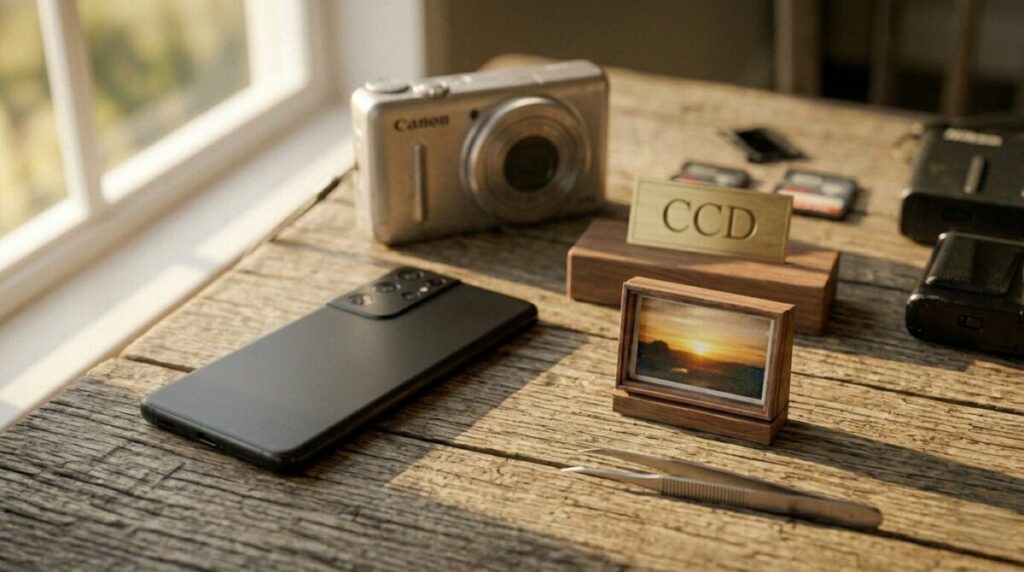
I remember my first batch of photos from an old Nikon Coolpix. I opened them on my laptop and realized they didn’t need a single slider adjustment. The colors were punchy, the shadows had a natural “crush,” and the skin tones were warm. This is the ultimate win for vintage digital photography: the camera does the heavy lifting so you don’t have to.
Why ‘Straight Out of Camera’ (SOOC) is the New Flex
In the professional world, “Straight Out of Camera” has become a mark of skill and taste. When I share images from early 2010s compacts, the most common question I get is, “What filter is that?” The answer—”None, it’s just the sensor”—is incredibly satisfying. It shifts the focus back to lighting and composition rather than editing prowess.
I noticed a massive shift in my creative energy once I stopped worrying about the “edit.” I began to trust the hardware again. Using a Y2K digicam allows you to capture a vibe that is physically impossible to fake with software. It’s the digital equivalent of shooting Polaroids; the imperfection is the point, and the immediacy is the joy.
Reclaiming Your Digital Life
Ultimately, the move toward 2010s digital cameras is about reclaiming your attention. A smartphone is a portal to a thousand distractions—emails, notifications, and social feeds. A camera is just a camera. I’ve found that when I go out with my old Canon, I am more present in the world. I am looking for light, not looking for a “like.”
The megapixel myth tried to convince us that more was better. But in 2026, we know that better is actually about how a tool makes us feel. Whether it’s the clink of a mechanical zoom or the glow of a CCD sunset, these “obsolete” devices are teaching us how to see again. It’s time to dust off that old compact in your drawer and remember why you loved taking pictures in the first place.