
Table of Contents
The air in Melbourne’s Albert Park feels different this week. It’s not just the humid breeze off the bay or the usual pre-season electric tension. It’s the sound. As the trucks unroll the pristine liveries of the most sophisticated machines on the planet, the “idle” of the engines carries a sharper, more clinical note. We are exactly five days away from the Australian Grand Prix (March 6–8), and the world is about to witness the most radical pivot in the history of Formula 1.
For decades, F1 has been a sport of “more.” More downforce, more cylinders, more fuel flow. But as the lights prepare to go out for the season opener, the paradigm has shifted to “smarter.” This isn’t just a new season; it is the debut of the Sustainable Era. With the introduction of 100% carbon-neutral fuels and a power unit split that nearly equates internal combustion with electrical surge, the sport has transformed into a high-speed laboratory for the future of human mobility.
Pre-season testing in Bahrain gave us a glimpse, but Melbourne will give us the verdict. This year, “Energy Management” has officially dethroned “Aerodynamics” as the king of the podium. The drivers aren’t just racing wheel-to-wheel; they are playing a 200-mph game of Battery Chess.
1. The Molecular Revolution: 100% Sustainable Fuels
The biggest change is one you can’t see with the naked eye. For the first time, every car on the grid is powered by 100% sustainable drop-in fuel. This isn’t just “bio-ethanol” mixed with gasoline; this is a feat of synthetic chemistry.
These fuels are derived from either non-food biological sources (like agricultural waste) or through Direct Air Capture (DAC), where carbon is literally pulled out of the atmosphere and synthesized into a high-octane liquid. The result is a carbon-neutral loop: the carbon emitted during the race is equal to the carbon captured to create the fuel.
But this transition came with a massive engineering headache. Sustainable fuels have different combustion characteristics than fossil fuels. They burn “cooler” but require more precise ignition timing. This has forced engine manufacturers like Ferrari, Mercedes, and Honda to completely redesign their combustion chambers to find the “sweet spot” of thermal efficiency.
2. The Electric Equalizer: Goodbye MGU-H, Hello 350kW
Under the hood, the architecture of the Power Unit (PU) has been gutted. The complex and expensive MGU-H (the unit that recovered energy from the turbocharger) is gone. While fans of pure mechanical sound might celebrate its departure, its absence has created a massive energy deficit that had to be filled elsewhere.
To compensate, the MGU-K (which recovers energy during braking) has seen a staggering upgrade. It now produces 350kW of power—nearly triple the output of the previous generation.
The Power Distribution Model
In the previous era, the Internal Combustion Engine (ICE) did the heavy lifting, with the electric motor providing a supplementary “boost.” This season, the ratio has shifted toward a near 50/50 split.
For the first time in history, a driver is relying on a battery for nearly half of their total propulsion. If you run out of “juice” on the back straight, you aren’t just losing a tenth of a second; you are a sitting duck.
3. The New Grid: Cadillac and Audi Join the Fray
The technical reset has done exactly what the FIA hoped: it invited the giants. This weekend in Melbourne marks the much-anticipated debut of two legendary names in the paddock.
- Audi: After years of rumors, the four rings are finally on the grid as a full works team. Taking over the Sauber operation, Audi has spent the last three years building a bespoke power unit in Neuburg. Their pre-season reliability was the talk of the paddock, suggesting that German precision might have cracked the “Sustainable Fuel” code faster than the incumbents.
- Cadillac: Partnered with the Andretti Global outfit, Cadillac brings an American grit to the grid. While they are entering as a new entity, their integration with GM’s massive electrical R&D department makes them a terrifying prospect in this new “Electric-Heavy” era.
The rivalry between Audi and Cadillac adds a new layer to the “Old Guard” battle between Ferrari and Red Bull (now officially partnered with Ford). It is a clash of philosophies: European precision vs. American power, all mediated through a green lens.
4. Battery Chess: The “Manual Override” Strategy
The most fascinating tactical shift this season is the Manual Override feature. In previous years, the energy deployment was largely automated—the car’s computer decided when to use the electric boost based on the GPS position on the track.
This season, the FIA has handed the “keys to the battery” back to the drivers.
Drivers now have a limited amount of “Override” energy per lap. It functions like a high-stakes game of poker. Do you use your 350kW boost to defend into Turn 1, or do you save it to “slingshot” past a rival on the high-speed run toward Turn 9?
The State of Charge (SoC) Dilemma
If a driver uses too much energy in a wheel-to-wheel scrap, they enter what’s known as “Harvesting Mode.” In this state, the car’s rear lights flash—a signal to the driver behind that they are vulnerable.
The Tactical Play: We saw this in Bahrain testing—Max Verstappen and Lewis Hamilton engaged in a “Battery Stand-off.” Both stayed within DRS range but refused to use their electric boost, waiting for the other to blink and drain their State of Charge (SoC) first. This is the “Battery Chess” that will define the Australian Grand Prix.
5. The Aerodynamic Pivot: Active Aero
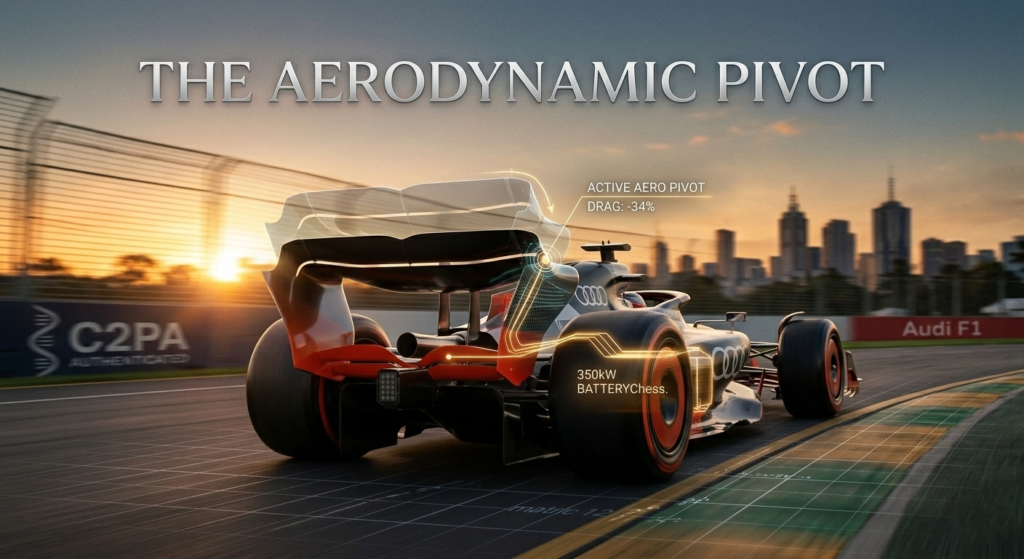
Because the cars now rely so heavily on electric power, they face a drag problem. At high speeds, a 350kW motor has to fight much harder against air resistance than an old-school V8.
To solve this, the new cars feature Active Aerodynamics. The front and rear wings aren’t static; they shift their angle in real-time to “trim” the car on straights (low drag) and “load” it in corners (high downforce).
This creates a “Transformer” effect. When you watch the onboard footage from Albert Park this weekend, keep an eye on the wing endplates. You’ll see them twitch and adjust mid-lap as the car’s brain tries to balance the need for speed with the desperate need to save battery life. It is a symphony of moving parts that makes the “DRS” of the past look primitive.
6. The Human Element: The Fatigue of Management
For the drivers, the physical toll is now compounded by a cognitive load that is off the charts. It is no longer enough to be the fastest person through a corner. You have to be a mathematician at 300 km/h.
Drivers like Fernando Alonso—veterans who have seen V10s, V8s, and V6 Hybrids—are finding a new lease on life in this era. The sport has moved toward “Racing Intelligence.” Experience in managing tires and fuel is now the foundation for managing the SoC.
However, the younger generation—raised on high-tech simulators that perfectly replicate these energy maps—might have the edge in the “Manual Override” battles. In Melbourne, we will see if the “Old Masters” can out-think the “Digital Natives” in a world where the battery is the ultimate weapon.
7. Conclusion: The Soul of Racing in a Green World
There was a fear that moving to 100% sustainable fuels and massive batteries would “neuter” Formula 1. Critics worried the cars would be quiet, heavy, and boring.
Bahrain proved them wrong. These cars are monsters. They are harder to drive, more prone to mistakes, and the power delivery is violent. When that 350kW MGU-K kicks in, it’s not a smooth transition—it’s a physical jolt that sends the rear tires searching for grip.
As we count down the five days to the Australian Grand Prix, the “Sustainable Era” isn’t about compromise. It’s about a new kind of intensity. We are going to Melbourne to see who played the best pre-season chess, who built the best molecular fuel, and who has the courage to push the “Override” button first.
The lights will turn green, but for the first time, the sport truly is green.
I’d love to hear from you: Are you excited about the “Battery Chess” and the tactical “Manual Override,” or do you miss the days of simpler, high-revving engines without the electronic complexity?