
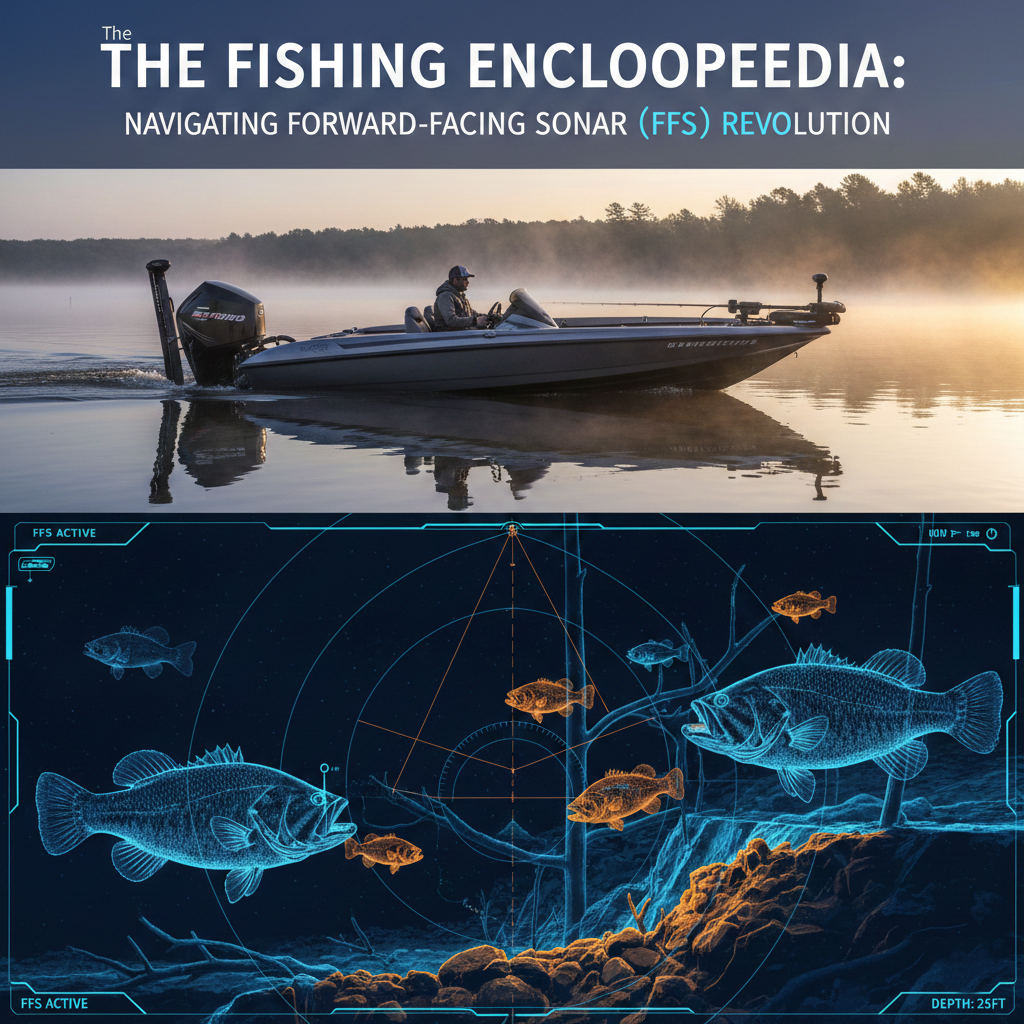
Table of Contents
I remember the first time I saw a “live” fish on a screen and wasn’t looking at a static map or a series of colorful blobs indicating depth; I was watching a shimmering, ghost-like outline of a largemouth bass suspended three feet off a submerged cedar tree. Then I watched, breath held, as my lure dropped into the frame. I saw the fish turn, flare its gills, and inhale the bait.
It felt like magic. But it also felt like I had just brought a heat-seeking missile to a sword fight.
We are currently standing at the most significant crossroads in the history of angling. The introduction of Forward-Facing Sonar (FFS) has done more than just change how we find fish; it has fundamentally altered the “Biological Contract” between the angler and the prey. As major competitive circuits like Major League Fishing (MLF) implement strict new regulations—specifically the Three-Hour Rule—the community is grappling with a difficult question: At what point does technology stop being a tool and start becoming a cheat code?
Whether you are a seasoned pro or a weekend warrior, understanding the “Digital vs. Traditional” divide is now a prerequisite for getting on the water. Here is my deep-dive into the physics of the FFS revolution, the rise of “Stealth-Mode” fishing, and why we are fighting so hard to save the “soul” of the sport.
The Physics of the “Video Game”: How FFS Works
To understand the controversy, you have to understand the technology. Traditional sonar works by sending a cone of sound straight down. You see what was under the boat. FFS is different. It uses a specialized transducer that sends out ultra-high-frequency sound beams in a forward-facing arc.
- The Live Action: The transducer processes thousands of “pings” per second, translating them into a real-time video feed.
- The Advantage: For the first time, I can see how a fish reacts to my lure. If a smallmouth bass follows my jig but doesn’t strike, I can change my retrieve speed mid-cast.
This has effectively turned the sport into a “video game.” The days of “blind casting” and relying on intuition or “reading the birds” are being replaced by staring at a 12-inch screen for ten hours a day.
The Three-Hour Rule: Saving the Soul of the Sport
The pushback has been intense. Critics argue that FFS is so effective that it removes the “mystery” of fishing. If you can see every fish in the creek, the advantage shifts entirely to the person with the biggest electronics budget, rather than the person with the most experience.
This season, the implementation of the Three-Hour Continuous Segment Rule marks a historic shift. Anglers are now restricted to using their FFS for only one three-hour window per day.
- The Logic: This forces us to return to “Traditional Mapping” and “Intuitive Fishing” for the majority of the day. It brings back the importance of knowing water temperatures, seasonal migrations, and structure.
- The Impact: I’ve found that this rule has actually made me a better angler. It forces me to be strategic. I save my “FFS time” for the high-pressure afternoon hours or specific deep-water structures. It turns the technology into a tactical strike rather than a crutch.
The Stealth Edge: The Silent Electric Revolution
While everyone is talking about the screens, the real competitive edge is happening under the water. With fish becoming more “pressured” by high-tech anglers, they are becoming “boat-shy.” The sound of a traditional internal combustion engine—or even a noisy old trolling motor—is enough to shut down a bite before you even make a cast.
This has birthed the Silent Electric Revolution. I recently switched to a high-output electric outboard, and the difference is night and day.
“In the modern era, the loudest person on the lake is usually the one who goes home empty-handed.”
I’ve been testing the newest Mercury Avator and ePropulsion series. These motors allow for “Stealth-Mode” maneuvering.
- Vibration-Free: Unlike gas motors, these units produce almost zero underwater vibration. I’ve been able to drift within ten feet of schooling fish without spooking them.
- The Physics of Sound: Sound travels five times faster in water than in air. A gas motor is essentially a dinner bell telling the fish to leave. Going electric isn’t just about the environment; it’s about tactical invisibility.
Finding the Balance: My Personal Manifesto
As I look at the screen on my bow, I often wonder what the “old-timers” would think. Part of me loves the precision. But another part of me misses the days when my only “sonar” was the ripple of a dragon-fly on the surface.
To keep the sport sustainable and rewarding, I follow a three-step balance:
- The ‘Screen-Off’ Hour: I spend the first hour of every trip with my electronics completely powered down. I watch the bank. I look for bait jumping. I reconnect with my gut.
- The Tactical Window: I treat my three hours of FFS as a learning session. I use it to understand why the fish are where they are, so that when I turn it off, I can apply that knowledge elsewhere.
- Respect the Resource: Technology should make us more efficient, but it shouldn’t make us greedy. The “FFS Revolution” puts more pressure on fish populations than ever before. Catch-and-release and proper fish handling are no longer optional—they are mandatory for the sport’s survival.
Fishing has always been a game of cat-and-mouse. Technology has just given the cat a better pair of glasses. But as long as we keep the “Three-Hour Rule” in mind and respect the quiet of the water, the soul of the sport—the challenge, the mystery, and the “one that got away”—will remain intact.
I’d love to hear your take: Do you think Forward-Facing Sonar is the natural evolution of the sport, or is it taking the “hunt” out of fishing? Would you be in favor of a “Three-Hour Rule” on your local lake?