
Table of Contents
I used to be a “vacation snob” and i believed that for an experience to count as an “adventure,” it required a passport, a ten-hour flight, and a mountain range I couldn’t pronounce. I spent my years saving up for two weeks of “real life” in a foreign country, while the other fifty weeks were spent in a gray haze of commuting, grocery shopping, and staring at the same three cracks in my driveway.
Then came a Tuesday evening when my car broke down two miles from my house.
Instead of calling a ride, I decided to walk home. I took a detour through a small patch of woods I had driven past ten thousand times. In those twenty minutes, I found a hidden creek, a family of owls, and a view of the sunset through the trees that felt more “exotic” than anything I’d seen in a travel brochure.
I realized then that I had been living in a masterpiece and never once looked at the canvas. This was my first Micro-Adventure.
A Micro-Adventure is a short, simple, local, and cheap experience that provides “vacation energy” without the “vacation price tag.” It’s about finding the extraordinary in the ordinary. Over the last few years, I’ve refined this into a lifestyle, and today, I want to show you how to reclaim your own backyard.
Why the “Micro” Scale is the New Luxury
In a world obsessed with “more,” there is a profound luxury in “less.” We often think we need a week off to recharge, but science and my own blistered feet tell me otherwise.
The Psychology of “Vacation Energy”
“Vacation energy” is simply a heightened state of awareness. When you are in a new country, you look at the architecture, you smell the air, and you notice the small details. You are present.
The goal of a Micro-Adventure is to trigger that same presence within 30 miles of your front door. By intentionally changing your route or your method of exploration, you force your brain out of “autopilot” and back into the moment.
Removing the Barriers
The biggest enemy of adventure is friction.
- Logistical Friction: Packing suitcases, booking flights, and navigating airports.
- Financial Friction: The crushing weight of a credit card bill after a week in a resort.
- Time Friction: Waiting for “the right time” of year to go.
Micro-Adventures have zero friction. You can decide to have one at 4:00 PM on a Thursday and be home by dinner.
Pillar 1: Urban Hiking (Seeing Your City for the First Time)
Most of us treat our cities like obstacle courses. We move from Point A to Point B as fast as possible. Urban hiking is the art of getting lost on purpose.
The “No-Map” Rule
One of my favorite ways to explore is what I call the “Random Left” strategy. I walk out my door and flip a coin at every intersection. Heads, I turn right; tails, I turn left.
Last month, this led me to an old industrial district I usually avoid. I discovered a street-art gallery in an alleyway and a tiny bakery run by a woman who makes the best sourdough I’ve ever tasted. I felt like a spy in my own town.
Seek the High Ground
Every town has a “high point.” Maybe it’s a parking garage, a hilltop park, or a church steeple. Finding the highest point within five miles of your home and watching the city lights come on is a spiritual experience. It gives you a sense of scale—reminding you that your “small” life is part of a massive, living organism.
The “Tourist for an Hour” Challenge
Go to your local library or town hall. Find the oldest map they have. Look for landmarks that no longer exist or names that have changed. Then, go find those physical locations. You’ll find yourself standing on a street corner looking at a modern gas station, but seeing the ghost of an old mill. It’s “time travel” via urban hiking.
Pillar 2: Local Foraging (The Sensory Connection)
Foraging is the ultimate way to engage your senses. When you are looking for something specific—a berry, a leaf, a mushroom—your vision sharpens. You stop looking at “the woods” as a green blur and start seeing individuals.
Note: Always use a local field guide and never eat anything unless you are 100% certain of its identity. The adventure is in the finding!
The Treasure Hunt
I started by looking for wild raspberries in the overgrown patches behind the local park. The first time I found a handful of sun-warmed berries, I felt a primal jolt of joy. It wasn’t about the food; it was about the realization that the earth is still providing, even in the suburbs.
The Seasonality Lesson
Foraging teaches you the “rhythm” of your home. You learn that the elderflowers bloom in late spring and the acorns drop in the fall. You become a “resident” of the ecosystem, not just a consumer.
Creating a “Backyard Tea”
One of my most successful Micro-Adventures involved identifying three safe, local plants (like dandelion root, wild mint, and pine needles) to make a “Backyard Tea.” Sitting on my porch, drinking a brew made entirely from plants found within a mile of my house, felt more rewarding than any expensive coffee.
Pillar 3: Night Sky Photography (Adventure After Dark)
Adventure doesn’t have to end when the sun goes down. In fact, for most of us, the world within 30 miles looks completely different under the stars.
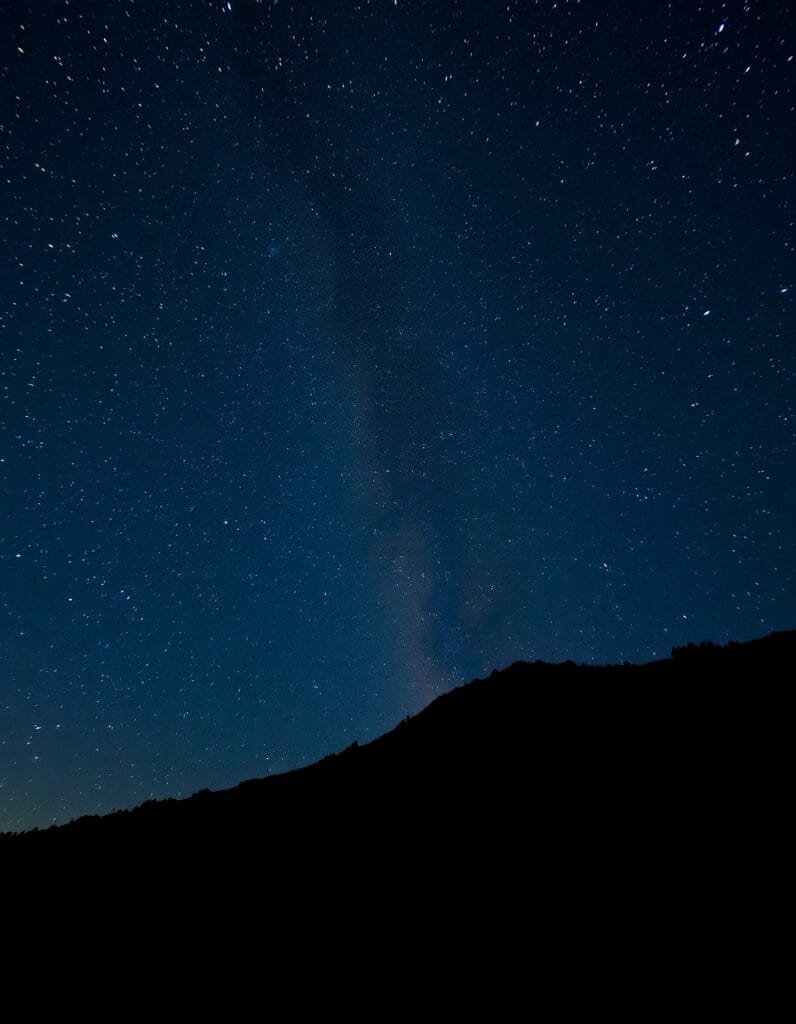
The Chase for Dark Sky
I use light-pollution maps to find “pockets of dark” near me. Often, these are state parks or even just quiet country roads. Driving twenty minutes out of town at 11:00 PM feels like embarking on a secret mission.
The Gear (Keep it Simple)
You don’t need a $5,000 camera. I started with a basic tripod and my smartphone.
- The Process: I set the exposure to 30 seconds, pointed it at the Milky Way, and waited.
- The Reveal: Seeing the stars “pop” on the screen—stars I couldn’t even see with my naked eye—gave me a sense of wonder that lasted for days.
Capturing the “Light Trails”
If you live in a bright city, embrace it! Long-exposure photography of moving cars or trains turns a boring highway into a river of light. It teaches you to see movement and time in a way that our eyes aren’t designed to perceive.
The “Micro-Adventure” Toolkit: What to Pack
Even though it’s “micro,” having a “Go-Bag” ready makes the transition from “work mode” to “adventure mode” instant. Here is what I keep in my trunk:
- A Quality Physical Map: Phones die. A paper map allows you to see the “big picture” and find green spaces you might miss on a small screen.
- A Sit-Mat: A small, waterproof pad. Being able to sit comfortably on a damp log or a concrete ledge for twenty minutes changes everything.
- A Journal and Pen: To record the “ghosts” of the town or the plants you find.
- A Headlamp: For when your urban hike turns into a night-sky mission.
- A Thermos: Because every adventure is 50% better with a hot drink.
How to Overcome “The Procrastination of the Familiar”
The hardest part of a Micro-Adventure isn’t the walking or the foraging; it’s the mental hurdle. We think, “I know that park. It’s just the park.”
To beat this, I use the “Rule of Three”:
- Go at a different time. Visit that park at 5:00 AM instead of 5:00 PM.
- Go in different weather. A walk in a heavy rainstorm (with a good raincoat) is a completely different sensory experience than a walk on a sunny day.
- Go with a different “Lens.” One day, go only looking for the color red. The next day, go only listening for bird calls.
By changing one variable, the “familiar” becomes “new.”
Final Thoughts: The Wealth of Your Backyard
We spend our lives waiting for the “big trip” to start living. We treat our home base as a waiting room for the next flight. But after years of Micro-Adventuring, I can tell you that the most beautiful things I’ve ever seen weren’t in Paris or Tokyo. They were in the overgrown lot behind the hardware store, the way the light hits the river under the bypass, and the sound of the wind through the pines in my neighbor’s yard.
Adventure isn’t about how far you go. It’s about how much you see.
Share your best “hidden gem” stories in the comments—I love hearing about the magic people find in their own neighborhoods!