

Table of Contents
When a pro athlete stands at the free-throw line with seconds left on the clock, they aren’t just relying on muscle memory—they’re using a psychological toolkit that the rest of us rarely prioritize. I remember watching a high-stakes championship game years ago and being struck by the athlete’s total composure. While I was sitting in my living room, sweating over a simple, overdue work email, this person was operating under the pressure of millions of eyes and the crushing weight of their entire team’s season. I spent weeks researching the mental side of elite performance, and what I found wasn’t just about “staying calm.” It was about an active, systematic approach to managing physiological stress.
The Biology of the “Choke”
We’ve all been there: the moment your mind goes blank during a high-stakes presentation, or your heart begins to hammer against your ribs right before a difficult conversation. This is the “choke” response. When we perceive high pressure, our amygdala—the ancient, emotional center of the brain—signals the body to prepare for “fight or flight.” This floods our system with a cocktail of adrenaline and cortisol.
This response is fantastic if you are being chased by a predator in the wild, but it is catastrophic if you need to think clearly, communicate effectively, or execute a delicate task. When your brain is in “survival mode,” it shunts energy away from the prefrontal cortex—the area responsible for complex reasoning and decision-making—and directs it toward your muscles. Athletes learn to interrupt this biological loop. They understand that stress is just a surge of biological energy. By reframing their physical sensations—labeling the racing heart as “readiness” rather than “anxiety”—they can actually improve their cognitive performance.
Tactical Breathing: The Secret Weapon
The most common tool in the athletic playbook is tactical breathing. When pressure hits, our breathing automatically becomes shallow, rapid, and erratic. This is a clear signal to our brain that we are in immediate danger. By forcing a steady, controlled rhythm—inhaling for four seconds, holding for four, exhaling for four, and holding for four—we manually override our autonomic nervous system.
This is often called “box breathing.” I started using this during my own high-stress professional moments, and it acts like a physical reset button for my nervous system. It forces the parasympathetic nervous system to take over, clearing the mental fog and allowing me to think logically again. By focusing purely on the count, I force my brain to stop ruminating on the “what-ifs” and focus on the immediate physical sensation of the breath.
Focusing on Process, Not Outcome
One of the biggest lessons I learned from sports psychology is the inherent danger of “outcome fixation.” If an athlete is standing on the field thinking about holding the trophy or what the press will say tomorrow, they are entirely distracted from the technical task at hand. They are living in a hypothetical future that they cannot control.
Instead, elite athletes focus exclusively on the “process.” They focus on the grip of the ball, the follow-through of the shot, or the rhythm of their internal dialogue. In my own work, I used to obsess over the potential failure of a massive project. Now, I actively shrink my focus down to the single next step. What do I need to do for the next 15 minutes? By narrowing the horizon, the pressure becomes manageable. You don’t manage the “big goal”; you manage the “next repetition.”
The Power of Visualization
Visualization isn’t just “daydreaming.” It is a proven mental rehearsal technique that triggers the same neural pathways as the physical act. Athletes visualize the scenario, the potential obstacles, and their successful response to those obstacles. When I prepare for a high-stress meeting, I don’t just hope it goes well; I visualize myself staying calm during the hardest questions.
I imagine the environment, the people, and the specific tension in the room. I mentally rehearse my breathing and my measured tone of voice. By “practicing” the stress in my mind, the real-life situation feels familiar, rather than overwhelming. The brain struggles to distinguish between a vividly imagined event and a real one; by rehearsing the success, you are building the neural map to get there.
The Importance of “Self-Talk”
How we talk to ourselves under pressure determines our success. I used to be my own worst critic. If I made a mistake in a project, I would spiral, telling myself I was incompetent. I learned that athletes do the exact opposite. They use “instructional self-talk.” Instead of saying “Don’t mess this up,” they say “Keep your eyes on the target.”
This is a subtle but massive distinction. The brain struggles with negative commands—if I tell you not to think of a pink elephant, you immediately think of one. If you tell yourself “don’t be nervous,” you only focus more on your nerves. By using constructive, instructional language, you guide your brain toward the desired action rather than the thing you are trying to avoid.
Developing a Pre-Performance Routine
Athletes have routines for everything. They have a specific way they warm up, a specific way they lace their shoes, and a specific way they enter the field. These routines are anchors. They signal to the brain that it is time to perform.
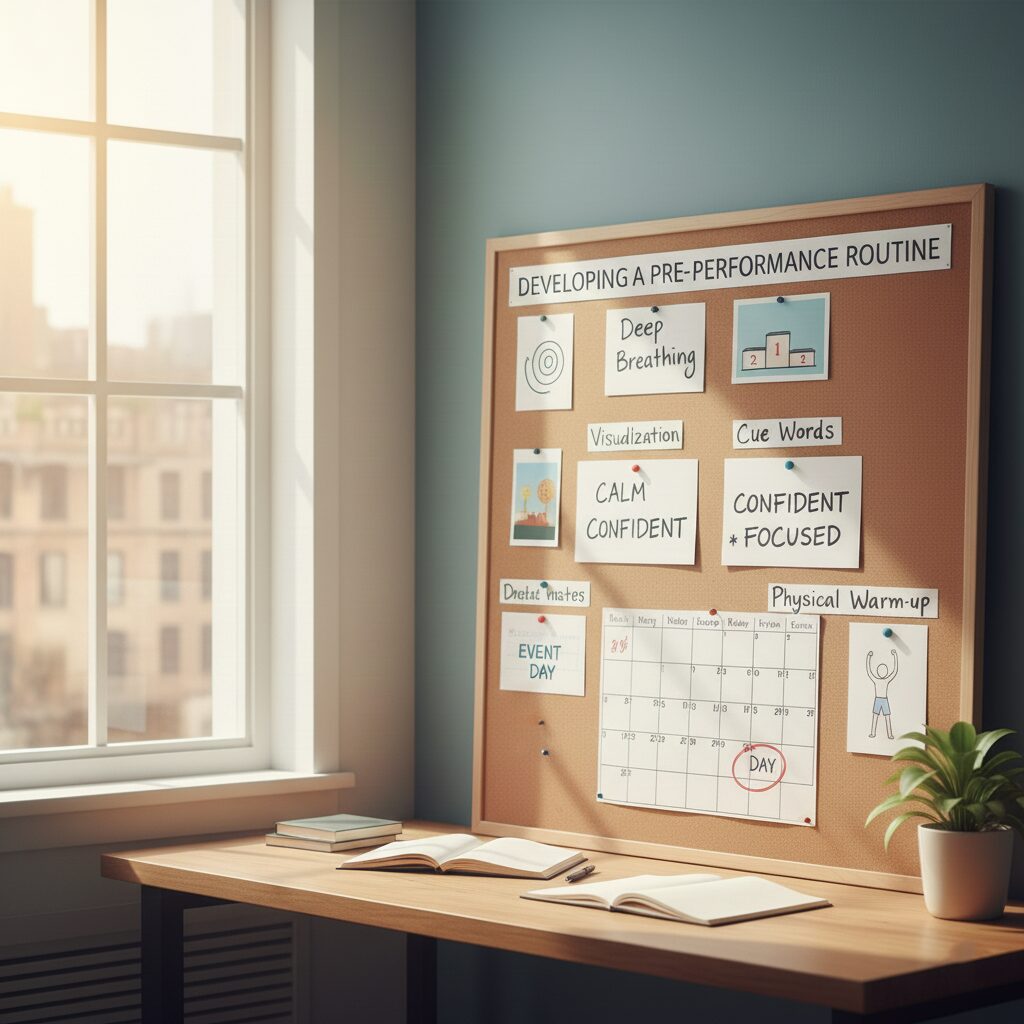
I’ve built my own “pre-meeting” routine. It involves three minutes of silence, a quick check of my posture, and a review of my key objectives. By having this consistent process, I eliminate the “start-up” anxiety that used to plague me. I am no longer entering a situation cold; I am entering it prepared, grounded, and primed for action.
Recovery: The Other Side of Pressure
We cannot talk about performance without talking about recovery. Even the most elite athletes cannot perform at 100% intensity indefinitely. They know that rest is not the absence of work; it is a critical part of the work. If you stay in a state of high-stress performance for too long, you will eventually burn out.
I’ve learned to build “micro-recoveries” into my day. These are short, intentional breaks where I step away from the stressor, change my environment, and allow my nervous system to return to baseline. Whether it’s a quick walk, a few minutes of meditation, or simply stepping away from a screen, these moments are not “wasted time.” They are the investments that allow me to show up at my best when the next period of pressure arrives.
Building Your Own Mental Toolkit
You don’t need a high-priced athletic trainer to build your own toolkit. Start by identifying your personal “pressure signals.” When do you feel the physical signs of stress? Is it in your jaw? Your shoulders? The speed of your thoughts? Once you recognize these triggers, you can immediately deploy your tools: tactical breathing to calm the body, instructional self-talk to focus the mind, and process-oriented goal setting to steady your progress.
Stress is a constant in a high-performing life, but it doesn’t have to be a wall. With the right psychological architecture, you can turn the pressure of the moment into the fuel for your best work. I’ve found that by viewing stress as a signal of growth rather than a sign of danger, I am significantly more effective, more resilient, and—most importantly—more consistent. You have the power to architect your own performance. Start today by practicing one tool, and see how much lighter that pressure starts to feel.