Table of Contents
For most people, a trip to the doctor follows a familiar, linear path: you describe your symptoms, clinicians run a few tests, and within a week or two, you have a name for your ailment and a plan to fix it. But for millions of individuals worldwide, the path is anything but linear. It is a labyrinth. It is a grueling, years-long journey through specialized clinics, misdiagnoses, and experimental treatments that lead nowhere. The medical community famously calls this journey the ‘Diagnostic Odyssey.”
On average, it takes 4.8 years for a patient with a rare disease to receive an accurate diagnosis. In that time, they may see eight different specialists and receive three misdiagnoses. By the time the answer arrives, the disease may have progressed beyond the point of easy intervention.
Tomorrow, February 28, marks Rare Disease Day. The theme for this year is “Equity.” While the term “equity” often conjures images of social or economic policy, in the realm of rare diseases, equity is fundamentally a data problem. As reports released today highlight, we are finally at the dawn of an era where “Data Power”—the convergence of massive bio-registries and Artificial Intelligence—is closing the diagnosis gap and bringing treatment timelines from decades down to mere months.
The “1 in 10” Reality: Why Rare isn’t Rare
The most persistent myth about rare diseases is right there in the name. We tend to think of these conditions as exotic outliers—medical curiosities that affect a handful of people in remote corners of the world. The reality is much more staggering.
While a single disease (like Sanfilippo syndrome or Fibrodysplasia Ossificans Progressiva) might only affect one in every 50,000 people, researchers have identified over 7,000 distinct rare diseases. When you aggregate them, the numbers shift dramatically:
- 1 in 10 people lives with a rare disease.
- 300 million people globally are affected.
- 50% of these patients are children, many of whom will not live to see their tenth birthday without a diagnosis.
Rare diseases are not a niche issue; they are a public health crisis hiding in plain sight. For too long, the pharmaceutical industry ignored them because the “market size” for any single condition was too small to justify the billions of dollars required for traditional drug development. These were “orphan diseases,” left behind by the march of medical progress.
But data doesn’t care about market size. AI tirelessly analyzes small sample sizes without the fatigue that plagues human researchers. Today, the “Data Power” revolution is turning these small, fragmented patient populations into the most valuable datasets in modern medicine.
AI Drug Repurposing: From Decades to Months
One of the most exciting breakthroughs discussed in today’s reports is the role of AI Drug Repurposing. Leading the charge are companies like Healx, which use high-performance computing to look at the world’s existing medicine cabinet through a new lens.
The traditional “bench-to-bedside” pipeline for a new drug takes roughly 12 to 15 years and costs billions. For a rare disease with only a few hundred patients, that math never works. AI drug repurposing flips the script. By using a platform like Healnet, researchers can scan thousands of drugs already approved by the FDA for other conditions and predict which ones might effectively treat a rare disease.
The process is essentially a massive game of biological matchmaking:
- Symptom Mapping: The AI ingests everything from patient-led registries to clinical notes and genetic sequences.
- Chemical Library Scanning: It then cross-references this “disease signature” against a library of existing chemical compounds.
- Predictive Modeling: The AI predicts how a drug—say, one originally designed for hypertension—might interact with a specific faulty enzyme in a rare metabolic disorder.
Because researchers have already proven these drugs safe for human use, companies can skip the lengthy Phase I safety trials. This has cut the time to find potential treatments from decades to months. In a world where 95% of rare diseases still have no approved treatment, this isn’t just a technological shift; it’s a moral one.
Encyclopedia Entry: The Rise of Epigenetic Tuning
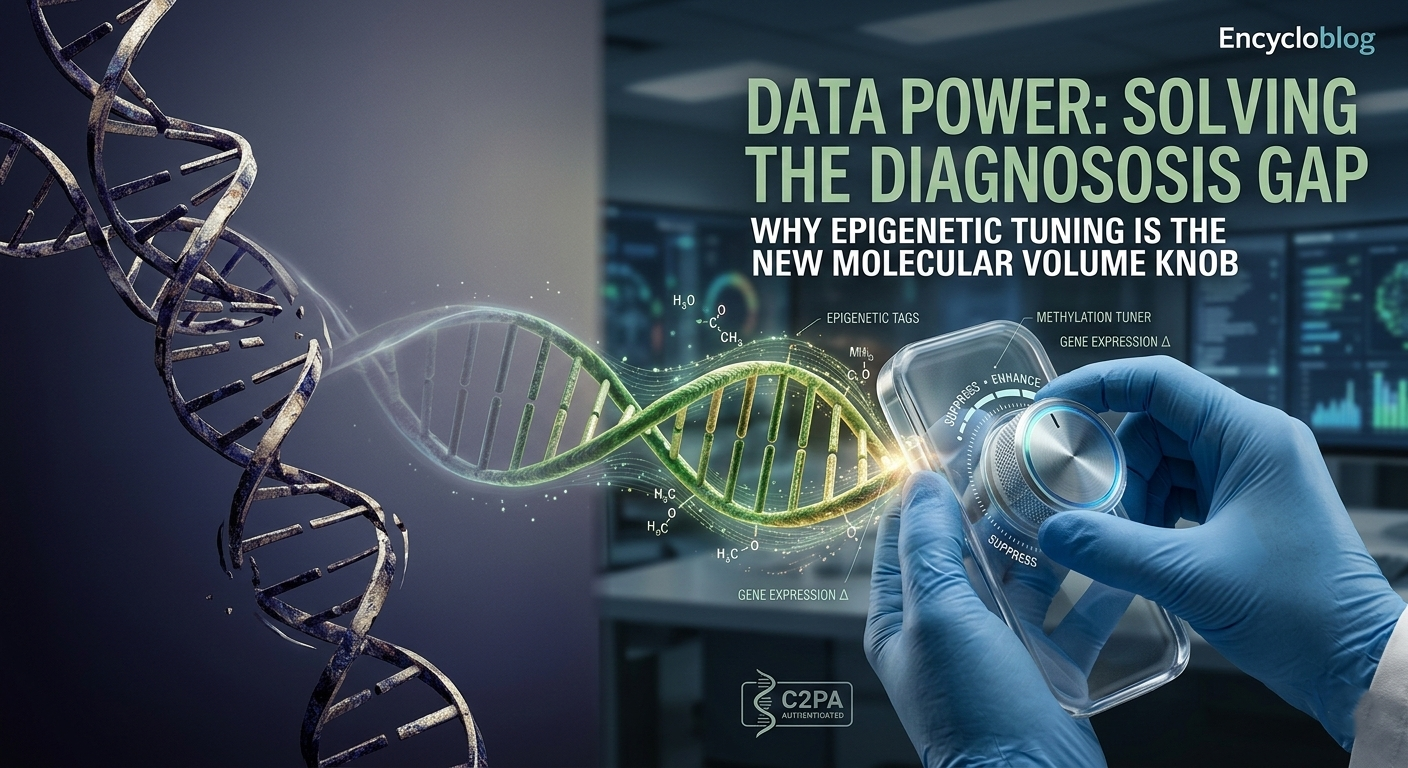
While AI helps us find existing tools, new biotechnology is giving us a completely different way to interact with the body’s internal code. We are moving beyond “Gene Editing” (like CRISPR, which physically cuts and replaces DNA) and into the more nuanced realm of Epigenetic Tuning.
Epigenetic Tuning: A therapeutic approach that modifies how a gene is expressed without altering the underlying DNA sequence. Think of your DNA as the “Sheet Music” and your epigenetics as the “Performance.”
The Molecular Volume Knob: Traditionally, we thought of genes as being either “broken” or “working.” Epigenetic tuning (pioneered by companies like Tune Therapeutics) uses specialized proteins to add or remove chemical tags—such as methyl groups—to the DNA. This acts as a volume knob, allowing doctors to turn a hyperactive, disease-causing gene down, or a dormant, healthy gene up.
For a patient with a rare disease caused by a “haploinsufficiency” (where one copy of a gene is missing or broken), epigenetic tuning could theoretically turn the “volume” up on the remaining healthy copy of the gene, compensating for the loss without the risks associated with permanent DNA editing.
The Equity Challenge: Breaking the Data Silos
The theme of Equity for this Rare Disease Day is a direct challenge to the “Silo Culture” of traditional medicine. For a diagnosis to happen faster than 4.8 years, data must move faster than the patient.
Historically, individual hospitals and proprietary pharmaceutical databases locked patient data in their basements. If you were a patient in rural Nebraska with a rare muscle-wasting condition, the one doctor in Berlin who actually understood your disease might never see your lab results.
The report released today highlights three pillars of the new Data Equity model:
- Global Patient Registries: Patients are no longer waiting for doctors to organize. They are creating their own “Decentralized Registries,” owning their data, and making it available to researchers worldwide through secure, blockchain-verified platforms.
- Federated Learning: This allows AI models to “learn” from sensitive medical data stored in different hospitals without the data ever leaving its secure home. The AI gets smarter; the patient’s privacy stays intact.
- Natural Language Processing (NLP): Many rare disease clues are buried in the “unstructured text” of a doctor’s notes—observations that didn’t fit into a standard check-box. New NLP tools are scanning millions of these notes to find the “shadow symptoms” that link undiagnosed patients together.
The Human Element: When Data Becomes a Name
We must remember that behind every “data point” is a family that is exhausted. The 4.8-year gap is not just a statistic; it is 1,750 days of waking up and not knowing why your child is losing their ability to walk or speak. It is the trauma of being told your symptoms are “all in your head” or “just stress.”
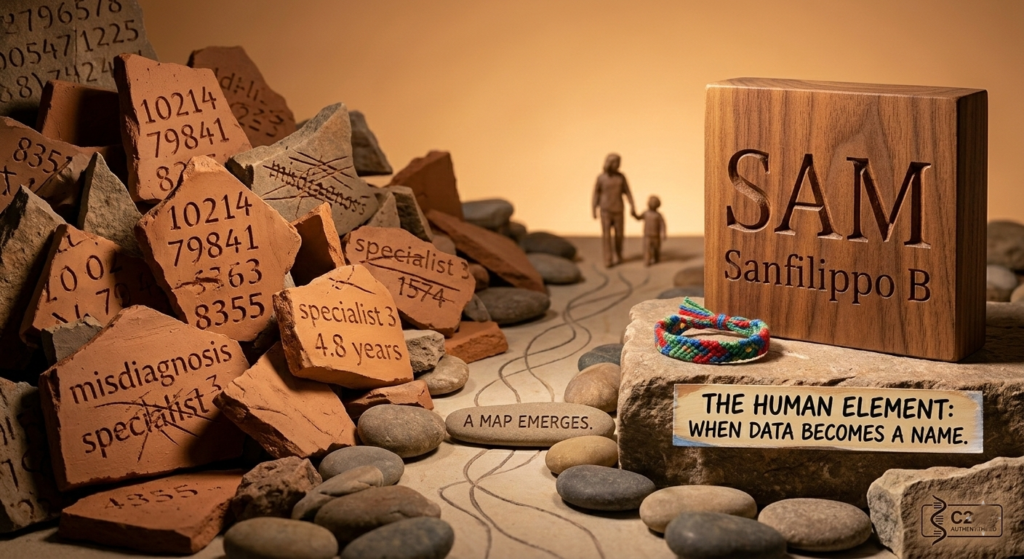
The power of data is that it provides a Name. And in the world of rare diseases, a name is the first step toward a community. Once a patient has a diagnosis, they can find the other 400 people on Earth who share their condition. They can join forces to fund research, share coping strategies, and lobby for better access to care.
Conclusion: The End of the “Orphan” Era
As we head into Rare Disease Day tomorrow, the message is clear: the age of the “Orphan Disease” is coming to an end. We are replacing isolation with connectivity and guesswork with “Data Power.”
The 4.8-year diagnosis gap is a relic of a time when we didn’t have the tools to see the patterns in the chaos. By leveraging AI drug repurposing and the precision of epigenetic tuning, we are ensuring that “rare” no longer means “ignored.” We are building a world where equity isn’t just an ideal, but a biological reality.
The labyrinth is being mapped. The “Odyssey” is being shortened. And for the 1 in 10 among us, the answer is finally within reach.
I’d love to hear from you: Do you know someone who has walked the “Diagnostic Odyssey”? How did getting a name for their condition change their life? Or, if you could “tune” one aspect of human biology to prevent a common suffering, what would it be?