
Table of Contents
We have all been sold the same tired narrative: to improve your life, you need a radical, Herculean transformation. You need to wake up at 4:00 AM, overhaul your diet overnight, and commit to an hour of intense exercise every single day. We buy the journals, we sign up for the expensive gym memberships, and we set the lofty, ambitious goals. And, almost invariably, by the third week of January—or three days into our new, “transformed” life—we burn out. The friction is too high, the disruption to our existing routine is too jarring, and the inevitable failure leaves us feeling worse than before.
But what if you could change your life without the agonizing struggle of a total overhaul? What if the secret to long-term health wasn’t found in monumental effort, but in the microscopic margins of your existing routine? The science of habit stacking suggests that the most effective way to build a new behavior isn’t to force it into your schedule, but to “stack” it onto something you already do every single day.
The Neuroscience of Habits
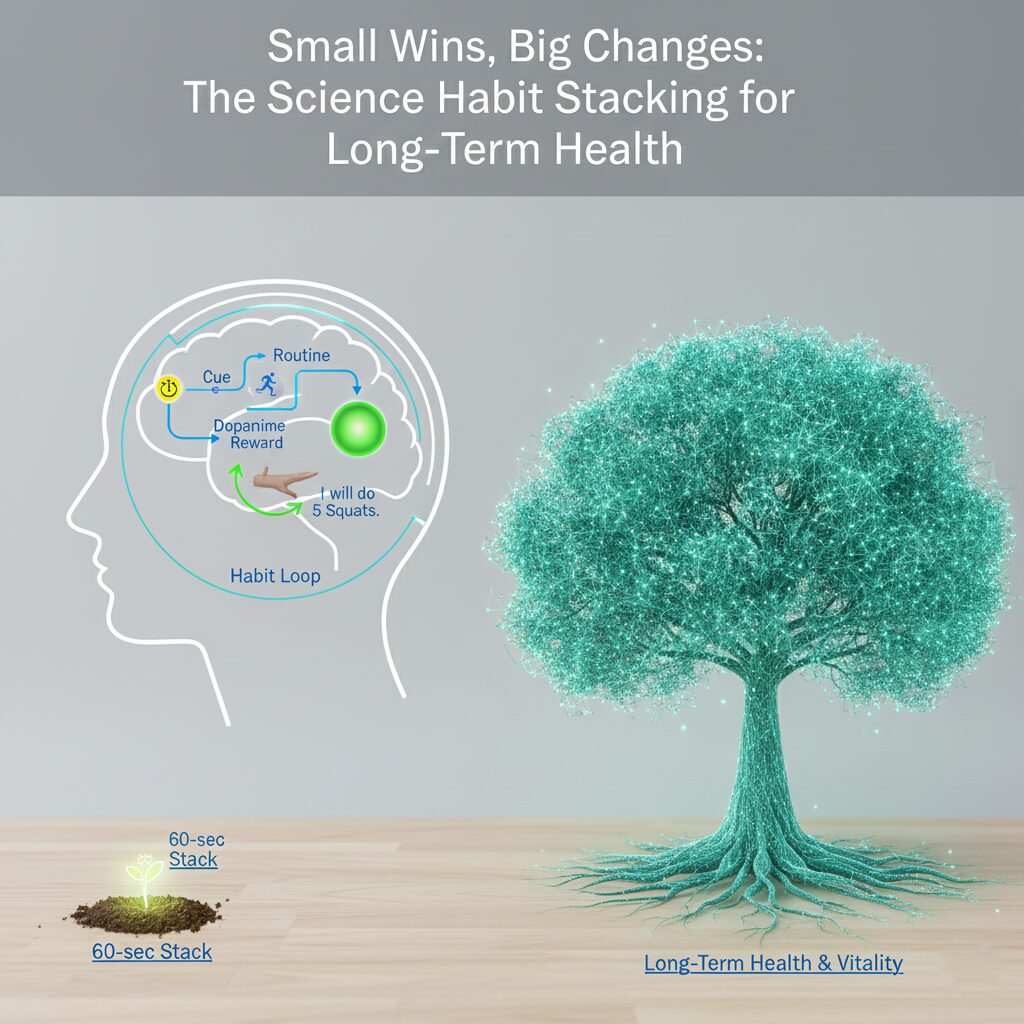
To understand why habit stacking works, we first have to understand what a habit actually is in the brain. Habits are essentially shortcuts. When we perform a behavior repeatedly, our brain creates a neural loop: a cue, a routine, and a reward. Over time, this loop becomes so efficient that it moves from the prefrontal cortex—the part of the brain responsible for deliberate, conscious decision-making—to the basal ganglia, the primitive area associated with memory, pattern recognition, and automatic behavior.
When a behavior becomes “automatic,” it essentially disappears from your conscious radar. You don’t have to “decide” to brush your teeth in the morning; you just do it. The problem with traditional self-improvement is that it requires you to use your prefrontal cortex—your limited, depletable willpower—to create a new loop from scratch. Habit stacking hacks this process by taking the neural energy of an existing automatic behavior and using it as a launchpad for a new one.
What is Habit Stacking?
Habit stacking is a strategy popularized by behavior expert BJ Fogg and expanded upon by writers like James Clear. The framework is remarkably simple: “After [Current Habit], I will [New Habit].”
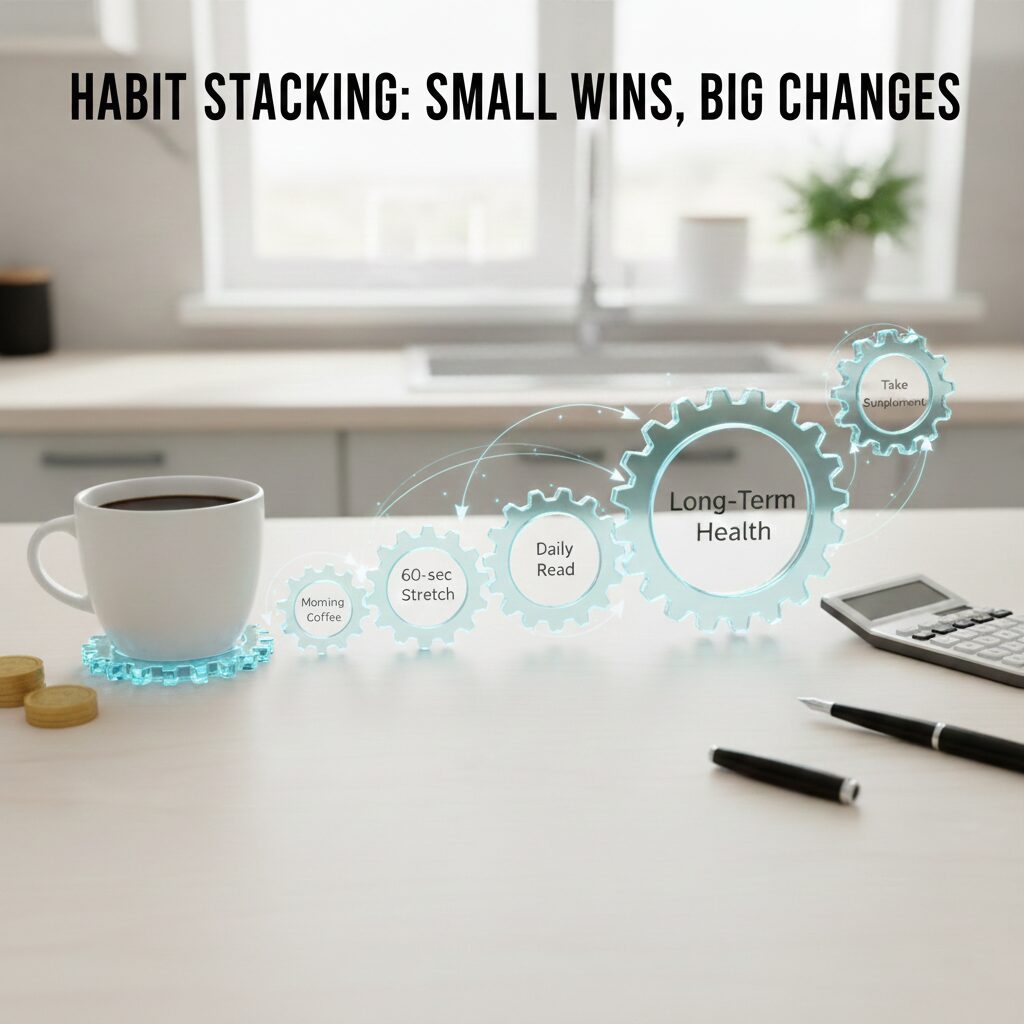
The genius of this approach lies in the “current habit.” You aren’t trying to create a new trigger from thin air. You are piggybacking on a behavior that is already wired into your basal ganglia. If you already drink coffee every morning, that behavior is a stable, reliable anchor. If you add a 60-second stretch or a moment of mindfulness immediately after pouring that first cup, you are utilizing an existing neural circuit to pull the new behavior along for the ride.
Why Small Wins Matter
The most common mistake we make when attempting to improve our health is aiming for “big wins.” We think that if the change isn’t massive, it doesn’t count. But neuroscience tells us the exact opposite. Small wins trigger the brain’s reward system, releasing a small hit of dopamine, which encourages us to repeat the action.
By keeping your new habit to under 60 seconds, you lower the “activation energy” required to start. When the barrier to entry is low, you are far more likely to remain consistent. And consistency, not intensity, is the primary driver of long-term health outcomes. A single push-up every day is infinitely more valuable than 100 push-ups once a month followed by a week of recovery.
Architecting Your Stacks
To build your own stack, you need to conduct a “habit audit.” Look at your current daily rhythm. What are the things you must do every day?
- Morning anchors: Waking up, brushing teeth, making coffee, getting the mail, turning on the computer.
- Work anchors: Sending your first email, finishing a meeting, taking a lunch break.
- Evening anchors: Changing into pajamas, turning off the lights, washing your face.
Now, identify the tiny, 60-second behaviors you want to add.
- Want more mobility? After you pour your coffee, do five squats.
- Want to lower stress? After you sit down at your desk, take three deep, intentional breaths.
- Want to practice gratitude? After you brush your teeth at night, think of one thing that went well that day.
These are not “workouts” or “life-changing events.” They are “micro-habits.” Yet, when you stack three or four of these throughout your day, the cumulative impact on your nervous system, your mobility, and your mental state is profound.
Managing Friction and “Environment Design”
Even with habit stacking, friction is the enemy. Environment design is the hidden variable that determines success. If your stack is “After I finish work, I will go for a run,” but your running shoes are buried in the back of the closet, you will fail.
You must make the new habit as frictionless as possible. If you want to take a supplement, put the bottle on your coffee machine. If you want to read, put the book on top of your pillow. By manipulating your physical environment, you reduce the decision-making required to initiate the stack. You are essentially setting up a “path of least resistance” that leads directly to your desired behavior.
Dealing with the Inevitable “Slip”
The biggest trap in habit formation is the “all-or-nothing” mentality. If you miss a day, you feel like the whole stack is broken. This is a cognitive distortion. Successful habit stackers embrace the “Never Miss Twice” rule. If you miss your stack on Tuesday, your primary goal for Wednesday is not to be perfect—it is simply to do the habit once. By focusing on the streak, you maintain the neural pathway. If you miss two days, you aren’t “failing”; you are just starting to form a new, unhealthy habit (the habit of not doing the task). The goal is to catch the error before it cements itself.
The Science of “Identity-Based” Habits
Finally, habit stacking works because it eventually changes your internal narrative. When you start doing something every single day—even if it only takes 60 seconds—you begin to tell yourself a new story. You stop thinking of yourself as someone who “wants to get healthy” and start thinking of yourself as someone who “is a healthy person.”
This is the psychological “holy grail.” When your habits align with your identity, the behavior is no longer something you have to do; it is simply who you are. This is why it leads to long-term health. It’s not a temporary diet or a seasonal exercise challenge; it’s an evolution of your character, built one tiny, 60-second stack at a time.
Starting Your Journey
Do not try to stack ten habits tomorrow. Start with one. Find one reliable anchor in your day, and add one 60-second habit to it. Do this for two weeks. Once that stack feels as natural as brushing your teeth, add a second.
You are not looking for an overnight transformation. You are looking for a compound effect. Like interest in a bank account, these small, daily habits seem insignificant in the short term, but over months and years, they create a massive, undeniable shift in your baseline health. Stop looking for the big win. Start looking for the small stack. Your future, healthier self is already waiting for the next 60 seconds to pass.