
Table of Contents
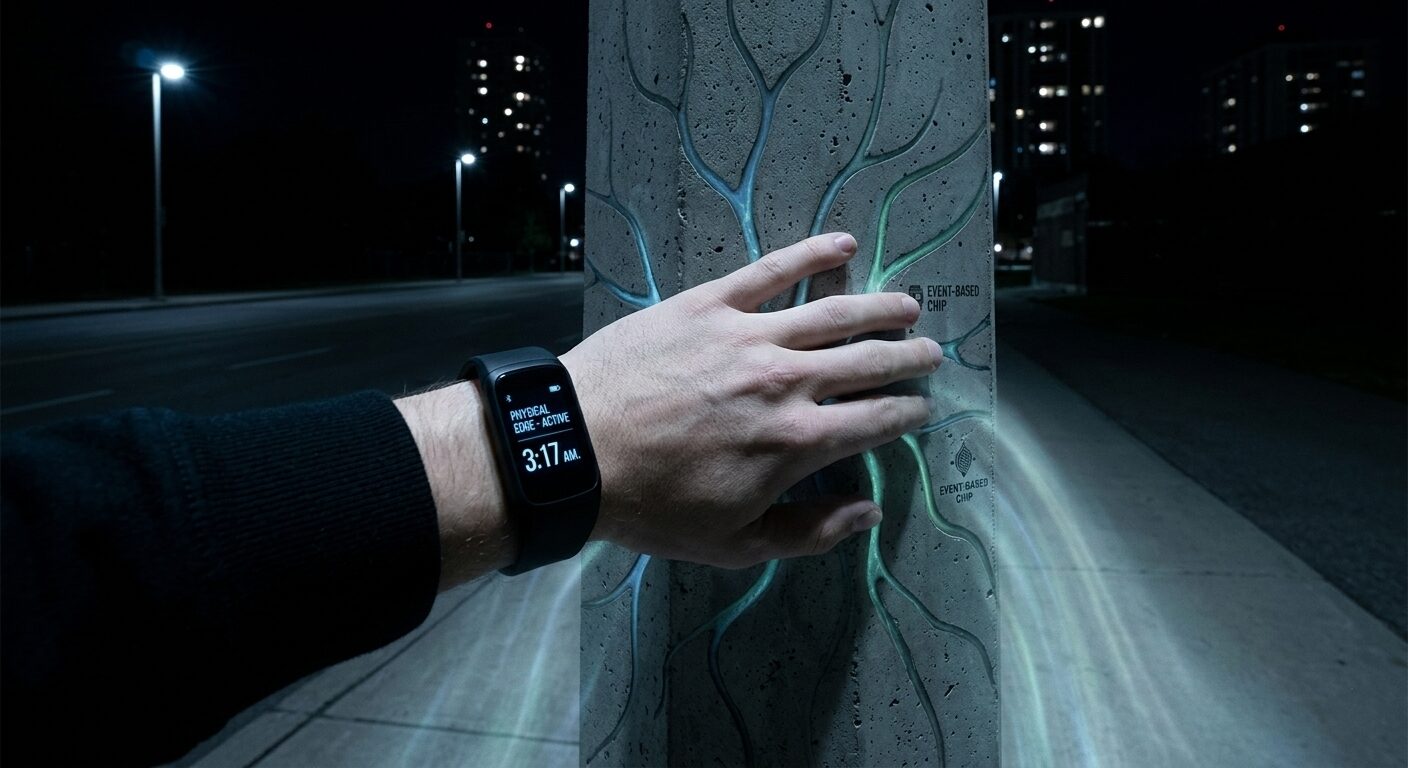
I was standing on a street corner at 3:00 AM when I realized the city was finally watching me—but not in the way I’d been taught to fear. Usually, a city at night is an energy vampire. Streetlights burn into the empty pavement, and massive data centers hum in the distance, processing billions of bytes of “nothing” just in case something happens. But as I stepped off the curb, the light above me didn’t just turn on; it pulsed into life, triggered by a chip that works exactly like my own brain. I wasn’t just in a smart city anymore. I was walking through one of the world’s first neuromorphic cities.
For years, we built “Smart Cities” that were essentially just regular cities with too many expensive sensors glued onto them. These systems were hungry. They sent every bit of movement—a falling leaf, a stray cat, a plastic bag—back to a central “cloud” to be analyzed. It was an energy disaster. By following the development of neuromorphic infrastructure, I’ve seen how we are finally solving the energy crisis by embedding “event-based” hardware directly into the physical fabric of our world. We aren’t just building better computers; we are turning our water pipes, power grids, and traffic lights into a literal, physical brain.
Why I Believe in the Event-Based Revolution
The secret to this transformation lies in a hardware shift that mimics the human biology. My own brain doesn’t process every single pixel in my field of vision at all times. Instead, my neurons only “fire” when they detect a change—a movement, a sound, a shift in light. This is the heart of the neuromorphic cities concept.
I recently visited a testing site for “Event-Based” traffic management. In a standard system, a camera records 30 frames of video every second, even if the road is empty. That data has to be stored and processed, wasting massive amounts of electricity. In the neuromorphic model, the chips in the cameras are “asynchronous.” They only transmit data when a pixel changes. If no car is moving, the chip stays silent. It uses 1/1,000th of the energy of a standard processor. Standing there, watching the power meter stay nearly flat while the city “slept,” I realized this is the only way we survive the energy mandates of the coming decade.
Solving the Sensing-to-Action Latency
One of the most frustrating parts of old urban tech was the delay. In technical terms, we call this Sensing-to-Action Latency. If a water pipe bursts or a power line fails, the data usually has to travel to a server farm, get processed by an AI, and then send a command back to the city. That “lag” can be the difference between a small leak and a flooded neighborhood.
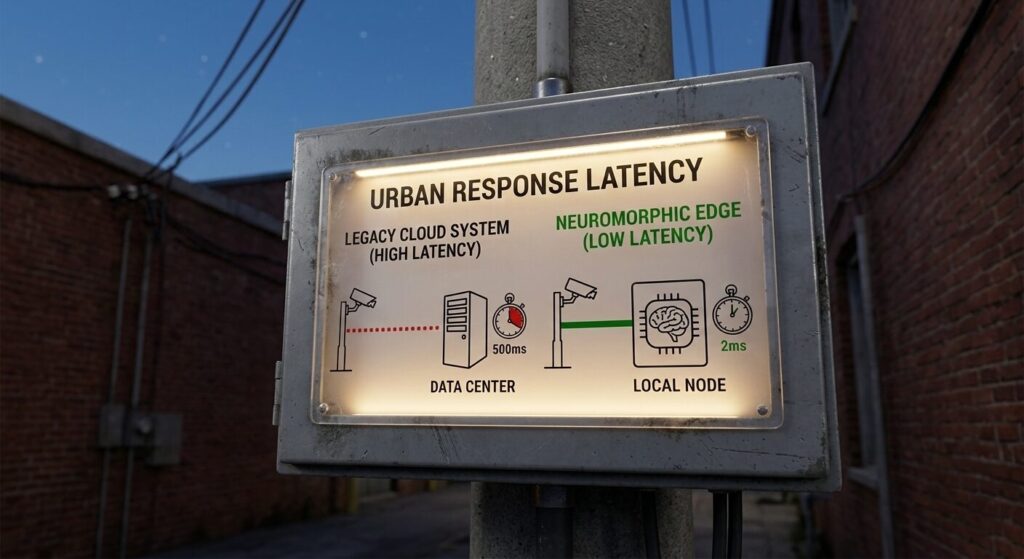
By moving “intelligence” to the physical edge—literally putting the brain inside the pipe—neuromorphic hardware eliminates that trip to the cloud. I watched a demonstration where a neuromorphic grid detected a power surge and isolated the circuit in less than a millisecond. The “brain” of the city reacted faster than a human could blink. This isn’t just about speed; it’s about autonomy. The city is becoming a self-healing organism that doesn’t need a constant tether to a massive, energy-hungry data center.
The Physical Edge: A City That Only Wakes Up When Needed
Living in a city with a neuromorphic spine feels different. It’s a quieter, more intentional kind of existence. I’ve spent time in neighborhoods where the power grid “breathes” with the inhabitants. During the day, the infrastructure is hyper-active, routing energy with surgical precision. At night, it doesn’t just “dim”—it enters a state of neural rest.
Because these chips only fire on activity, the city’s “brain” is only as active as its people. This shift to the physical edge is the only way to avoid a total energy collapse. We cannot keep building bigger data centers to manage our lives. We have to make the things themselves—the bricks, the steel, and the copper—smart enough to handle their own decisions.
A Future That Mimics Life
As I finished my walk that night, I looked back at the street I’d just traversed. The lights behind me were already “falling asleep” again. There was no wasted light, no wasted data, and no wasted heat. By building neuromorphic cities, we are finally moving past the era of the “energy vampire” and into an era of biological efficiency. We are no longer just living in a place; we are living inside a mind that knows exactly when to wake up, and exactly how to care for us.