
Table of Contents
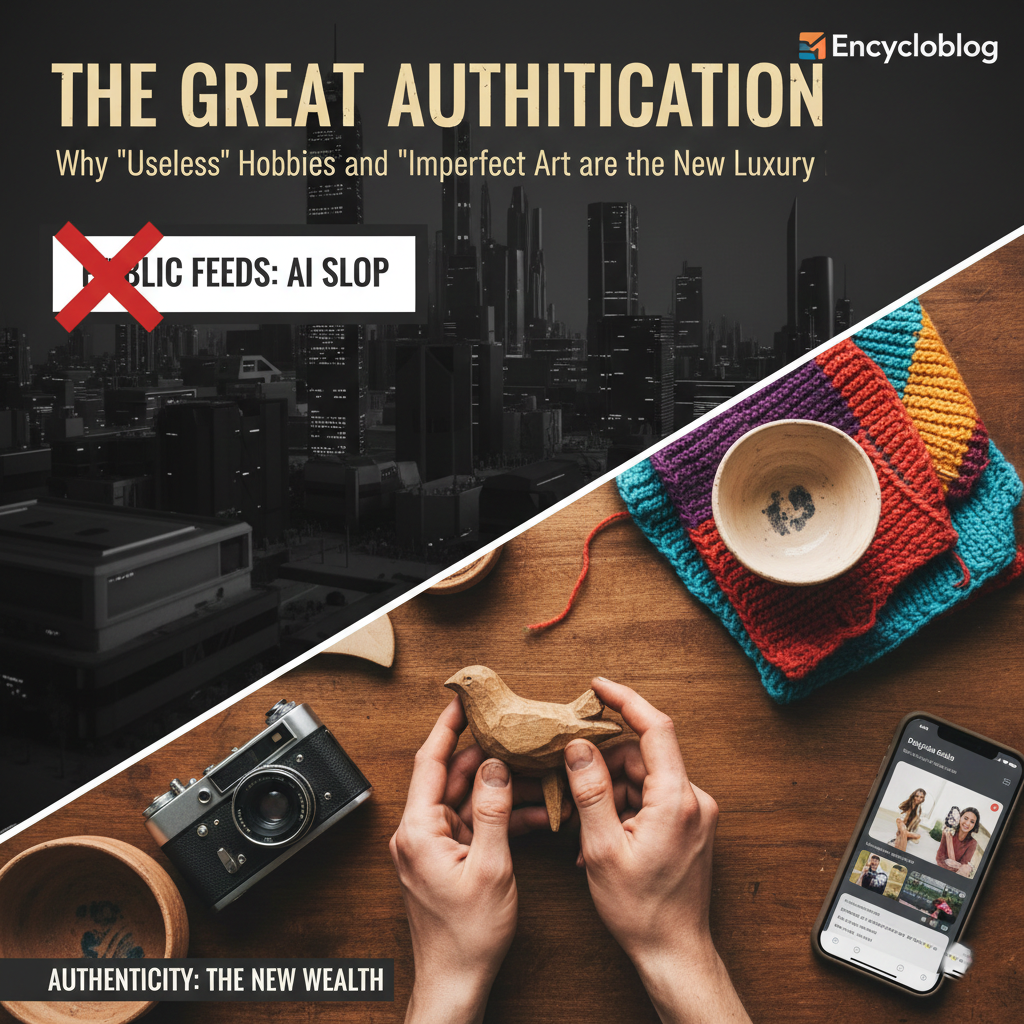
I spent three hours yesterday evening wrestling with a block of linden wood. My palms were sore, my workbench was covered in shavings, and the “bird” I was attempting to carve looked more like a lumpy potato with an identity crisis. I didn’t take a photo of it neither did i post it to a story or “prompt” a camera to enhance the lighting.
I just sat there, feeling the grit of the wood under my fingernails, and realized I was experiencing the most expensive luxury available: The Great Authentication.
For the last few years, we’ve been drowning in “Slop.” That’s the industry term for the infinite, frictionless, AI-generated content that has turned our public feeds into a hall of mirrors. When every image is perfect, when every paragraph is grammatically flawless but soul-dead, and when every video is a synthetic dream, “perfection” becomes worthless. In fact, in 2026, perfection is a red flag.
We are currently living through a “Medieval” shift in digital culture and we are fleeing the public squares—the massive, algorithm-driven social platforms—and retreating into what I call Digital Guilds. We are moving back to “Oral-First” cultures where truth isn’t found in a verified checkmark, but in a trusted voice within a gated circle. If you’ve felt a sudden, desperate urge to bake bread, join a private group chat, or knit a sweater with “mistakes” on purpose, you aren’t just picking up a hobby. You are participating in the new underground resistance against the non-human.
The Death of the Feed and the Rise of the ‘Digital Guild’
I remember the exact moment I deleted my last public-facing social media app. I was scrolling through a series of “travel photos” of a place I’d actually visited, and I realized the AI-enhanced versions were “better” than the real thing. The sky was bluer, the architecture more intricate. The feed had become a fantasy land that no longer correlated with the ground I stood on.
This week, ethnographers confirmed what many of us felt: the Public Feed is dead. In its place, we’ve built the Digital Guild. These are private, invite-only group chats, gated Discord servers, and encrypted threads where the entry fee isn’t money—it’s proof of humanity. * The Medieval Dream: Much like the craftsmen of the middle ages, we are forming circles around shared expertise and personal trust. In these guilds, we don’t broadcast; we converse.
- Oral-First Information: We’ve stopped trusting “The News” and started trusting “The Guy.” If I want to know if a new restaurant is good, I don’t check a review site (which is likely a bot-on-bot battlefield); I ask the “Dining Guild” in my private chat. Information is once again moving person-to-person, just like it did in a medieval marketplace.
The Cult of the ‘Useless’ Hobby
I’ve noticed a strange trend in my “Maker Guild.” The most respected people aren’t the ones making money; they are the ones doing things that are intentionally “useless.”
In a world where an AI can generate a 4K masterpiece in three seconds, the value of my lumpy wooden bird isn’t in the result—it’s in the inefficiency.
We are witnessing the Sanctification of the Slow. * Tactile Friction: I took up pottery last month. The mud is cold, the wheel is loud, and I’ve broken more bowls than I’ve kept. That “friction”—the resistance of the physical world—is what makes it real.
- Biological Proof: When I give a friend a hand-knit scarf, they can see the uneven stitches. Those “flaws” are biological signatures. They are the watermark of a human being who spent twenty hours of their finite life doing something “inefficiently” because they cared. In 2026, a mistake is a sign of high status.
‘Imperfect’ Art: The Post-Algorithm Aesthetic
We’ve entered the Post-Algorithm Era, and the aesthetic has shifted dramatically. If you look at the interior design or fashion trends this month, you’ll see a move toward “The Raw and the Ragged.”
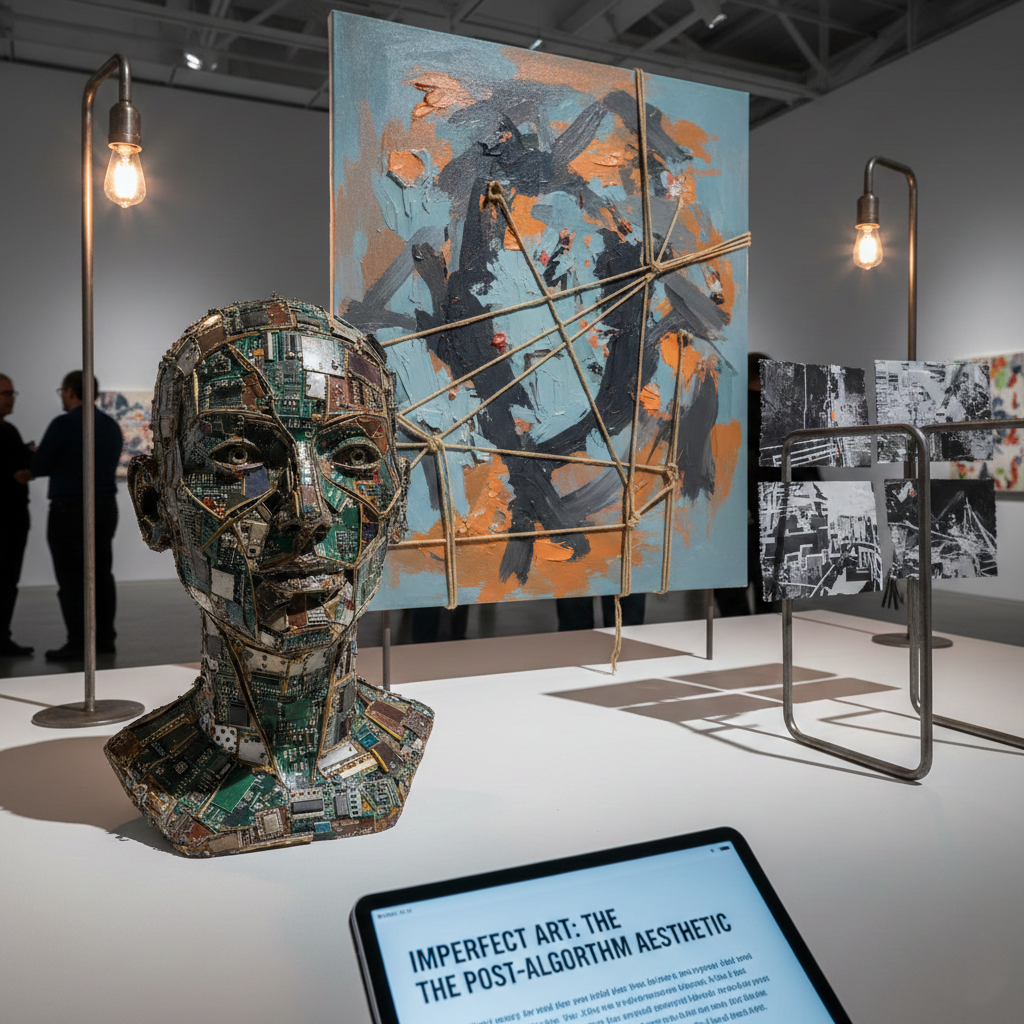
We are fleeing the “Corporate Memphis” and “AI-Slick” look. We want furniture with visible grain, clothes with visible mending, and music with “analog hiss.”
- Substance over Slop: The goal of art is no longer to be “beautiful” (AI has won that race); the goal is to be Substantiated. * Gated Culture: This is why “Live” experiences are surging. You can’t fake the energy of a room. You can’t “prompt” the sweat of a drummer. We are paying a premium to be in the physical presence of other biological entities doing “imperfect” things.
How to Find Your Way in the Post-Algorithm Era
If you’re feeling lost in the digital fog, here is the “Encyclopedia Entry” for navigating the Great Authentication:
- Seek the ‘Friction-Full’: If a task feels too easy, it’s probably not giving you the psychological “Reset” you need. Choose the hobby that requires your hands, your patience, and your physical presence.
- Audit Your Circles: Move your valuable conversations from public “comments sections” to private “guilds.” Trust is the only currency that AI can’t inflate.
- Celebrate the Flaw: Stop using filters. Stop editing your life. In a world of synthetic perfection, your “imperfections” are the only way we know you’re still there.
- Practice ‘Analog Curation’: Keep a physical journal. Buy a film camera. Print your photos. Give your memories a “body” so they can’t be deleted or simulated by an algorithm.
Why Authenticity is the New Wealth
We used to define luxury by what we could buy. we now define luxury by what cannot be automated. You can buy a perfect, AI-generated song, but you can’t buy the feeling of learning to play the guitar. You can buy a perfect, 3D-printed house, but you can’t buy the history of a cottage built by hand.
The Great Authentication isn’t a “return to the past”; it’s a way forward. It’s the human spirit asserting itself in the face of the machine. By choosing “useless” hobbies and “imperfect” art, we are drawing a line in the sand. We are saying: This is where the algorithm ends, and where I begin.
My lumpy wooden bird will never be a masterpiece. It won’t win an award. It won’t even sit level on a table. But it is real. I made it with my own two hands, in my own time, for no other reason than to feel the wood turn into something else. that makes it the most valuable thing I own.
I’ve spent so much of my life trying to be “optimized” and “efficient” that I forgot how much joy there is in being a complete amateur. There is a profound freedom in doing something badly, simply because you are the one doing it.
I’d love to know: What is one “useless” hobby you’ve picked up recently—something that doesn’t make you money, doesn’t look “perfect” on a feed, but makes you feel completely human?