
Table of Contents
I remember the “Static Age” of astronomy. When I was younger, the universe felt like a beautiful, high-resolution museum. We had the Hubble Deep Field—a breathtaking, motionless tapestry of galaxies millions of light-years away. If something changed in the sky, we usually didn’t find out about it until months later, after a team of Ph.D.s had scrubbed the data and published a paper in a prestigious journal. The stars were “eternal,” which was just a polite way of saying they were slow to report their news.
That era ended this week.
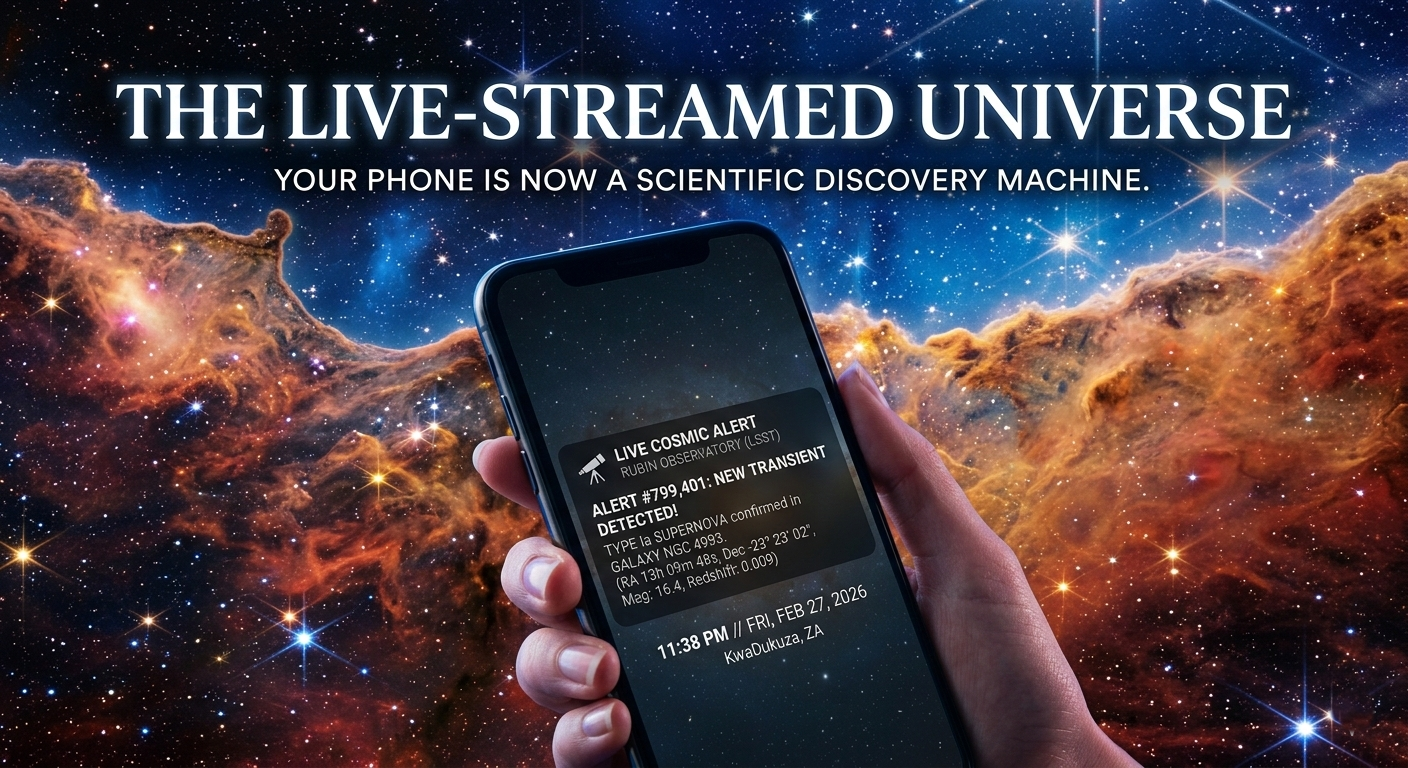
Between February 25 and February 27, the Vera C. Rubin Observatory in Chile officially opened the floodgates. They released the first 800,000 public alerts from their survey of the southern sky. This isn’t just a new batch of photos; it is the beginning of the “Live-Streamed Universe.” Every single night, this observatory is churning through 20 terabytes of data, capturing the entire visible sky every few nights.
If a star explodes, if an asteroid tumbles, or if a black hole gobbles up a nearby sun, you no longer have to wait for the evening news. The universe is now sending push notifications directly to your lock screen.
1. The Death of the “Still Life” Galaxy
For centuries, the night sky was the ultimate “still life.” We looked at the stars to find our way home because they were the only things in our lives that didn’t seem to change. But the truth is, the universe is a chaotic, violent, and flickering place; we just didn’t have a fast enough shutter speed to see it.
The Rubin Observatory’s primary mission, the Legacy Survey of Space and Time (LSST), has changed the frame rate of our reality. It is equipped with a 3.2-billion-pixel camera—the largest digital camera ever constructed. To put that in perspective, you would need roughly 1,500 high-definition television screens to display just one of its images.
But the real magic isn’t the size of the image; it’s the Transient Engine.
The Encyclopedia Entry: LSST & The Alert Stream
LSST (Legacy Survey of Space and Time): A ten-year mission to conduct a multi-color panoramic survey of the southern sky. Unlike previous telescopes that “pointed and stared” at specific targets, LSST “scans and repeats,” creating the first-ever motion picture of the cosmos.
The Magnitude of Speed: The system is designed to detect any change in the sky—brightness, position, or appearance—and broadcast it to the global community with staggering efficiency.
Alert Speed < 120 seconds from image capture
This means that within two minutes of the photons hitting the sensor in the Chilean Andes, a digital “handshake” has happened. An AI has compared the new image to a template of the “old” sky, spotted a difference, and blasted that data out to the world.
2. The Rise of the “Citizen Discovery” Machine
We are witnessing the democratization of the frontier. In the past, “Scientific Discovery” was a gated community. You needed a grant, a tenure-track position, and access to a mountain-top facility. Today, you just need a data plan and a curious thumb.
This week’s release of 800,000 alerts marks the beginning of the Citizen Scientist golden age. Because the Rubin Observatory produces roughly 10 million alerts per night, there are simply not enough professional astronomers on Earth to look at them all.
This has led to the creation of “Community Brokers”—AI-driven platforms that filter the firehose of data for the public. You can now subscribe to “channels” based on your interests:
- The Near-Earth Channel: Get alerts for asteroids that are making a close pass.
- The Supernova Channel: Be the first to see a star that died ten million years ago but whose light just arrived.
- The “What is That?” Channel: For the anomalies—the flickering lights that don’t fit our current models of physics.
The Hook: Beating the News Cycle
The most relatable part of this shift is the Discovery Lead Time. By the time a “Breaking News” story hits your favorite tech site about a “newly discovered comet,” the Citizen Science community has already been tracking it for forty-eight hours. They’ve calculated its trajectory, argued about its composition in Discord servers, and maybe even given it an unofficial nickname.
Astronomy has moved from a “look-back” science to a “live” event. It is the ultimate reality TV, and the cast consists of billions of stars.
3. Inference Economics in Deep Space
You might wonder how we handle 10 million notifications a night without our phones melting. The answer lies in Inference Economics.
Just as we discussed the falling cost of AI “thinking” in the business world, the same revolution is happening in the heavens. The Rubin Observatory uses Edge AI to perform the first layer of “thought.” The telescope’s local servers do the heavy lifting:
- Subtraction: It subtracts the “Static Sky” from the “New Sky.”
- Categorization: It uses neural networks to guess what the change is. Is it a satellite? A cosmic ray hitting the sensor? Or a genuine astrophysical event?
- Prioritization: It assigns a “Scarcity Score.” If the event looks like a rare Kilonova (the collision of two neutron stars), the alert is fast-tracked to the world’s largest telescopes for immediate follow-up.
Because the cost of this “inference” has dropped so low, we can afford to be “wrong” occasionally. We would rather send 100 “maybe” alerts to a citizen scientist than miss the one “definitely” that changes our understanding of dark matter.
4. The Cultural Shift: From Hobbies to Notifications
The image of the “astronomer” is undergoing a radical rebranding. For a century, it was the “Old Man with a Telescope”—someone standing in a cold dome, squinting through an eyepiece.
In this new era, the astronomer is a Data Orchestrator.
- They are the teenager in a high school coding club who writes a script to flag “Flickering Red Giants.”
- They are the retired teacher who spends twenty minutes a morning “vetting” asteroid candidates on their tablet.
- They are the professional researcher who manages a “fleet” of automated robotic telescopes that slew to new targets based on the Rubin alerts.
The “Gamification” of the Cosmos
We are seeing the rise of Discovery Leaderboards. Platforms like Zooniverse and Planetary Response are gamifying the search for the unknown. When you help identify a “Solar System Object,” you get a digital badge. If your identification leads to a confirmed discovery, your name is forever linked to that object in the Minor Planet Center database.
This isn’t just about “helping out”; it’s about Digital Sovereignty. We are taking the responsibility for planetary defense and cosmic understanding away from a few centralized agencies and distributing it across the global nervous system of the internet.
5. Why the “Live Sky” Matters for Earth
Why should you care about a star exploding in a galaxy you’ve never heard of? Because the “Live-Streamed Universe” is the ultimate training ground for Crisis Response.
The logic we use to track a “Fast-Moving Asteroid” is the same logic we use to track a “Fast-Moving Cyclone” or a “Fast-Moving Financial Collapse.” By learning to manage a “Firehose of Alerts” from the Rubin Observatory, we are training ourselves to be better Orchestrators of information.
Furthermore, the LSST is our first true “Planetary Defense” system. Before this month, our map of “Killer Asteroids” was incomplete. With the Rubin’s alert stream, we are expected to discover 10 to 100 times more near-Earth objects than we currently know. We are finally turning the lights on in a dark room full of furniture.
6. Conclusion: The Living Room of the Infinite
We are no longer observers of the universe; we are participants in its timeline.
When you get a notification that a Supernova has just been detected, you are witnessing a moment of cosmic transition in real-time. You aren’t just looking at a screen; you are looking through a window. The 20 terabytes of data being produced tonight are a testament to our desire to stay connected to something larger than our own atmosphere.
The “Encyclopedia of the Now” is being written at a speed of 120 seconds per page. The stars are no longer static points of light; they are a live-streamed conversation. The question is: Are you listening?
I’d love to hear from you: If your phone gave you the chance to name a newly discovered asteroid (even if it’s just an unofficial nickname for your community), what would you call it?