
Table of Contents
In 2026, society conditions us to believe that “new” means “better.” Every year, the tech cycle demands our attention, telling us that our screens need more pixels, our processors need more cores, and our tools need a digital companion—a cloud connection, a subscription, or a proprietary app. Planned obsolescence traps us in a loop, depreciating the value of our possessions the moment companies announce a newer model.
But if you look closely at the history of human ingenuity, you will find a different story—the story of Peak Design.
These are items that haven’t changed in decades, not because their manufacturers are static, but because they have achieved a state of perfection. Their design locked them in an “un-updateable” state the moment they reached perfection. These tools do not ask for a software update; they do not require a Wi-Fi connection; they do not experience “battery degradation.” They are the antithesis of the modern consumerist loop. They are the artifacts of a philosophy that prizes utility over novelty.
The Philosophy of “Peak Design”
What makes an object “un-updateable”? It isn’t just about build quality or durability, although those are prerequisites. It is about a fundamental alignment between form and function where every component serves a singular, necessary purpose. When you hold a tool that has reached Peak Design, the “interface” disappears. You aren’t operating a machine; you are extending your own capability.
We are currently living through the “Great Digital Fatigue.” We grow tired of constant updates, endless syncing, and proprietary cables. By surrounding ourselves with “Un-Updateable” gear, we are reclaiming a sense of autonomy. These tools don’t rely on a cloud server to function. They don’t have terms of service that change overnight. When you purchase an item that has reached Peak Design, you are opting out of the upgrade cycle. You are saying, “This is good enough forever.” Here is my Hall of Fame—10 tools that have reached the summit of their evolution.
1. The Victorinox Swiss Army Knife (The Original Tinker)
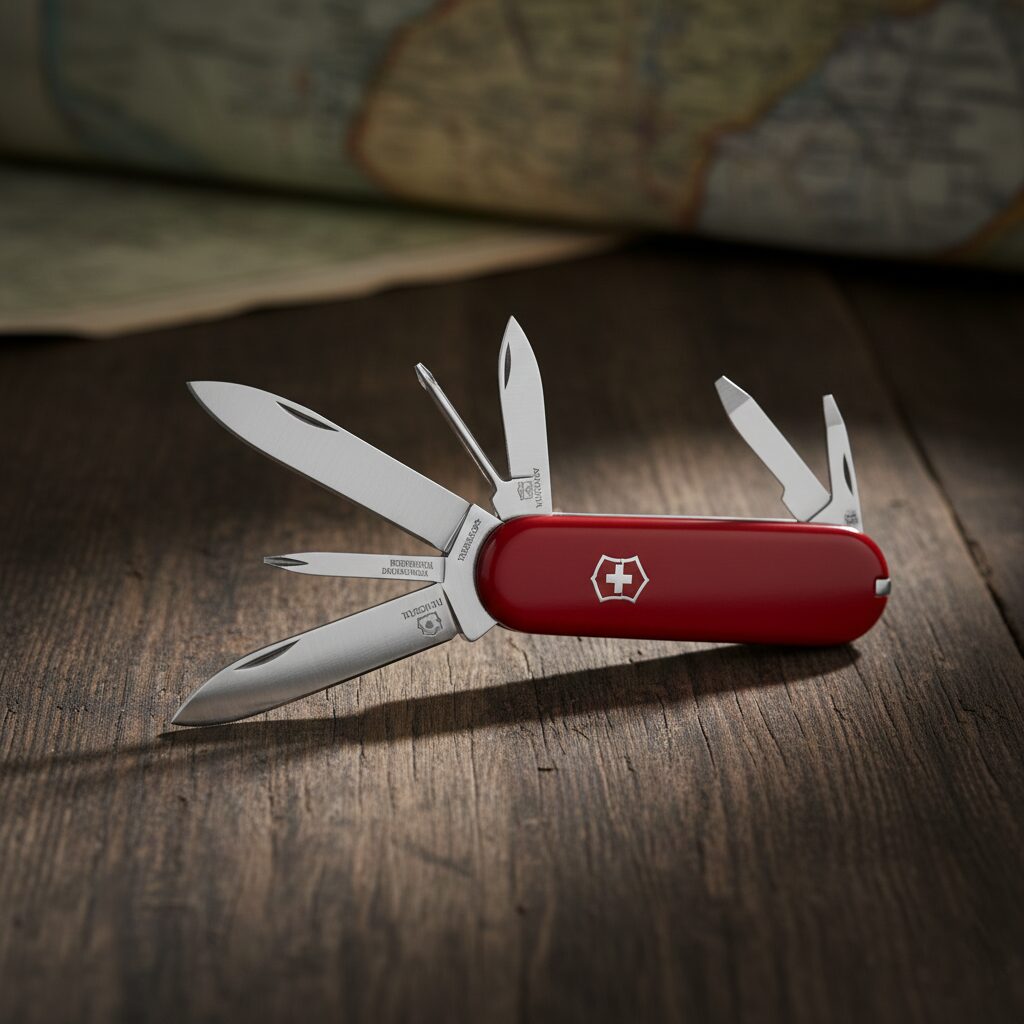
It is easy to dismiss this as a relic of a simpler time, but consider the geometry. The pivot tension, the gauge of the stainless steel, and the specific selection of tools haven’t shifted in decades for a reason. It is a masterpiece of compact mechanical engineering and it doesn’t need Bluetooth connectivity; it needs a razor-sharp edge, a sturdy spring, and a reliable hinge. It is the ultimate testament to the idea that if a problem is well-defined, the solution can be finalized.
2. The Lodge Cast-Iron Skillet
There is no non-stick coating to flake off into your food, no delicate electronic temperature sensors to fail, and no fragile composite handle to snap. It is a solid slab of iron. It only gets better with time as it builds a “seasoning”—a polymerized layer of oil that acts as a natural non-stick surface. You are essentially cooking with a piece of history that, if treated correctly, will be passed down to your grandchildren.
3. The Seiko 5 Mechanical Movement
In an age where smartwatches track our every heartbeat and ping us with notifications, a mechanical watch movement keeps time using nothing but a coiled spring, a balance wheel, and gravity. The Seiko 5 movement is a triumph of micro-mechanical engineering that operates indefinitely, provided it is worn. It reminds us that timekeeping is a physical, observable act, not just a digital readout.
4. The Parker Jotter Pen
We have spent years trying to digitize the act of writing, yet nothing feels as precise as a well-balanced pen on paper. The Parker Jotter has remained largely unchanged since the 1950s. It features a simple, satisfying click mechanism and a durable stainless-steel body and it is the gold standard of tactile feedback. It works every time the tip touches the page, regardless of whether you are at your desk or in the middle of a desert.
5. The Anglepoise Desk Lamp
Invented in 1932, the Anglepoise lamp introduced a revolutionary spring system that allowed a light source to hold its position in any direction without locking screws. It solved the problem of workspace illumination with such elegance that virtually every articulating desk lamp designed since is essentially a footnote to this original design. It is functional elegance at its peak.

6. The Zippo Lighter
The design is famously simple: a windproof chimney, a flint, and a wick. The “Zippo click” is one of the most recognizable mechanical sounds in the world. Its true perfection lies in its repairability. If a Zippo fails, it is usually because the flint is gone or the wick is charred—both of which are replaceable by the user in seconds. It is a masterclass in modular, reliable engineering.
7. The Stanley 60 1/2 Block Plane
Woodworking has seen the rise of laser cutters and CNC machines, but for shaping wood by hand, the block plane remains supreme. The Stanley 60 1/2 design has been copied by countless manufacturers because the way it balances in the hand and the precision with which it allows you to shave wood is fundamentally correct. It connects the artisan to the material in a way a power tool never can.
8. The Leatherman PST (Pocket Survival Tool)
While modern multitools have become increasingly complex, the original Leatherman PST remains a high-water mark. It focused on the absolute essentials: pliers, a wire cutter, and a set of blades and it proved that you didn’t need a tool for every scenario, just the right tool for the most critical ones. It is a tool of pure utility.
9. The Fender Stratocaster
Designed by Leo Fender in 1954, the Stratocaster’s contoured body was revolutionary for its comfort. Its modular design—allowing for easy pickup, bridge, and neck adjustments—meant that a player could customize their sound indefinitely without buying a new instrument. It is the only guitar you ever need to own because it can be anything you want it to be.

10. The 6-Inch Steel Rule (Starrett)
It seems mundane, but precision measurement is the bedrock of civilization. A high-quality, satin-chrome steel rule is impervious to temperature, humidity, and the passage of time. It doesn’t need to be calibrated; it simply is. It is a permanent reference point in a world that is constantly shifting.
The Curator’s Eye: Why We Need Peak Design
When you look at this list, you notice a pattern: these tools are defined by their Analogue Resilience. They function without a power source, they are repairable by the user, and they are made of materials that age with “patina” rather than “degradation.”
In 2026, we are bombarded by marketing that tells us our lives are incomplete without the latest features. But the truth is, the more features a tool has, the more points of failure it possesses. Peak Design is about removing features until only the necessary remains. It is about reaching the point where adding anything would make the tool worse, and removing anything would make it broken.
Challenging the Consumerist Loop
Our culture is obsessed with the “New.” We track delivery dates for gadgets that will be obsolete in 24 months. By curating a life of “Un-Updateable” gear, we are performing a quiet act of rebellion. We are choosing to invest in tools that respect our intelligence and our longevity.
When you buy a Seiko 5 or a Lodge skillet, you are not just making a transaction; you are entering into a long-term partnership with an object. You are agreeing to maintain it, to learn its quirks, and to trust it. That is a relationship that no subscription-based software can ever offer.
The Future of Ownership
Does this mean we should abandon technology? Of course not. We need our computers, our high-speed networks, and our AI assistants. But we should be discerning about where we apply the tech cycle. We should hold our software to a standard of utility and speed, but we should hold our physical tools to a standard of permanence.
As we move forward into a future of increasing digital noise, I challenge you to look at your desk, your kitchen, and your toolbox. Identify the things that have earned their place in your personal Hall of Fame. Ask yourself: Does this tool need to be updated, or is it already as good as it gets?
Everything else is just noise. The tools of Peak Design are the ones that will still be working, still be useful, and still be beautiful, long after the digital trends of 2026 have been forgotten. Invest in the permanent. The rest will take care of itself.