
Table of Contents
The silence of this Saturday morning was not the peaceful weekend reprieve many investors were hoping for. Instead, it was shattered by the digital screaming of price alerts and the sobering reality of “Operation Epic Fury.” As the sun rose over the Middle East today, February 28, it illuminated a world that looks fundamentally different from the one we occupied just twenty-four hours ago.
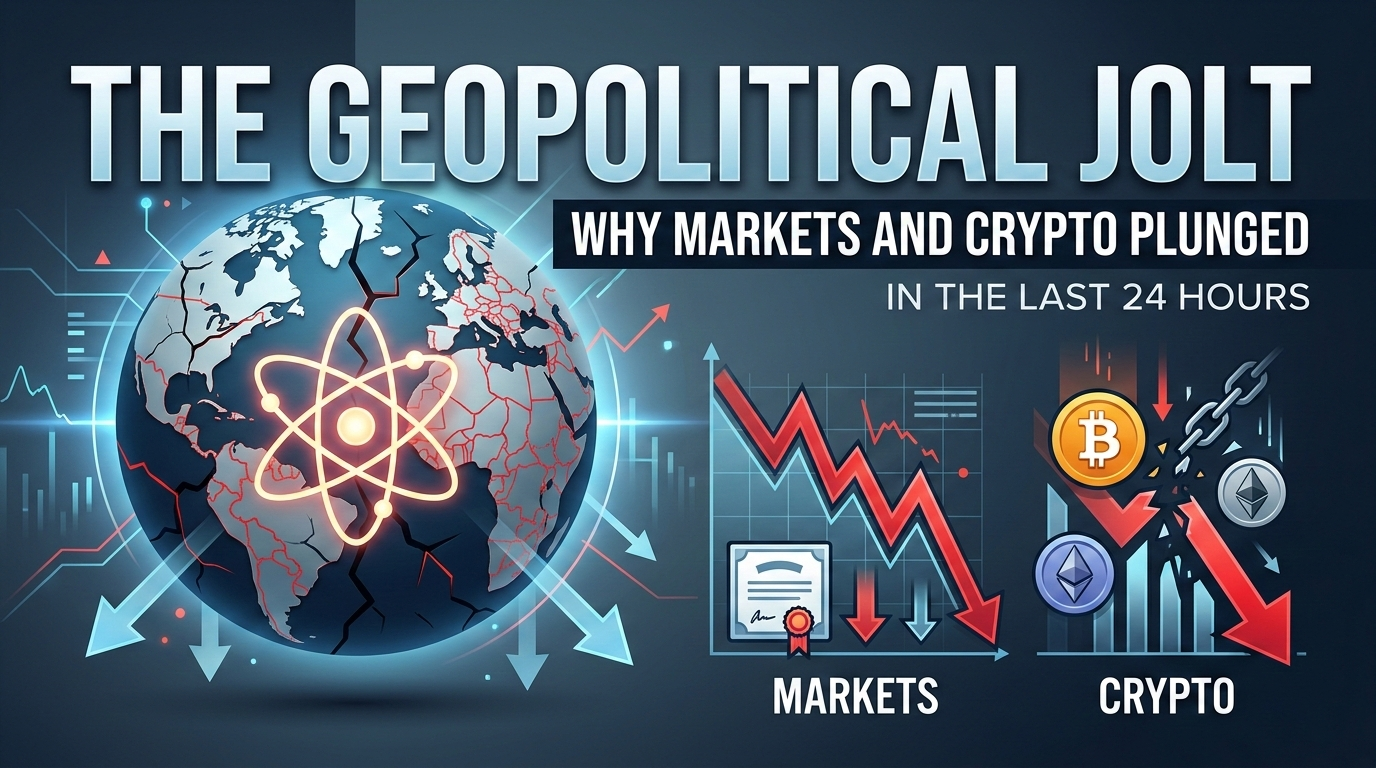
By the time the first cup of coffee was poured in New York, the damage was already etched into the charts. Bitcoin had slid 6.4%, struggling to find its footing after a chaotic overnight session. XRP, often the bellwether for institutional cross-border sentiment, took an even harder hit, plummeting 9.4% as the physical infrastructure it aims to digitize faced its greatest challenge in years.
This is the “Black Swan” event of our current era. It is a violent, unscripted reminder that even in a world governed by autonomous AI agents, decentralized ledgers, and virtual reality, physical geography still dictates the value of your wallet. When airspaces close and the “Kinetic World” grinds to a halt, the “Digital World” doesn’t just float away—it sinks under the weight of the friction.
1. Operation Epic Fury: The Kinetic Friction
To understand the market bloodbath, we have to look at the sky. Overnight, the escalation of regional tensions reached a breaking point. Operation Epic Fury—the code name for the sweeping defensive and offensive maneuvers currently dominating the headlines—has led to the total closure of major air corridors across the Middle East.
In a globalized economy, “Airspace Closed” is a phrase that translates directly into “Margin Call.”
- Supply Chain Paralysis: This isn’t just about passenger flights. These corridors are the arteries for high-value cargo—specifically the semiconductor components and server hardware that fuel the global AI boom.
- The Energy Premium: With the Straits and the skies effectively “locked,” the market is pricing in an immediate and sustained spike in energy costs. For Bitcoin miners, who operate on razor-thin margins between electricity costs and block rewards, this is a double-edged sword that leaned toward the “sell” side today.
When physical cargo cannot move, the “velocity of money” slows down. Investors, sensing a long-term disruption, did what they always do in a crisis: they scrambled for the most liquid “exit door” available. In the current market, that meant dumping highly liquid crypto assets to cover positions in more traditional, slower-moving sectors.
2. The Crypto Paradox: Why “Digital Gold” Bleeds
The most frequent question on social media this morning is: “If Bitcoin is digital gold, why is it falling during a war?”
It’s a fair question, and the answer is a bit of “tough love” for the purists. In a moment of extreme geopolitical jolt, the market doesn’t look for a “store of value” three years from now; it looks for “Collateral” right now.

- De-Risking: Most of the massive gains we’ve seen recently were built on “leverage”—money borrowed against existing assets. When a shock like Operation Epic Fury happens, volatility spikes. Exchanges automatically close out leveraged positions to protect themselves, leading to a “cascading liquidation.”
- The XRP Factor: XRP’s 9.4% drop is particularly telling. As an asset designed to facilitate the instant settlement of international payments, its utility is highest when the world is open for business. When airspaces close and trade agreements are “frozen” by emergency decrees, the immediate demand for cross-border settlement drops.
- Flight to Stables: We aren’t seeing people exit the ecosystem entirely. We are seeing a massive rotation into “hard” stablecoins. People are parked in digital dollars, waiting to see if Operation Epic Fury is a forty-eight-hour headline or a six-month campaign.
3. The New Lexicon: Defining “Inference Hedging”
As the dust settles from the initial plunge, savvy institutional players are already moving into a new defensive posture. This week has introduced a concept that will likely define the remainder of the decade: Inference Hedging.
Historically, investors hedged against inflation (by buying gold) or against currency collapse (by buying Bitcoin). But we now live in a world where the primary “commodity” isn’t oil or gold—it is Compute.
Inference Hedging: The strategic practice of securing “Compute Reserves” or “Inference Credits” in geographically stable zones to protect against the loss of AI functionality during regional conflicts.
In the current era, an AI model is only as good as the electricity and fiber-optic cables that feed it. If a conflict destroys a data center hub or severs a sub-sea cable, the “Inference” (the AI’s ability to think and provide answers) is disrupted. Savvy investors are now treating Compute Power as a tangible asset that must be hedged.
4. The “Black Swan” of Physical Geography
For years, the “Techno-Optimist” narrative was that we had moved past geography. We were told that the cloud was everywhere, that Bitcoin was “borderless,” and that AI was an omnipresent force.
Operation Epic Fury has proven that the “Cloud” still has a physical address.
- The Sub-Sea Cable Reality: The vast majority of the “borderless” internet travels through a few highly congested underwater cables. Regional conflicts often involve “Gray Zone” warfare—the intentional or “accidental” severing of these lines.
- The Cooling Problem: Large-scale AI training and inference require massive amounts of water and electricity. Conflict zones inevitably face utility rationing.
If you are an investor who thought your portfolio was “digitally insulated,” this morning’s 6.4% drop in BTC was a cold shower. Your digital assets are still tethered to the ground by copper wires and jet fuel.
5. Supply Chain Echoes: Beyond the Chart
The plunge we are seeing isn’t just a “trading event.” It is a pre-emptive strike on the next quarter’s earnings.
When airspace closes, the “Just-in-Time” delivery model for precision electronics fails. We are looking at a potential three-to-six-week delay in the arrival of the next generation of GPUs and specialized hardware. This creates a “scarcity premium” for those who already have the hardware, but a “productivity tax” for everyone else.
This is where the Inference Hedging becomes actionable. Companies that pre-purchased compute credits in the Nordics or the American Midwest are currently outperforming those who relied on “Global Spot Pricing” for their AI needs. Geography, once again, is the ultimate arbiter of success.
6. Strategy: How to Navigate the Jolt
If you are looking at your screen today and seeing red, the worst thing you can do is panic-sell into a low-liquidity “Black Swan” event. Here is how the “Pro” desks are handling the next 48 hours:
- Monitor the “Inference Spread”: Watch the cost of compute in different regions. If you see the price of AI-processing in safe zones skyrocketing, it means the market expects a long-term disruption of global infrastructure.
- Stablecoin Triage: Ensure your “cash” is in stablecoins with the highest level of transparency. In a physical conflict, “unbacked” or “algorithmic” assets are the first to lose their peg.
- Physical/Digital Rebalancing: We are moving toward a “Barbell Strategy.” This means holding high-growth digital assets (like Bitcoin/XRP) on one end, and physical commodities (Energy/Hardware) on the other. The “middle” (unproductive tech stocks or speculative tokens) is the danger zone.
Conclusion: The Humbling of the Digital Age
Operation Epic Fury is a humbling event. It reminds us that for all our progress in the “Inference Era,” we are still inhabitants of a physical planet. A fighter jet in the sky still has more immediate impact on a market than a thousand AI agents in the cloud.
The 6.4% drop in Bitcoin and the 9.4% slide in XRP are not “deaths” of the technology; they are “tests” of its resilience. We are learning, in real-time, how a decentralized world reacts to a centralized conflict.
The markets will eventually find their floor. The airspaces will eventually reopen. But the lesson of the “Compute Disruption” will remain. In the new economy, being “Global” isn’t enough. You have to be “Geographically Redundant.”
I’d love to hear from you: Does this morning’s “Black Swan” make you question the “Digital Gold” narrative for Bitcoin, or do you see this as a necessary stress test for the next era of finance?