
Table of Contents
I remember the first time I looked through a microscope in a dusty university lab. I saw a purple smudge on a slide and my professor told me, “That is a liver cell.” Back then, we treated the human body like a simple machine. If the filter was clogged, you cleaned it. If the pump was weak, you reinforced it. But as I stood before the glowing screens displaying the Global Cellular Atlas recently, I realized that everything I thought I knew about my own biology was wrong.
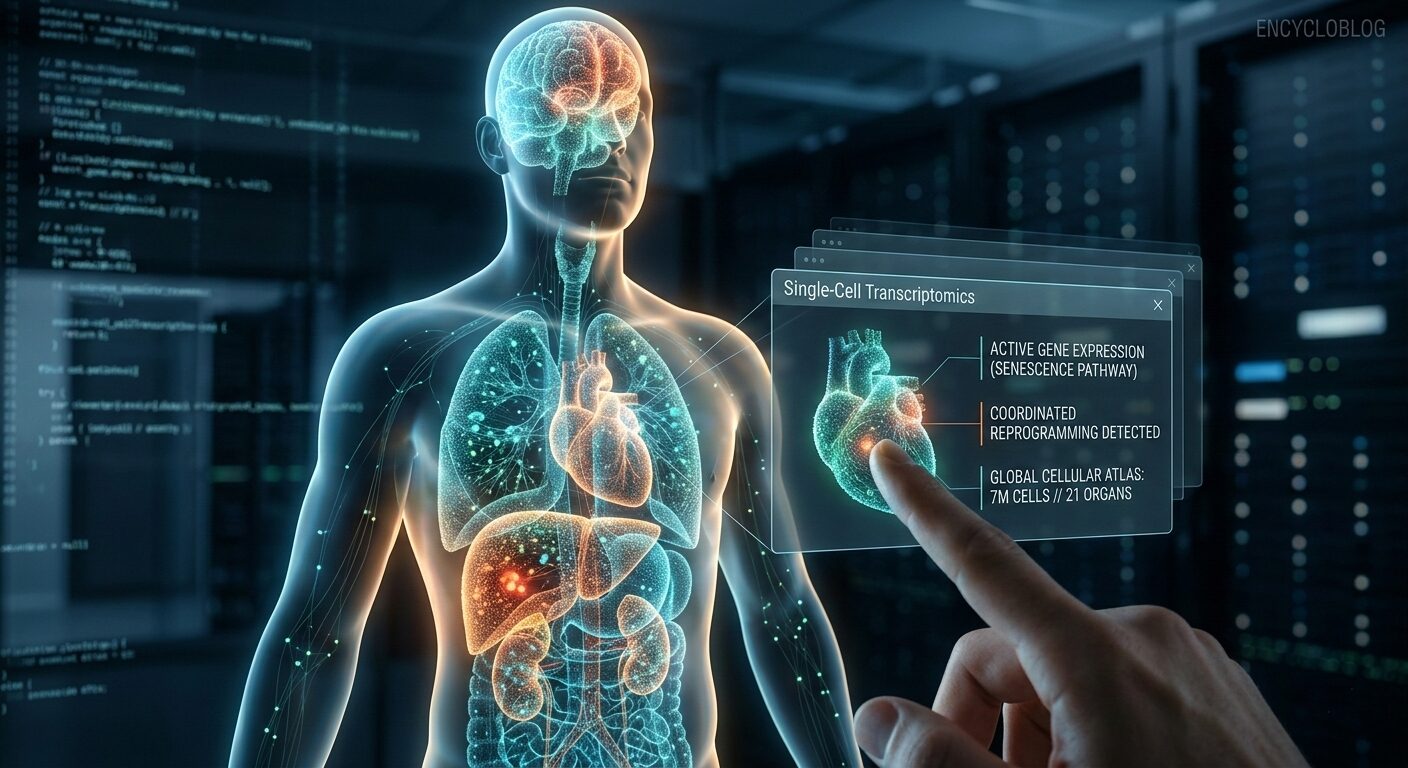
The Global Cellular Atlas is not just a map. It is a Google Earth for the human soul. I spent hours scrolling through the data, watching as seven million individual cells across twenty-one different organs were laid bare. For the first time in my life, I wasn’t looking at “the liver” or “the heart.” I was looking at the vibrant, bustling neighborhoods of a microscopic civilization. I was seeing the “Experience” of being alive written in the very code of our existence.
This discovery marks the end of an era. We are moving away from the “one-size-fits-all” medicine that has dominated our lives for a century. We are entering the age of Precision Gerontology. As I dove deeper into the atlas, I realized that the most terrifying and beautiful secret of our bodies had finally been revealed: aging isn’t a slow fade. It is a coordinated, intentional reprogramming. And for the first time, I could see exactly where it starts.
The Shift from Organs to Neighborhoods
For a long time, I viewed my body as a collection of solid parts. If I felt a pain in my chest, I worried about my heart. If I felt a dull ache in my side, I thought about my kidneys. But the Global Cellular Atlas has taught me that these organs are not monolithic blocks of tissue. They are complex ecosystems.
Imagine you are looking at a city from a satellite. You see buildings, roads, and parks. That is how we used to see organs. But when you zoom in—all the way down to the street level—you see the coffee shops, the hardware stores, and the families living in apartments. You see the “neighborhoods.”
In the atlas, I saw that a single organ, like the lung, is actually made up of dozens of these neighborhoods. Some cells are the “architects,” maintaining the structural integrity of the tissue. Others are the “policemen,” scanning for invaders. Most importantly, I saw that these cells talk to each other. They send chemical signals back and forth like neighbors whispering over a fence.
When we get sick, it isn’t the whole organ that “breaks.” It is usually a specific neighborhood that starts to fail. The Global Cellular Atlas allows us to find the exact “street corner” where the trouble began. This is the foundation of the new medical revolution. By understanding the social life of our cells, we can treat diseases before they ever have a chance to spread to the rest of the “city.”
The Secret Code of Aging: It Is Not a Fade
I used to think of aging like a candle burning down. Eventually, the wax runs out and the light goes out. It felt inevitable and, frankly, quite depressing. However, as I navigated the data within the Global Cellular Atlas, a different story emerged.
Aging is not a slow, random decline. It is a coordinated “reprogramming.” I saw evidence that our cells actually have a schedule. At certain points in our lives, specific clusters of cells in our organs receive a signal to change. They stop being “builders” and start becoming “senescent”—cells that no longer divide but stick around, creating inflammation in their neighborhood.
What shocked me most was that this reprogramming starts much earlier than we thought. It doesn’t happen all at once when we turn sixty or seventy. I saw organ clusters in the kidneys and the gut that began their “aging shift” while the rest of the body still felt young and vibrant.
This is where Precision Gerontology comes in. If aging is a program, that means we can learn to read the code. And if we can read the code, we might be able to edit it. By using the Global Cellular Atlas, we can identify which neighborhoods are aging too fast and intervene before the rest of the organ catches up. It turns the “inevitable” into something manageable.
The Encyclopedia Entry: Single-Cell Transcriptomics
To understand how I was able to see these details, we have to talk about the “lens” used to build the map. This is where the science gets truly mind-bending.
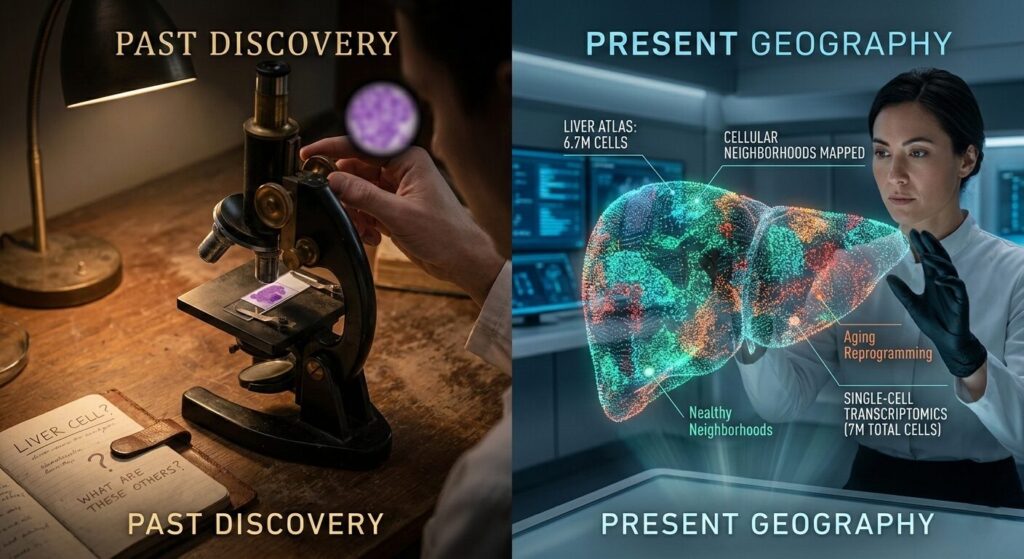
Single-Cell Transcriptomics: This is a technology that allows us to look at a single cell and see exactly which genes are “turned on” at that exact moment.
The AI Reader: Every cell in your body has the same DNA, but a heart cell acts differently than a brain cell because it “expresses” different genes. Imagine your DNA is a massive library of 20,000 books. In a heart cell, the “contracting” books are open on the desk. In a brain cell, the “thinking” books are open. Single-Cell Transcriptomics uses Artificial Intelligence to “read” every open book in every single cell across the Global Cellular Atlas.
Precision Gerontology: The End of One-Size-Fits-All
I’ve spent most of my life taking medicine the same way everyone else does. If I have a headache, I take the same pill as my neighbor. But my Global Cellular Atlas is not the same as yours. My cellular neighborhoods have different histories, different stresses, and different aging schedules.
Precision Gerontology is the practice of treating the person, not the population. Because we now have the atlas, a doctor won’t just look at my blood pressure. They will look at the “Inference” of my cellular health. They will see that my heart neighborhoods are thriving, but my liver neighborhoods are showing early signs of that “aging reprogramming.”
This means we can move away from reactive medicine—waiting for something to break—and move toward proactive “tuning.” We can provide the specific nutrients, lifestyle changes, or therapies that my specific neighborhoods need to stay in their “rubber” state rather than their “glassy” state.
I feel a profound sense of relief knowing that the “Diagnostic Odyssey” for many chronic diseases is about to end. We no longer have to guess. We have the map. We have the coordinates. We just have to follow them.
Navigating the 21 Organs: A Tour of Life
As I traveled through the twenty-one organs mapped in the atlas, some things truly stood out.
- The Gut: I saw that the “neighborhoods” here are the most diverse in the entire body. They are constantly negotiating with trillions of bacteria. The atlas shows how this communication is the “master switch” for our immune system.
- The Heart: I noticed that heart cells are incredibly loyal. They don’t change neighborhoods often, which is why damage to the heart is so difficult to repair. But the atlas revealed “dormant” neighborhoods that we might be able to wake up for healing.
- The Brain: This was the most complex part of the Global Cellular Atlas. The neighborhoods here are densely packed and the “conversations” between them are lightning-fast. Seeing the early “reprogramming” signs of neurodegeneration here was a sobering reminder of why this work is so vital.
Every organ tells a different story of survival and adaptation. But the common thread is the same: the more we zoom in, the more we see that we are not a single being. We are a collection of seven million tiny lives, all working together to keep us in the game.
The Future of the Human Map
I often wonder what the researchers who first mapped the human genome twenty years ago would think of the Global Cellular Atlas. We went from knowing the “alphabet” of our DNA to seeing the “poetry” of our cells in action.
The next step is to make this map dynamic. Right now, it’s like a high-resolution photograph. In the future, it will be a live-stream. We will be able to watch our neighborhoods react to a meal, a workout, or a stressful day in real-time. We will see the immediate impact of our choices on the “reprogramming” of our aging.
For me, the atlas has turned my body from a mystery into a mission. I no longer feel like a passenger in a machine I don’t understand. I feel like a mayor of a beautiful, complex city. I have the data. I have the map. And I have the chance to ensure that every neighborhood in my body thrives for as long as possible.
This is the promise of the Global Cellular Atlas. It is the end of the “slow fade” and the beginning of a life lived with precision, purpose, and profound understanding.