Table of Contents
Society has spent my entire life trying to force me into a box. From the moment I entered school, the question was always, “What do you want to be when you grow up?” It was assumed that the only way to be successful was to choose a lane, commit to it with singular focus, and sprint toward the finish line. We are taught that specialization is the path to stability and that “keeping your options open” is just a polite way of saying you are indecisive or afraid of commitment.
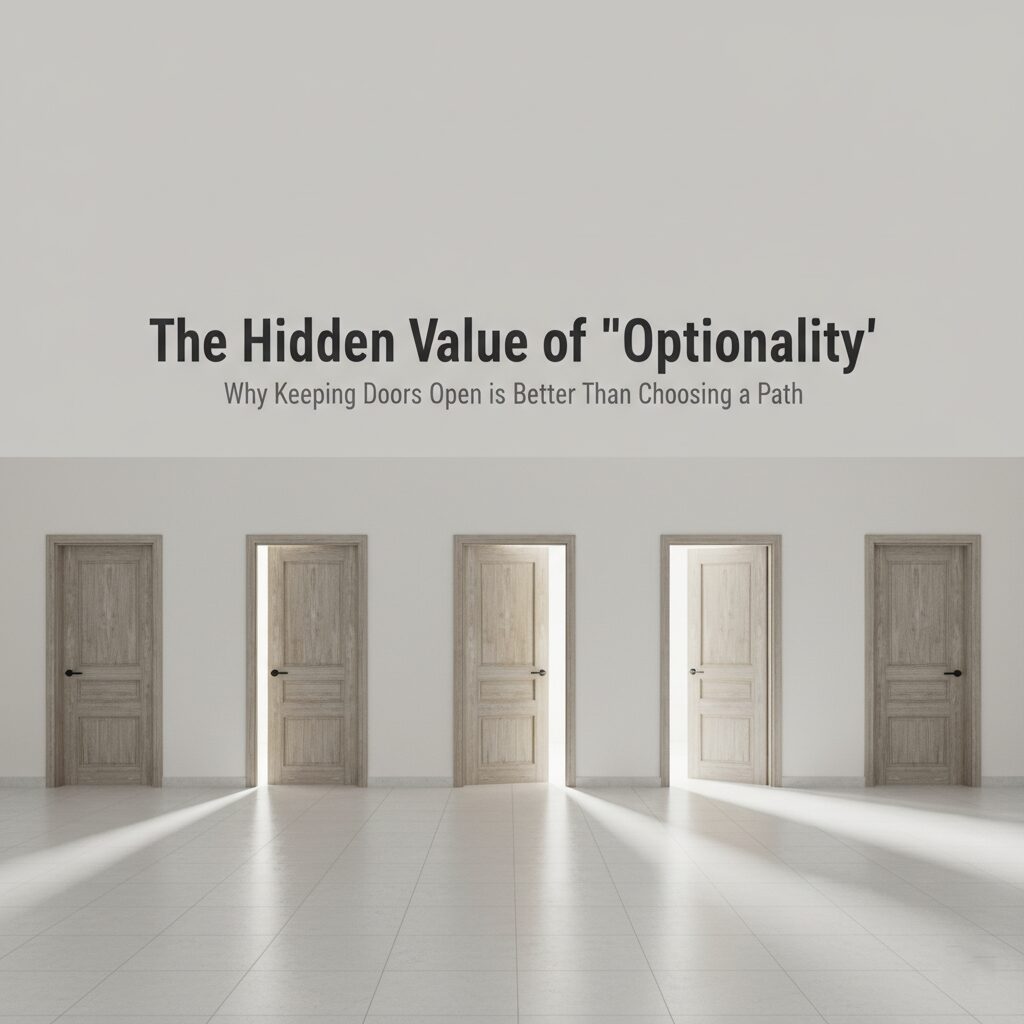
But after years of watching friends burn out in careers they chose at twenty-two and seeing the rapid pace at which the world changes, I have come to a different conclusion. I believe the most valuable asset you can cultivate in an uncertain world is optionality. It is the strategy of keeping doors open, acquiring diverse skills, and delaying premature specialization. It is not about being flighty or non-committal; it is about building a life that is resilient to change because you are never locked into a single point of failure.
The Myth of the Narrow Path
When you choose a singular path early, you are essentially making a massive bet on a future you cannot fully predict. You are betting that the economy will continue to reward that specific skill, that your own interests will never shift, and that technology will not render your specialization obsolete.
I remember my own early attempts to “pick a lane.” I focused entirely on a specific corporate function, believing that deep, narrow expertise was the only currency that mattered. When the industry shifted—as it always does—I found myself with plenty of depth but very little leverage. I had become a master of a dying craft. That was the moment I realized the “pick a lane” advice was fundamentally flawed. It prioritized efficiency for the status quo over long-term survivability.
Defining Optionality: The Power of “Not Yet”
Optionality is the ability to choose from a variety of paths when the moment is right, rather than being forced into a path before you have all the information. It is the conscious decision to value flexibility over immediate, rigid structure.
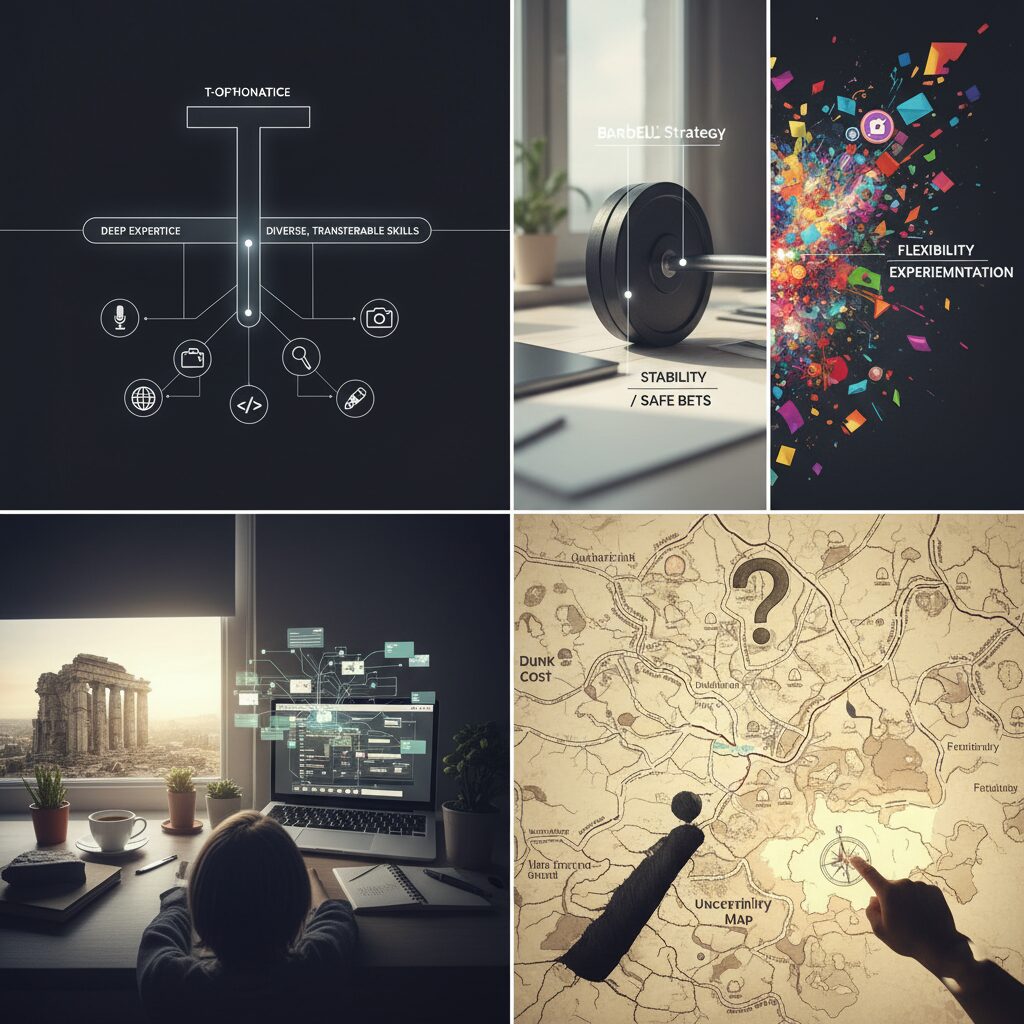
In my own life, I started applying this by treating my career like a portfolio. Instead of just deep-diving into one niche, I began cultivating a “T-shaped” skill set. I kept one area where I was highly skilled, but I spent my “free” time—the time others spent on pure specialization—acquiring secondary skills that were completely unrelated. I learned design while working in finance; I learned coding while working in management.
By keeping these doors cracked open, I wasn’t just hedging my bets; I was creating a unique intersection of skills that made me more valuable precisely because I wasn’t just “the guy who does X.” I was the person who could connect X, Y, and Z.
Why Flexibility beats Specialization in the Long Run
The world is not linear. It is complex, emergent, and volatile. When you specialize too early, you become rigid. Rigid things break under pressure. Flexible things adapt.
Optionality allows you to capture “convex upside”—a term coined by thinkers like Nassim Taleb. It means that your potential for gain is much higher than your potential for loss because you have maintained the ability to pivot. If a new opportunity arises, you have the skills to move toward it. If your current industry collapses, you have an alternative route already scouted.
This isn’t about being a “jack of all trades, master of none.” It is about being a master of how to learn and maintaining enough breadth to jump between domains. You are building a “barbell” life: safe in some areas, but highly flexible and ready to experiment in others.
The Psychological Burden of “The Lane”
Beyond the economic advantages, there is a massive psychological benefit to optionality. The pressure to “commit” is a major driver of anxiety. We feel as though we must decide our entire future before we even know who we are.
I’ve found that by explicitly rejecting the need to “pick a lane,” I’ve lowered my baseline stress levels significantly. When I know that my choices are not irreversible, I can experiment with much more courage. If I try a new project and it doesn’t work out, I haven’t “ruined my career trajectory.” I have simply collected more data. This shift from commitment to experimentation is the hallmark of a high-optionality mindset.
Building Your Personal Optionality Portfolio
So, how do you actually put this into practice without becoming a professional dilettante? It starts with a few core principles:
- Maintain Your Financial Runway: Optionality is hard to maintain if you are living on the edge of your means. Debt is the enemy of choice. The more margin you have, the more you can say “no” to bad paths and “yes” to interesting, unproven ones.
- Focus on Transferable Skills: Always prioritize skills that work across domains—communication, systems thinking, writing, and analytical reasoning. These are the foundations upon which you can build any specific expertise later.
- Build a “Digital Garden”: I document what I learn publicly. Whether it is a blog, a newsletter, or even just a shared research folder, building a public body of work creates “serendipity hooks.” When people see the variety of your interests, they bring opportunities to you that you couldn’t have planned for.
- Avoid the “Sunk Cost” Trap: If you find yourself staying in a career or a project just because you’ve already invested time into it, you are losing your optionality. Learn to recognize when a door has stopped offering new value, and have the courage to step away.
Embracing Uncertainty as a Strategy
The fear of the unknown is what keeps most people locked in their “lanes.” We crave the certainty of a defined title, a clear ladder, and a predictable future. But that certainty is an illusion.
True success in the 21st century looks more like a wandering path than a straight line. It looks like the ability to reinvent yourself, to connect disparate ideas, and to show up wherever the world needs your unique intersection of skills. By choosing optionality, you are essentially choosing to be an active participant in your own future, rather than a passenger on a track laid down by someone else.
It is time to stop viewing the ability to change your mind as a weakness. It is, in fact, your greatest strength. The world is changing too fast for anyone to be a permanent specialist. Keep your doors open, keep your skills broad, and remember that you are never truly stuck unless you decide that the path you are on is the only one you are allowed to walk.
What is one ‘door’ you have been afraid to close, or one unconventional interest you’ve been hesitant to pursue? How might leaning into that ‘optionality’ actually make your main path stronger?