
Table of Contents
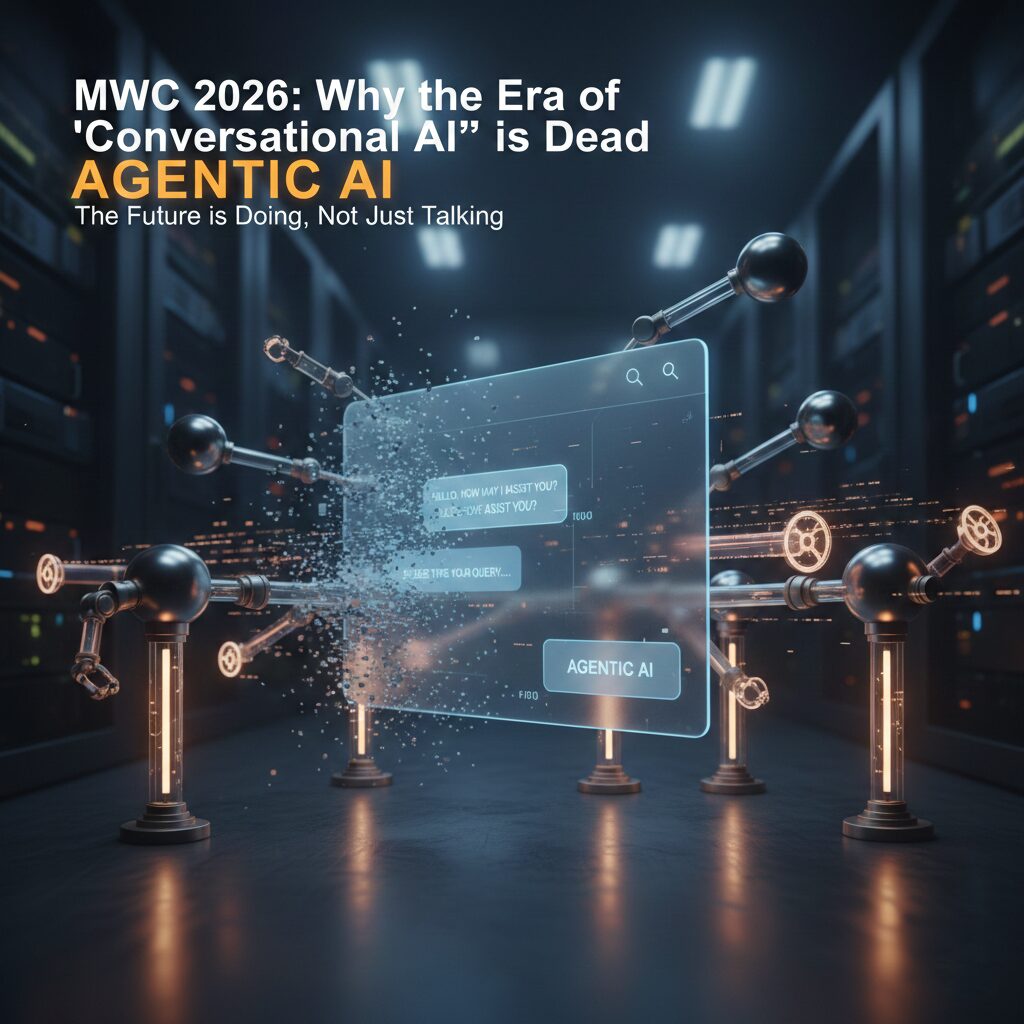
I walked out of the Fira Gran Via in Barcelona yesterday, and the air felt different. If MWC 2025 was the year of the “Chatbot Gold Rush”—where every booth featured a demo of an AI writing poetry or summarizing emails—MWC 2026 was the funeral for that era. The industry has officially pivoted. We are finished with “Conversational AI.” The C-suite executives I spoke with weren’t asking, “How does your model talk?” They were asking, “How does your agent hit my KPI?” We have entered the “Flight to Reality.” Agentic AI
For the past two years, we were seduced by the parlor trick of token prediction. We were amazed that a model could generate a plausible sentence. But business doesn’t run on plausible sentences. Business runs on processes. The hype cycle of the “Chatty LLM” has crashed against the wall of corporate demand, and in its place, we are seeing the rise of Agentic AI.
From ‘Chatting’ to ‘Closing’: The Agentic Shift
The fundamental flaw of the conversational model was that it was passive. You asked, it answered, and then it waited for you to do the actual work. But that is not how a supply chain manager operates. They don’t need an AI to talk about a shipment delay; they need an AI to call the supplier, negotiate a new delivery window, update the inventory database, and notify the warehouse staff—all before the manager has even finished their morning coffee.
This is the promise of the Agentic Application. We are moving from models that optimize for “coherence” to models that optimize for “completion.” At MWC, I saw agents managing outages in real-time. These systems didn’t just alert a human; they autonomously orchestrated the repair ticket, assigned the technician, and verified the fix. The AI wasn’t a companion; it was a colleague.
The Flight to Reality: Why KPIs Are the New North Star
I spent an hour with the head of procurement for a major automotive firm, and they told me, “I don’t need a model that can pass the Bar Exam. I need a model that can find me a 5% margin improvement by auditing our vendor contracts.”
That is the “Flight to Reality.” Enterprise clients are no longer interested in “General Intelligence.” They are interested in KPI-Driven Reasoning. They want systems that understand business logic, constraints, and consequences. If an AI “hallucinates” a poem, it’s a funny anecdote. If an AI “hallucinates” a supply chain logistics update, it’s a multi-million dollar disaster. We are prioritizing robustness, verifiability, and closed-loop execution.
The Encyclopedia Entry: Defining ‘Agentic Application’
To understand why the old guard of LLMs is being replaced, we have to distinguish between prediction and agency.
Agentic Application (n.): A software system powered by AI models capable of autonomously breaking down a high-level goal into a multi-step plan, executing those steps through external tools, and self-correcting based on real-time feedback.
The Reasoning Shift: While Generative AI (LLMs) focuses on predicting the next probable token, Agentic AI focuses on the “Reasoning Path.” It uses a Task-Tree architecture to navigate constraints to hit a specific KPI.
The 2026 Standard: An Agentic Application is judged not by the fluency of its speech, but by its “Completion Rate”—the percentage of processes it can execute from start to finish without human intervention.
Vertical Integration 2.0: AI as the Operating System
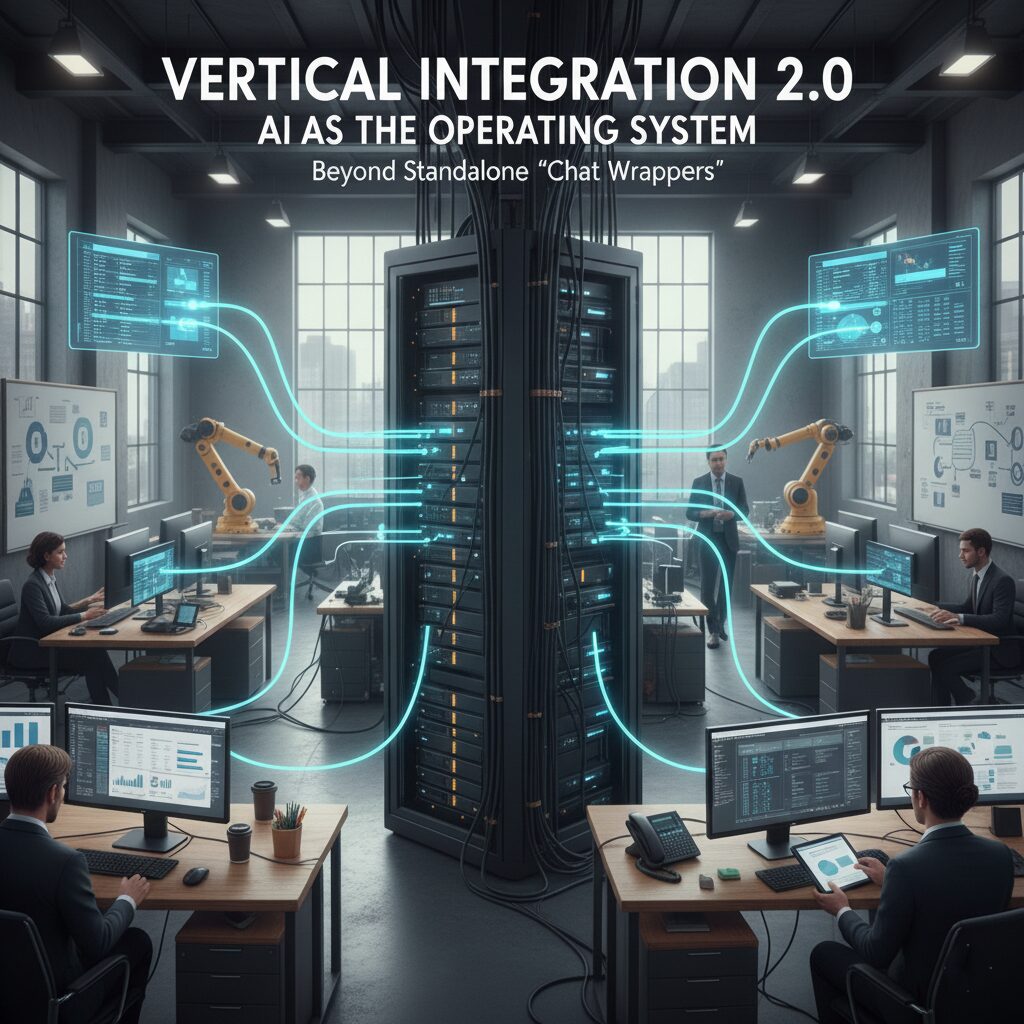
This shift is why Vertical Integration 2.0 is the dominant narrative. We are moving beyond standalone “Chat Wrappers” and integrating reasoning models directly into the Operating System of the Business.
The hardware—from the 45 TOPS compute pucks in our pockets to the massive server clusters running at the edge—is being optimized not for language, but for process orchestration. We are embedding these agents into the ERP (Enterprise Resource Planning) systems and CRM (Customer Relationship Management) platforms. The AI is becoming the “connective tissue” of the organization, moving data between silos that were previously untouchable.
A Peer-to-Peer Reality Check
Let’s be candid: building a true Agentic AI is an order of magnitude harder than building a chatbot. Chatbots are forgiving; they can ramble, and we still call it “intelligent.” Agents are unforgiving. If they fail a step, the entire process breaks.
We are seeing a high “Failure-to-Deploy” rate in the initial waves of these agents, mostly because the underlying business processes were never digitized in a way that AI could interpret. However, the companies that are winning are the ones that are cleaning their data, hardening their APIs, and treating their internal processes like code.
The Final Pulse
The era of “Conversational AI” died so that the era of “Actionable AI” could live. As I look back at the MWC floor, the silence of the booths that were purely “chat-focused” was telling. The noise—and the money—was centered on the companies that were actually doing things.