
Table of Contents
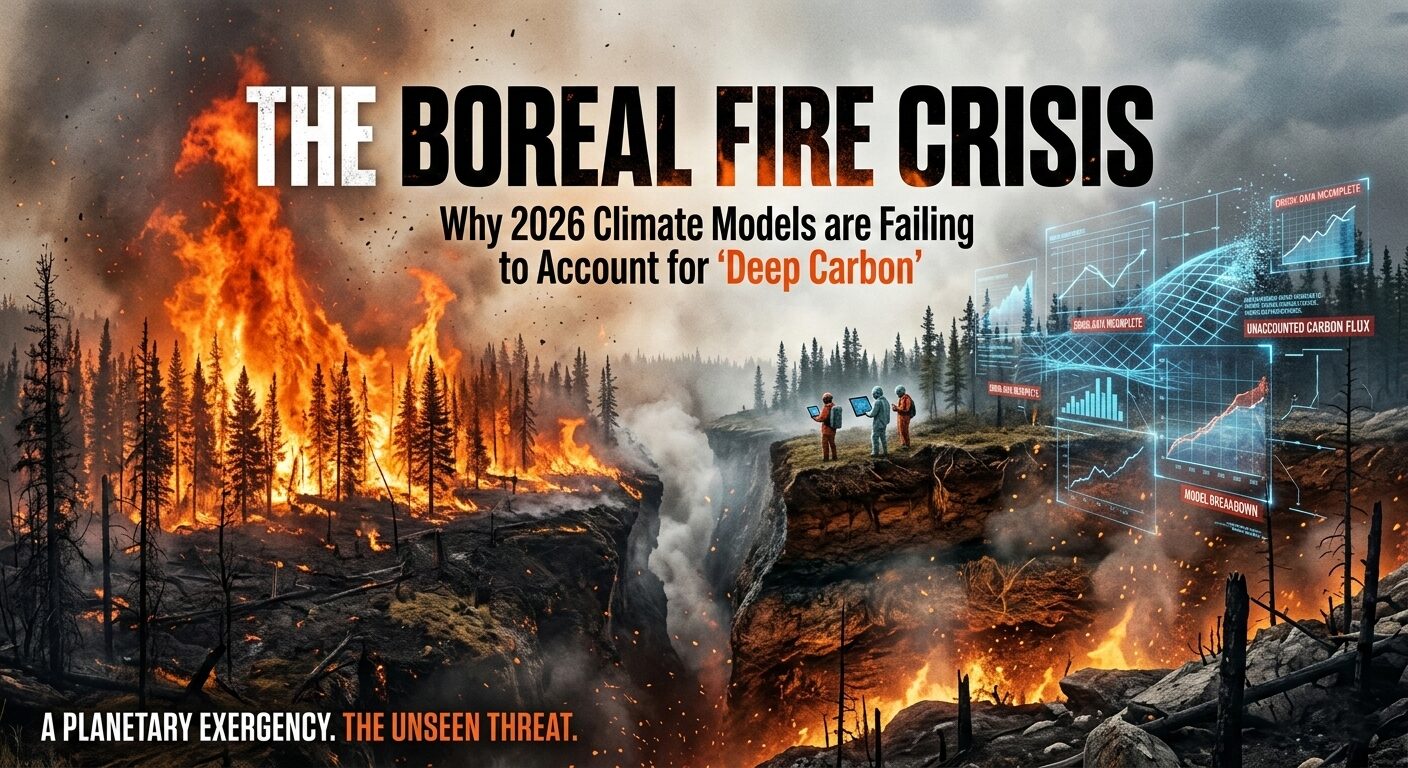
I am standing on the edge of a blackened expanse in the Northwest Territories, and the ground beneath my boots is breathing. It isn’t the heat of the flames—those passed through weeks ago—it’s the smoke rising directly from the earth. In the climatology world, we call these “Zombie Fires,” but the study released on March 4 reveals a far more sinister reality. We aren’t just losing trees; we are losing the ground itself. The boreal forests are burning deeper into the peat soils than at any point in recorded history, releasing Deep Carbon that has been locked away since the end of the last Ice Age.
The problem, as I’ve seen firsthand during this field season, is that our current 2026 climate models are effectively blind to this. We’ve built our forecasts around “surface fuel”—the leaves, the twigs, and the trunks. But the real “Carbon Bomb” is subterranean. As the planet warms, the permafrost that once acted as a frozen lid on these peat bogs is melting. When the fire hits, it doesn’t just pass over; it sinks. It eats into the ancient layers of organic matter, and once that Deep Carbon is released, there is no “Biological Reset” that can put it back.
The Peatland Feedback Loop: A Self-Sustaining Inferno
I remember a conversation with a soil scientist who described peat as “compressed time.” A single meter of peat can represent a thousand years of captured carbon. But today, March 5, that time is being unspooled in a matter of days.
This is the ultimate “Feedback Loop.” The process is terrifyingly efficient:
- Rising temperatures dry out the surface of the peat bogs.
- Wildfires, fueled by the A19 chip level of atmospheric predictability (ironically making us better at watching the disaster), ignite the dry peat.
- The combustion releases Ancient Carbon, which adds more greenhouse gases to the atmosphere.
- The planet warms further, drying more peat, and the cycle repeats.
Our models are failing because they assume a linear recovery. They assume that if we plant new trees, the carbon is “offset.” But you cannot offset the loss of a 5,000-year-old carbon sink with a 5-year-old sapling.
Deep Carbon: The “Missing Link” in 2026 Forecasts
The March 4 study highlights a massive data gap. When we look at “Global Carbon Budgets,” we are usually looking at what’s coming out of tailpipes and smokestacks. We haven’t accounted for the “Subterranean Pulse.”
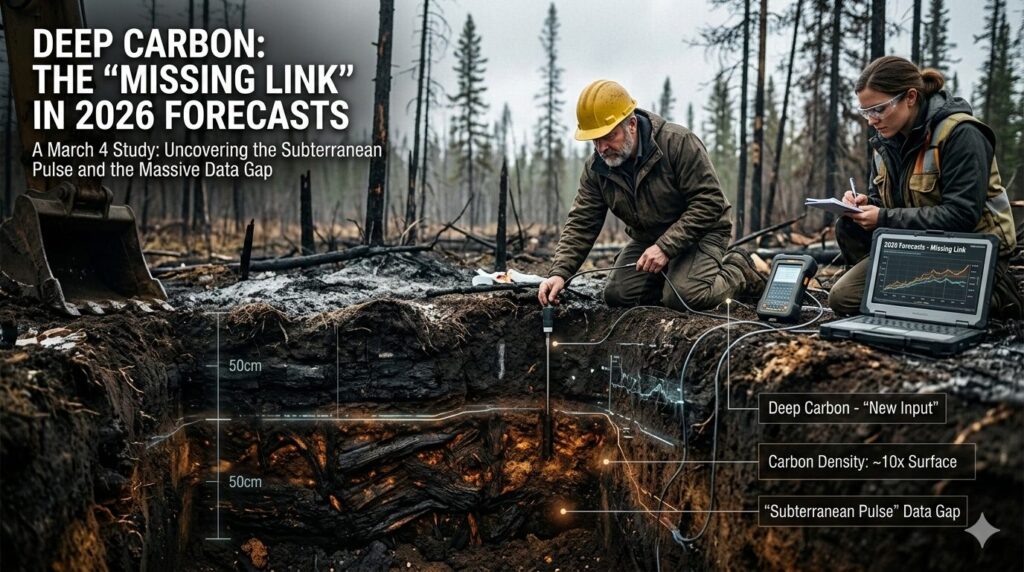
In my field notes, I’ve recorded “burn depths” exceeding 50 centimeters. In these layers, the carbon density is ten times higher than in the trees above. Because this carbon hasn’t been part of the atmospheric cycle for millennia, its release represents a “New Input” that current mitigation strategies simply aren’t prepared for. It’s like discovering a secret bank account that only pays out in debt.
The Encyclopedia Entry: Defining “Peatland Carbon Sequestration”
To understand why this is a “Tipping Point,” we have to understand the efficiency of the bog.
Peatland Carbon Sequestration (n.): The natural process by which wetlands (bogs, fens, moors) capture and store atmospheric carbon dioxide in the form of partially decayed organic matter.
The Efficiency King: Despite covering only 3% of the Earth’s land surface, peatlands store roughly twice as much carbon as all the world’s forests combined. This is due to the anaerobic (oxygen-poor) conditions that prevent complete decay.
The 2026 Tipping Point: When peatlands dry out and burn, they transition from a “Carbon Sink” (storing CO2) to a “Carbon Source” (releasing CO2). Once ignited, these fires can smolder underground for months, bypassing traditional fire-suppression techniques.
Why 2026 Technology is a Double-Edged Sword
We have the tools to see the crisis—the Galaxy S26 Ultra in my pocket can map the thermal signature of these fires with sub-meter precision—but we don’t yet have the tools to stop them.
The integration of Vertical Integration 2.0 into our satellite monitoring has made our “Global Pulse” data incredibly accurate. We can see the smoke plumes; we can measure the CO2 spikes in real-time. But the “Invisible AR” of climate science is that we are watching a catastrophe in high definition while our policy models are still running in standard definition. We are accurately measuring our own arrival at a tipping point.
The “Biological Reset” of the North
We often talk about the “Glowmad” lifestyle or the “Coolcation” surge to Norway and Tasmania. But the “Coolcation” is only possible if the North stays cool. The Boreal Fire Crisis is a direct threat to the very idea of a “Climate Escape.”
If the northern forests continue to burn at this depth, the “Cool” in “Coolcation” will become a relic of the past. I’ve spoken with local communities in the Yukon who describe the “Atmospheric Stress” of the smoke as a permanent fixture of their spring. This is the “Biological Reset” we didn’t ask for—a fundamental change in the chemistry of our atmosphere driven by the smoldering remains of the ancient past.
A Peer-to-Peer Reality Check
Let’s be candid: individual action, while important, cannot solve the Deep Carbon problem. This requires a fundamental shift in how we value “Subterranean Assets.”
We need to treat peat bogs with the same level of protection we give to the Amazon or the Great Barrier Reef. We need to invest in “Sponge City” style infrastructure for the wilderness—wetland restoration that keeps the peat saturated even during heatwaves. If we don’t keep the “Lid” on the carbon, the 45 TOPS of our best AI will spend the rest of the century simply calculating the rate of our decline.
The Final Signal
As the sun sets over the smoldering boreal, the “Global Pulse” feels heavy. The discovery of the March 4 study is a warning shot. The fire isn’t just on the horizon anymore; it’s under our feet.
It’s time to update the models. It’s time to account for the Deep Carbon. Because the earth is breathing, and right now, it’s exhaling the past into our future.