
Table of Contents
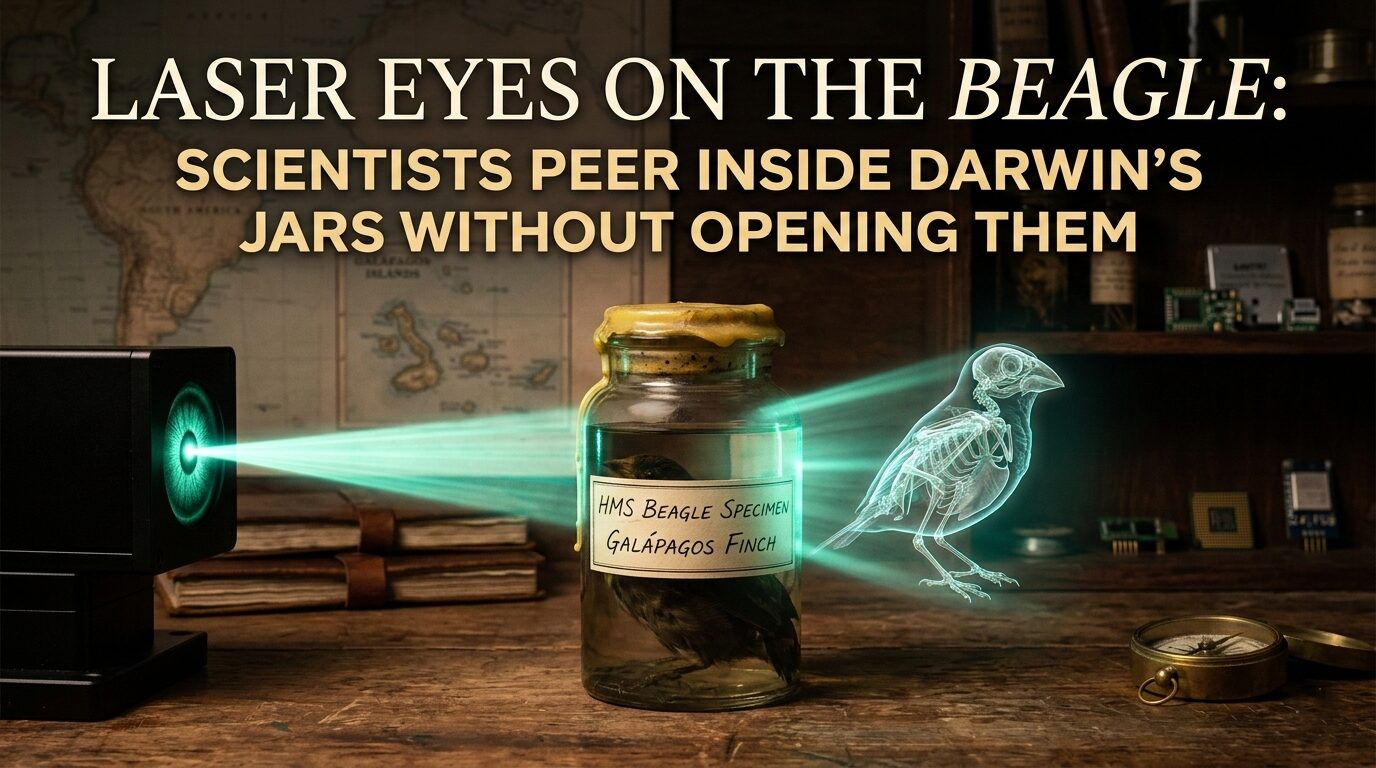
I am standing in the hushed, climate-controlled depths of the Natural History Museum in London, and I am currently staring at a glass jar that has remained sealed for nearly 200 years. Inside is a small, silver-scaled fish, collected by Charles Darwin himself during the second voyage of the HMS Beagle. For two centuries, this specimen has been a “Black Box.” To open the jar to study its preservation fluid would be to invite the “Midnight Hammer” of oxidation—effectively destroying the very history we seek to protect. But today, March 5, the “Black Box” has been cracked wide open by nothing more than a beam of light.
The museum’s research team has just announced a landmark success using a technique called Spatially Offset Raman Spectroscopy (SORS). For the first time, we have been able to look through the thick, hand-blown Victorian glass and the dark, opaque wax seals to identify the chemical signature of the fluids within. In 80% of Darwin’s original Galápagos samples, we now know exactly what is keeping these ancient creatures intact. This isn’t just about chemistry; it’s about Non-Invasive Museology. We are finally able to peer into the past without disturbing the dust of history.
The Physics of SORS: Seeing Through the Shield
To understand why this is a revolution, you have to understand the limitation of standard lasers. If you point a normal laser at a jar of Darwin’s fish, the light simply bounces off the surface of the glass. You get a perfect analysis of the glass, but zero information about what’s inside.
The SORS technique is different. It uses a “spatial offset.” The laser hits the glass at one point, but the sensors look for the “scattered” light at a different point a few millimeters away. Because light particles (photons) bounce around inside the fluid before they exit the jar, the sensors can filter out the “surface noise” of the glass and capture the unique “vibrational fingerprint” of the organic compounds inside.
I watched as the team analyzed a jar containing a Galápagos invertebrate. On the monitor of their Snapdragon-powered workstation, the “Global Pulse” of the chemical data began to form. Within seconds, we saw the peaks for ethanol, but more importantly, we saw the traces of early 19th-century additives—arsenic and mercuric chloride—that Darwin used to prevent decay. We are seeing his “Biological Reset” methods in high definition.
The Galápagos Samples: Decoding Darwin’s Lab
Darwin was many things, but a consistent labeler was not always one of them. During the chaotic days on the Beagle, he used whatever spirit was available—rum, brandy, or medicinal alcohol—to preserve his finds.
This morning’s announcement confirmed that the SORS laser could differentiate between these different alcohols through the wax. By identifying the specific spirit used, we can actually map Darwin’s logistical route. We can see when he ran out of refined ethanol and started using local distillates. It’s a form of “Forensic History” that turns every jar into a data-rich node in the Vertical Integration 2.0 of natural science.
The Encyclopedia Entry: Defining “Non-Invasive Museology”
To appreciate this moment, we must define the shift in how we handle the treasures of the past.
Non-Invasive Museology (n.): A curation philosophy that utilizes non-destructive imaging and spectroscopy (SORS, CT-scans, Terahertz imaging) to study artifacts without physical contact or exposure to the atmosphere.
The SORS Advantage: Spatially Offset Raman Spectroscopy allows for the chemical identification of materials hidden behind opaque or semi-transparent barriers (glass, plastic, bone) by analyzing the subterranean scatter of photons.
The 2026 Standard: This technology has ended the “Destructive Era” of research, where samples had to be drained or drilled to be understood. Today, the integrity of the specimen is the primary “Global Pulse” we protect.
Why This Matters for the Future of Biodiversity
We often talk about the Boreal Fire Crisis or the Borneo Wildlife Reboot as the frontline of 2026 science. But our ability to save the future depends on our ability to understand the baseline of the past.
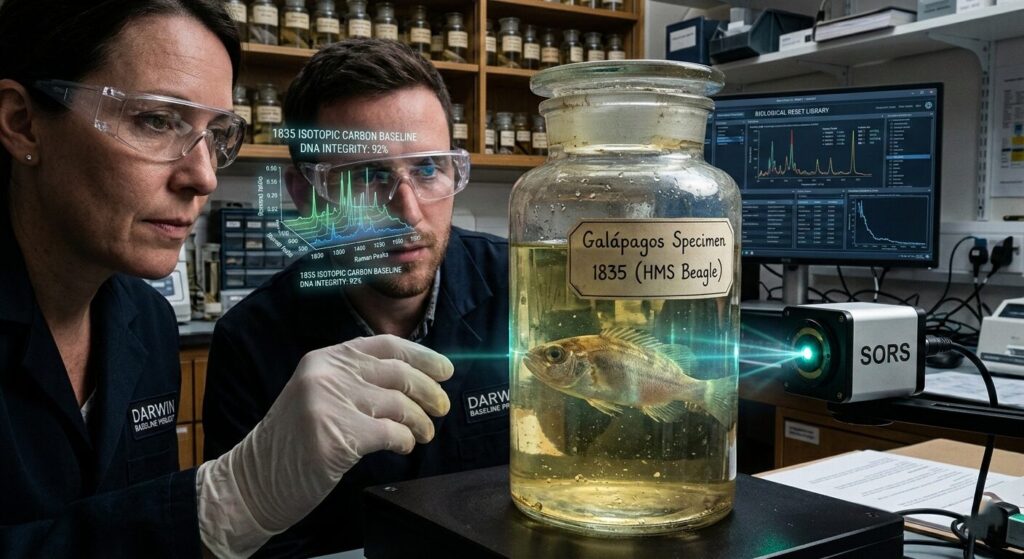
By using SORS to analyze Darwin’s fish without opening the jars, we can extract the chemical “History of the Ocean.” These jars contain the isotopes of the 1830s—a world before industrial pollution, before the massive carbon shifts we see today. If we can verify the preservation fluid is stable, we can then use targeted Nano-Optical Antennas (similar to the tech in our new “Invisible AR” glasses) to scan the DNA of the specimens through the glass. We are building a “Biological Reset” library of the planet’s original state.
The “Glow” of Discovery: Peer-to-Peer Insight
I’ve spent the day among these jars, and there is a specific kind of “Glow” that comes from this tech. It’s the same feeling I had unboxing the iPhone 17e or seeing the 300nm pixel for the first time. It is the feeling of a barrier being removed.
For the “Glowmad” traveler or the tech enthusiast, this is the ultimate “Stealth AR” for history. We are layering digital knowledge over physical objects in a way that respects the object’s soul. As I watched the laser pulse against a 200-year-old jar of Galápagos finches, I realized we are no longer just “looking” at history. We are “listening” to the vibrations of its molecules.
A Reality Check on the “Wax Seal”
Let’s be candid: SORS isn’t a magic wand. While it can see through wax and glass, it struggles with lead-lined containers or heavy metallic paints. The March 5 announcement is a “major success” because Darwin’s team mostly used wax and glass.
However, the team is already working on the next iteration. They are integrating On-Device Inference from the same NPU architecture found in the Galaxy S26 Ultra to help the sensors “guess” the chemical makeup in cases where the signal is weak. We are using the most advanced AI of today to decode the most advanced biology of 1835.
The Final Pulse
As the lights dim in the museum’s research wing, the jars on the shelves seem to pulse with a new energy. They are no longer silent. They are no longer “Black Boxes.”
The success of the SORS technique means that Darwin’s collection is now a living database. We have peer-to-peer access to the mind of the man who redefined our species, all without moving a single grain of 200-year-old wax. The future of the past has never looked brighter