
Table of Contents
For decades, we have been told a singular, unwavering story about the “climate-friendly” landscape. It was a story of dense, emerald forests—billions of trees standing as silent sentinels against a warming world. In this narrative, the cow was the villain: a methane-burping, soil-trampling inhabitant of “marginal lands” that were better off left to rewild into woods.
But this month, as the United Nations officially kicks off the International Year of Rangelands and Pastoralists, that story is being fundamentally rewritten. We are entering a period of global reckoning where we finally acknowledge that for over 50% of the Earth’s surface, the secret to a healthy planet isn’t a forest. It’s a herd.
This is the Pastoralist Manifesto. It is a celebration of the “Cow-Positive” side of climate change and a roadmap for the millions of shepherds, ranchers, and nomads who manage the world’s most critical, yet most ignored, ecosystems.
The Cow-Positive Paradox: Hooves as Healers
To understand why grazing is the secret to saving the soil, we have to look past the individual animal and look at the system.
For millions of years, the world’s great grasslands—the African Savanna, the Great Plains, the Central Asian Steppe—were managed by massive, tightly packed herds of wild herbivores: bison, wildebeest, and elk. These herds didn’t wander aimlessly; they moved constantly to avoid predators.
This movement created a specific biological rhythm:
- Intense Disturbance: Thousands of hooves would chip the hard-baked soil crust, essentially “tilling” the land without a plow.
- Litter Incorporation: The animals would trample standing dead grass (which otherwise chokes out new growth) into the soil, where it could be broken down by microbes.
- Biological Fertilization: They would leave behind a concentrated dose of dung and urine—nature’s most effective liquid gold.
- The Great Rest: Most importantly, the herd would move on, leaving the land untouched for months. This “rest” allowed perennial grasses to grow deep, carbon-storing root systems that can reach ten feet into the earth.
This is Regenerative Grazing. By using domestic livestock to mimic these wild ancestral herds, pastoralists are proving that we can sequester more carbon in the soil of a grassland than we can in the biomass of many forests. Unlike trees, which store carbon in their trunks (vulnerable to wildfires), a grassland stores its carbon deep underground, where it is stable, secure, and permanent.
Rangeland Ecology: The Frontline of Food Security
While the world has focused on protecting rainforests, we have largely ignored the Rangeland. In the encyclopedia of our planet, rangelands are the “un-forests”—the vast expanses of shrublands, savannas, mountains, and wetlands that are too dry, too rocky, or too steep for tractors and plow-based agriculture.
The Encyclopedia Entry: Rangeland Ecolog
Rangelands: Land types characterized by natural or semi-natural vegetation, including grasses, shrubs, and forbs. They cover approximately 54% of the Earth’s land surface and support over two billion people.
The Frontline: Because rangelands cannot be plowed for crops without causing catastrophic desertification, they are the world’s most durable source of food security. Pastoralists convert cellulose (grass)—which humans cannot eat—into high-quality protein (meat and milk) using zero fossil-fuel inputs for “feed production.”
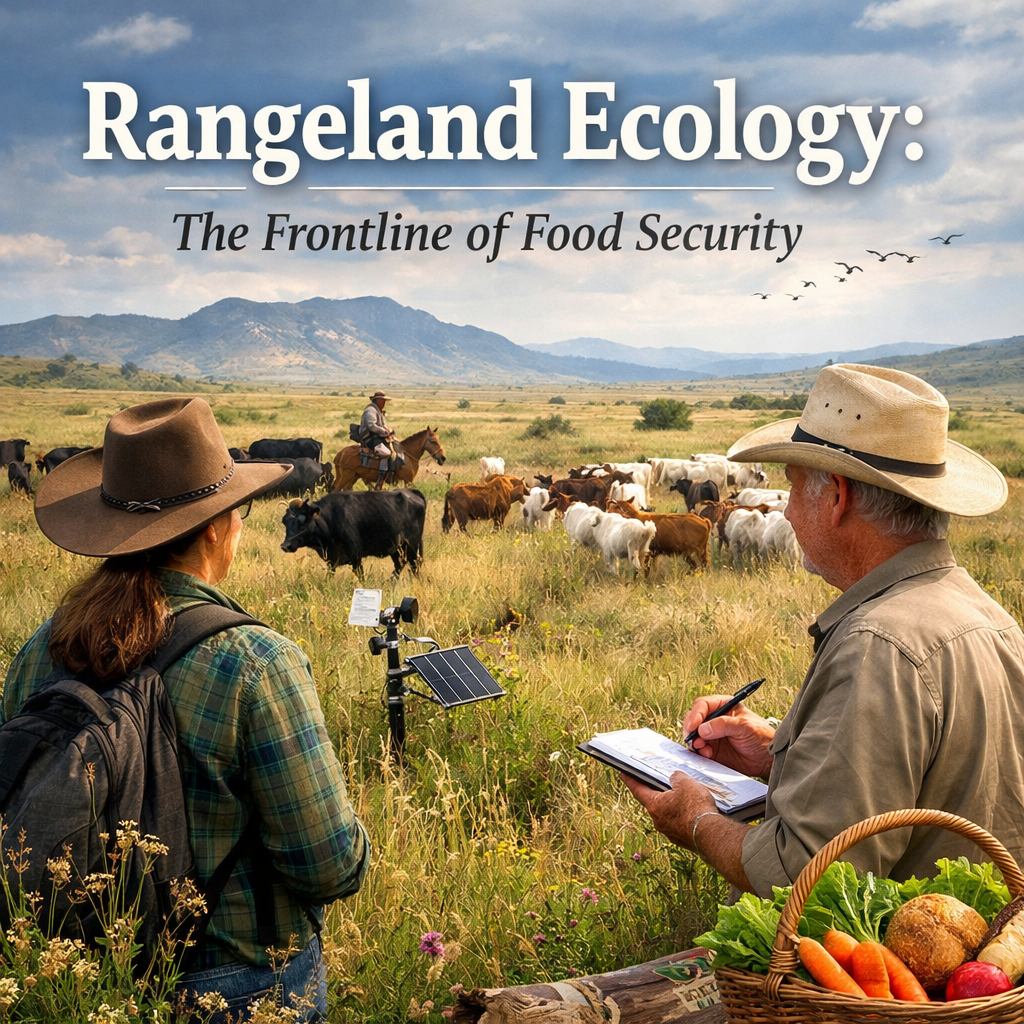
Rangelands are not “wastelands.” They are our most significant carbon sinks and our primary defense against desertification. When we remove the grazers, the grass dies standing up, the soil turns to dust, and the carbon escapes back into the atmosphere.
Why Trees Aren’t Always the Answer
There is a dangerous trend of “Greenwashing” that involves planting trees in natural grasslands. In the climate community, this is often called Afforestation, and in many biomes, it is an ecological disaster.
- Albedo Effect: Grasslands are light-colored and reflect more of the sun’s heat back into space. Dark forests absorb that heat, which can actually increase local warming in certain latitudes.
- Water Theft: In dry rangelands, trees act like massive straws, sucking up limited groundwater and drying out the surrounding plains.
- Fire Risk: A forest in a drought-prone area is a tinderbox. When it burns, all that sequestered carbon is released in a single afternoon. A grazed grassland keeps its carbon “bank” in the soil, safe from the flames.
The Pastoralist as an AI Orchestrator
Wait—what does a shepherd have to do with AI? In this new era, more than you might think. We are seeing a revolution in Digital Pastoralism.
Modern pastoralists are increasingly using satellite data and “Virtual Fencing” to manage their herds with surgical precision.
- NDVI Tracking: Satellite imagery tells the herder exactly which paddocks have the highest nutrient density this morning.
- Virtual Fences: Cows wear collars that use GPS and subtle audio cues to keep them in a specific “cell” of the rangeland. No physical fences are needed, which allows wildlife (like deer and wolves) to move freely across the landscape.
- Carbon Verification: Using soil sensors and AI-driven modeling, ranchers can now prove exactly how much carbon they are sequestering, allowing them to sell “Carbon Credits” to offset the emissions of industrial cities.
The Material Shift: The ‘Soil-to-Skin’ Movement
This isn’t just about food; it’s about the materials we wear. We are seeing a massive shift in the fashion industry toward Soil-to-Skin transparency.
High-end brands are beginning to ditch synthetic, microplastic-leaching fibers and even “vegan leathers” (which are often just plastic) in favor of Regenerative Leather and Wool.
- Climate-Positive Leather: This is hide sourced from animals that were part of a regenerative grazing program. Every pair of boots made from this leather represents a net-reduction of atmospheric CO2.
- Bio-harmonious Fibers: Unlike the plastic-laden “mini-liver” crisis we discussed previously, wool and leather are part of the biological cycle. They don’t turn into microplastics; they turn back into soil.
A Call for ‘Meat Sovereignty’
As we celebrate the International Year of Rangelands, we must also challenge the “One-Size-Fits-All” narrative of the global food system. The push for lab-grown meat and plant-based alternatives makes sense for industrial, grain-fed feedlots. But for the pastoralist, meat is a by-product of land restoration.
When you buy meat from a regenerative rancher, you aren’t just buying protein. You are paying for the “Hoof-Impact” that prevents desertification. Aswell as paying for the “Rest Period” that allows the grass to grow deep. You are paying for the Sovereignty of a local community that manages the land better than any algorithm ever could.
I’d love to hear from you: Does the idea of “Cow-Positive” climate action change the way you think about your diet or your clothes? Or do you still find it hard to see livestock as anything other than a net-negative for the planet?