
Table of Contents
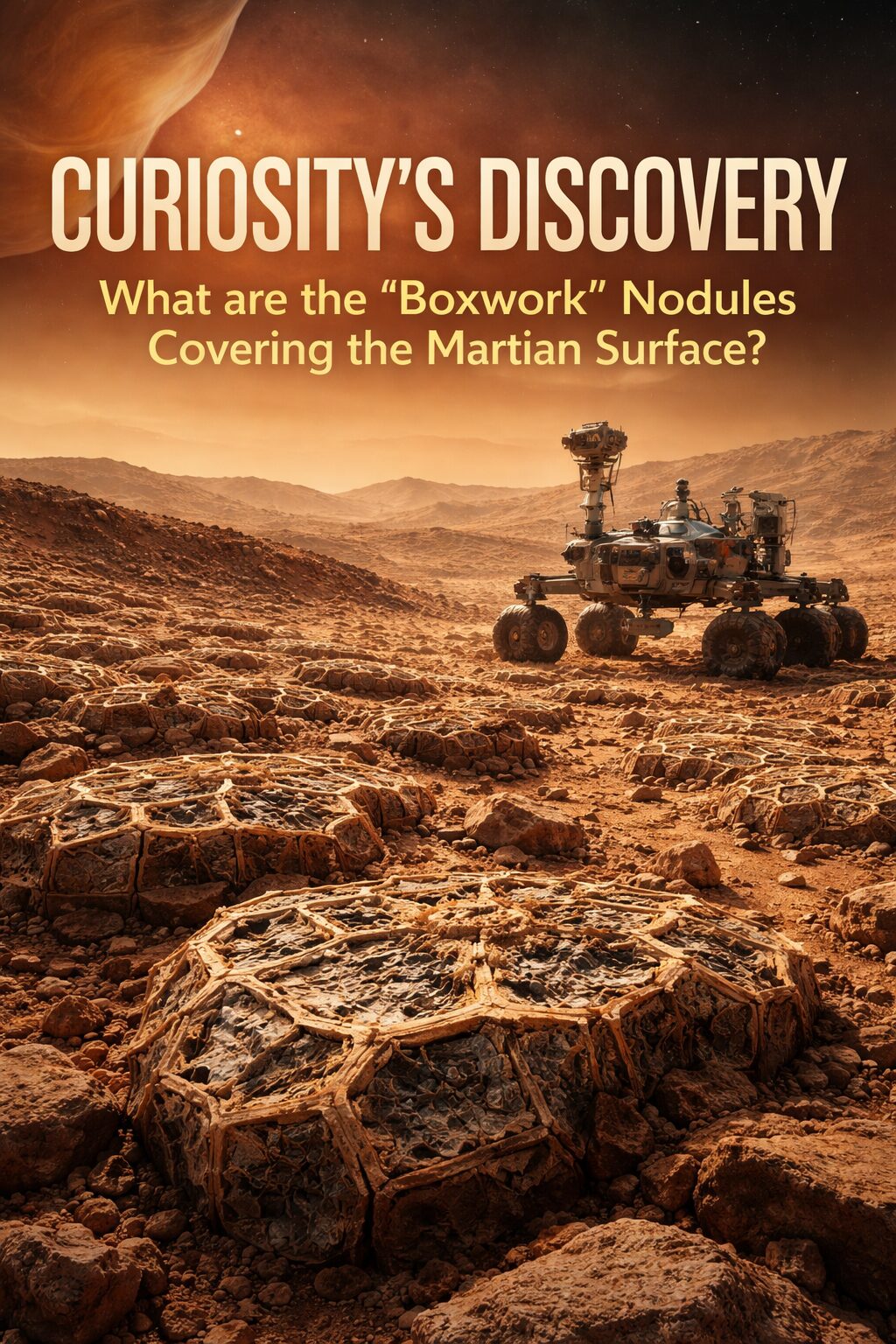
I remember the first time I saw the raw, unedited feed from the Curiosity Rover hitting the NASA servers. I’ve looked at thousands of images of red dust and jagged basalt, but this was different. Sprawled across the floor of the Gale Crater was a network of jagged, interconnected ridges that looked less like geology and more like a fossilized spiderweb. These are the “Boxwork” structures, and as I zoomed in on the high-resolution frames, I saw them: thousands of tiny, bulbous nodules clinging to the ridges like calcified pearls.
The internet, as it often does, went into a frenzy. Within hours, “Martian Spider Eggs” was trending. I’ll be the first to admit that, at a glance, the symmetry is haunting. They look biological. They look purposeful. But as someone who has spent years tracking the “scars” of planetary evolution, I knew the truth was actually far more explosive than a science-fiction trope. These nodules aren’t signs of life; they are the fingerprints of an ancient, aggressive, and watery past that we are only just beginning to map.
The Mystery of the ‘Arachnid’ Nodules
When I first stared at the “boxwork” ridges, I felt a sense of vertigo. In terrestrial geology, boxwork is rare—usually found in the deep, damp recesses of caves like Wind Cave in South Dakota. Seeing it out in the open, under the thin Martian sky, felt wrong. The nodules covering them only added to the eerie aesthetic.
The debunking of the “egg” theory happened quickly in my mind, but the geological mystery remained. Why were these ridges standing tall while the surrounding rock had turned to dust? And what created those tiny, uniform spheres? To answer that, I had to look past the surface and into the hydrothermal history of Mars. These aren’t eggs; they are mineral deposits. But they prove that, once upon a time, the ground beneath Curiosity’s wheels was a pulsing, pressurized plumbing system of liquid water.
The Encyclopedia Entry: The “Boxwork” Formation Process
To understand what Curiosity found, we have to imagine Mars billions of years ago. It wasn’t just a world with lakes; it was a world with a “circulatory system.”
Boxwork Formation: This is a secondary geological structure formed by the “in-filling” of fractures in a host rock.
- The Fracture: Long ago, tectonic stress or thermal cooling cracked the Martian bedrock.
- The Infusion: Mineral-rich water (likely laden with hematite or silica) pulsed through these cracks.
- The Scarring: As the water evaporated or changed chemically, the minerals hardened into “veins” that were much tougher than the surrounding rock.
- The Erosion: Over eons, the softer “host” rock was sandblasted away by Martian winds, leaving only the hard mineral “scars” behind—the standing ridges we now call Boxwork.
The nodules are the final “exclamation point” of this process. They are likely concretions—minerals that precipitated out of the water and grew outward from a central point, much like how a pearl forms around a grain of sand.
Proving the Pulse: Hydrothermal History
What fascinates me most about this discovery is what it says about the intensity of Martian water. This wasn’t a gentle soaking. To form boxwork of this scale, you need high-pressure, hydrothermal activity.
I imagine standing on that spot four billion years ago. Beneath my feet, the crust would have been vibrating. Hot, mineral-heavy water was being forced through every crack and crevice, carving out the path for the ridges we see today. The “Boxwork” isn’t just a pretty pattern; it is a pressure gauge. It tells us that Gale Crater was once a geologically active “hot zone.”
By analyzing the chemical signature of the nodules using Curiosity’s ChemCam, researchers found high concentrations of magnesium and iron. This suggests that the water was “aggressive”—chemically potent enough to dissolve bedrock and re-deposit it as these spiderweb ridges.
Why the “Egg” Theory Persists (and Why It’s Wrong)
I understand why people want them to be eggs. There is a deep, human desire to find company in the cosmos. The nodules are remarkably uniform in size, which in biology usually suggests a single “clutch” or species.
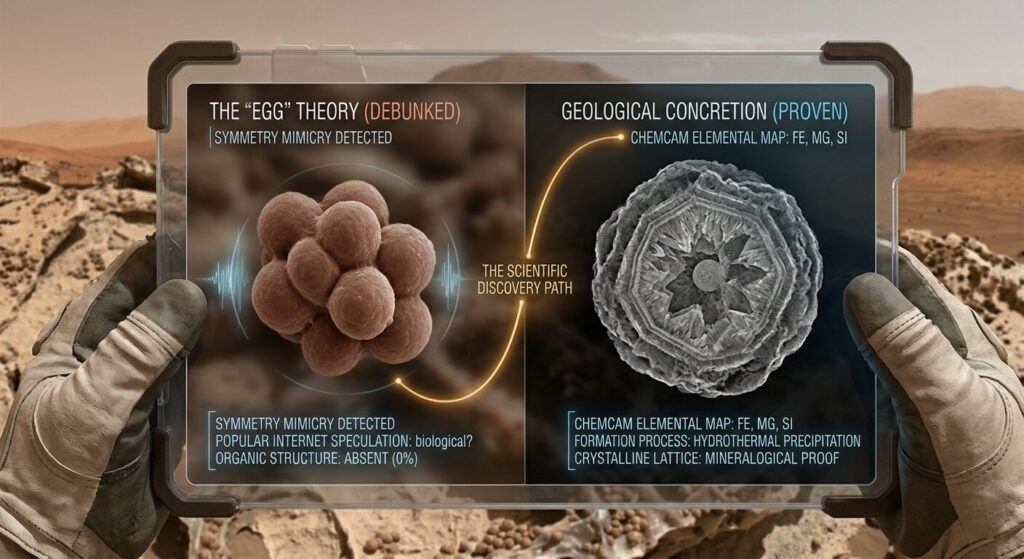
However, nature is a master of mimicry. On Earth, we have “Blueberries” in Utah (Moeraki Boulders) and similar hematite spheres on Mars that form through purely chemical means. The lack of any internal organic structure or “shell” material in the rover’s microscopic imaging confirms that these are stone, through and through. But in my opinion, the reality is cooler: we are looking at the “fossilized plumbing” of a dead world.
The Future of the Gale Crater Map
This discovery has changed how I look at the Martian landscape. We used to think of the surface as a static, dry graveyard. Now, thanks to the Global Cellular Atlas of planetary geology, we see it as a layered history book.
Every ridge of boxwork we find is a coordinate. If we map enough of them, we can recreate the entire underground river system of ancient Mars. We can see where the water was hottest, where it stayed the longest, and—crucially—where it might have been hospitable enough for microbial life to take hold in the darkness of the crust.
I don’t need “arachnid eggs” to be excited about Mars. Seeing those mineral nodules is enough. They are a bridge to a time when the Red Planet was alive with the sound of rushing water. Curiosity didn’t find a nest; it found the evidence of a planet that once had a heart.