
Table of Contents
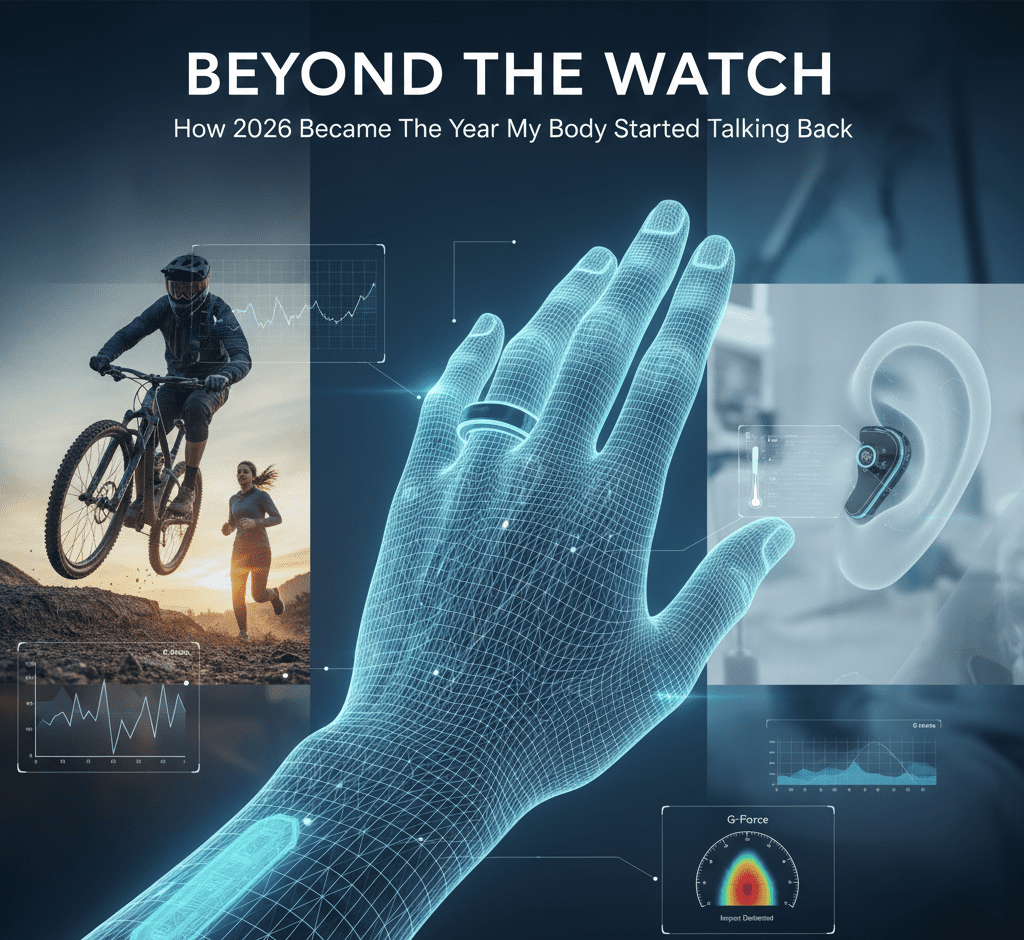
I was 4,000 feet up a rain-slicked trail in the Dolomites last month when I realized the “wearable” era had officially ended. I wasn’t wearing a gadget anymore; I was wearing a digital twin.
I’d taken a corner a little too fast on my mountain bike. The front tire washed out on a patch of loose shale, and for a split second, the world was just grey rock and high-velocity gravity. Before I even felt the sting in my shoulder, my ear—via a tiny bio-sensing “hearable”—chirped a calm, synthesized voice: “Impact detected. G-force threshold exceeded. Heart rate spiking to 165 bpm. Initiating 30-second emergency countdown.”
I wasn’t just checking my pulse. My gear was conducting a triage.
In 2026, the “smartwatch” has evolved into something far more intimate. We’ve moved past counting steps and entered the era of the Bio-Integrated Self. Here is the breakdown of the three “Holy Grail” sensors that changed everything this year.
The Invisible Needle: Non-Invasive Glucose Sensing
For decades, the “Holy Grail” of medical tech was the non-invasive glucose monitor. If you were diabetic or even just “bio-curious,” you had to choose between a finger-prick or a semi-permanent filament stuck in your arm.
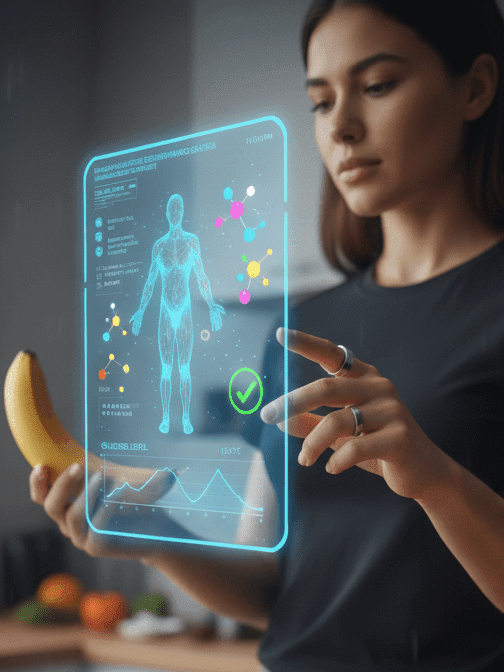
In 2026, that changed. Using Bio-RFID and photothermal detection, the new crop of sensors (led by startups like Know Labs and the latest flagship rings) can now “see” the sugar in your interstitial fluid using radio waves and light—no needles required.
The Lived Experience: The Taco Bell Incident
I’ve been testing a non-invasive patch for three weeks. The most humbling moment? Seeing a real-time “Glucose Spike” notification at 11:30 PM after a “guilt-free” late-night taco run.
- The Sensation: There is no physical feeling to the sensor, but the psychological impact is massive.
- The Insight: Seeing my blood sugar hit 160 mg/dL and watching the subsequent “insulin crash” made me realize why I felt like a zombie the next morning. It turns “dieting” from a guessing game into a high-fidelity data stream.
The Thermal Ghost: Millikelvin Sensitivity
We used to think of “skin temperature” as something you only checked when you felt a fever coming on. But in 2026, we’ve realized that our skin temperature is a “thermal ghost” of our internal health, changing in increments so small the human touch can’t feel them.
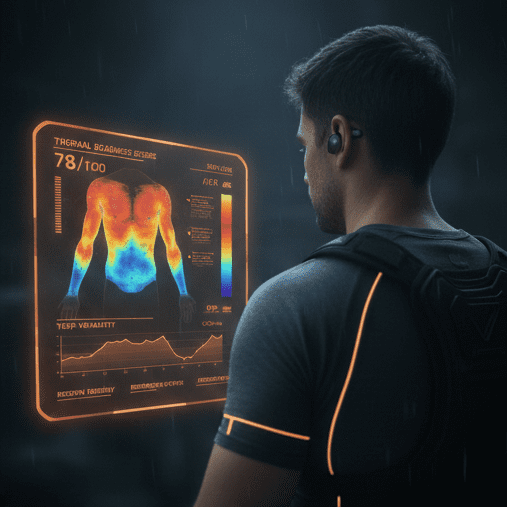
Modern wearables now feature sensors with millikelvin (mK) resolution. They don’t just tell you that you’re 98.6°F; they detect the 0.02°C drop that happens right before you get a migraine, or the subtle rise that indicates your body hasn’t recovered from yesterday’s 10k run.
Why It Matters (Beyond the Flu)
- Stress Mapping: When I’m in a high-stakes meeting, my “Bio-Dashboard” shows a specific thermal signature in my extremities. My hands get slightly colder—the classic “fight or flight” vasoconstriction—before my brain even registers that I’m nervous.
- The Recovery Score: If my skin temp stays 0.5 degrees above my baseline overnight, I know I’m overtrained. It’s the ultimate “permission to sleep in” tool.
The Digital Guardian Angel: Crash Detection for the Extreme
In 2026, “Crash Detection” isn’t just for car accidents anymore. It’s for the “Extreme Hobbyist”—the downhill longboarders, the backcountry skiers, and the mountain bikers who regularly flirt with the hospital.
New sensor arrays combine IMUs (Inertial Measurement Units) with high-G impact sensors embedded in helmets and chest protectors. These aren’t just “dumb” accelerometers that freak out if you drop your phone. They use AI models trained on thousands of real-world wipeouts to distinguish between a “hard landing” and a “loss of consciousness.”
The “Dolomites” Incident
Back on that trail, when my hearable started its countdown, I was able to tap my wrist to cancel the 911 call. But the data didn’t stop there.
- The Aftermath: The app analyzed the “impact vector” and told me I’d likely suffered a minor soft-tissue strain in my left shoulder based on my altered range of motion detected by my smart-shirt sensors.
- The Verdict: It suggested I take a 48-hour “active recovery” break. Ten years ago, I would have pushed through it and torn something. In 2026, I listened to the data.
The “Encycloblog” Perspective: Data vs. Soul
There is a danger here, of course. We’re becoming a society of “Quantified Humans.” There’s a risk that we stop listening to our intuition because our ring says our “Readiness Score” is low.
I’ve had mornings where I felt like a million bucks, but my wearable told me my heart rate variability (HRV) was “sub-optimal.” For a second, I felt my mood dip. I had to remind myself: The sensor is the map, but you are the driver.
The 2026 Wearable Power-User Checklist:
If you’re looking to jump into the bio-sensing deep end this year, here is what you actually need:
- The Form Factor: Move beyond the wrist. Smart Rings are the king of sleep and recovery; Hearables are the king of active biometrics and coaching.
- The Data Sovereignty: Look for brands that let you own your raw data. Don’t let your health metrics become a proprietary secret behind a subscription paywall.
- The “Nipple” Test: (Yes, we call it that in the industry). If the sensor requires a sticky patch that rips your hair out, you won’t wear it for 7 years. Look for textile-integrated sensors—garments where the tech is woven into the thread.
The Encycloblog Bottom Line: We are officially the first generation of humans who can see inside themselves without a scalpel. Whether you’re using it to manage a chronic condition like diabetes or just trying to survive a black-diamond ski run, the tech of 2026 has turned the “body” from a black box into an open book.
Would you trust a wearable to call an ambulance for you, or does that feel like a step too far into the “Matrix”? Let’s debate the ethics of automated triage in the comments.