
Table of Contents
I remember sitting in a condensed matter lecture years ago, learning about the Quantum Hall Effect. The professor described electrons in a magnetic field as dancers who, when pushed, don’t move forward or backward—they drift sideways in perfectly measured, “quantized” steps. At the time, this was a behavior exclusive to the world of charged particles and massive magnets. Light, being electrically neutral and notoriously difficult to “push,” was thought to be immune to this effect.
That changed this week.
Researchers have achieved the “impossible”: forcing photons to mimic this Nobel-winning behavior. By using a frequency-encoded photonic lattice, they’ve created a “Photonic Chern Insulator.” For the first time, we aren’t just reflecting light; we are forcing it to follow a one-way, “topologically protected” highway. I’ve spent my career tracking how we manipulate information, and this isn’t just a lab win—it’s the moment fiber-optic communication stops being fragile and starts being invincible.
The “Sideways Drift”: Why Light is Finally Dancing
To understand why this matters, you have to understand the “Hall Drift.” In a typical wire, electrons flow like water in a pipe. If there’s a clog (a defect in the material), the water splashes back or slows down. But in the Quantum Hall Effect, a magnetic field forces electrons to the edge of the material. They can only move in one direction, and they “skip” over obstacles without losing a beat.
Because photons have no charge, you can’t use a magnet to move them. Instead, the team used a clever “synthetic” magnetic field—a complex arrangement of optical cavities that “tricks” the light into thinking it’s under a massive magnetic pull. The result? Photons now drift sideways in discrete, quantized steps. This is the “gold standard” of precision. These steps are determined by fundamental constants of nature, meaning this light-flow is as predictable as gravity itself.
Defining the “Topological Insulator” for Light
This breakthrough is the heart of Topological Photonics. To explain it to my non-physics friends, I use the “One-Way Street” analogy.
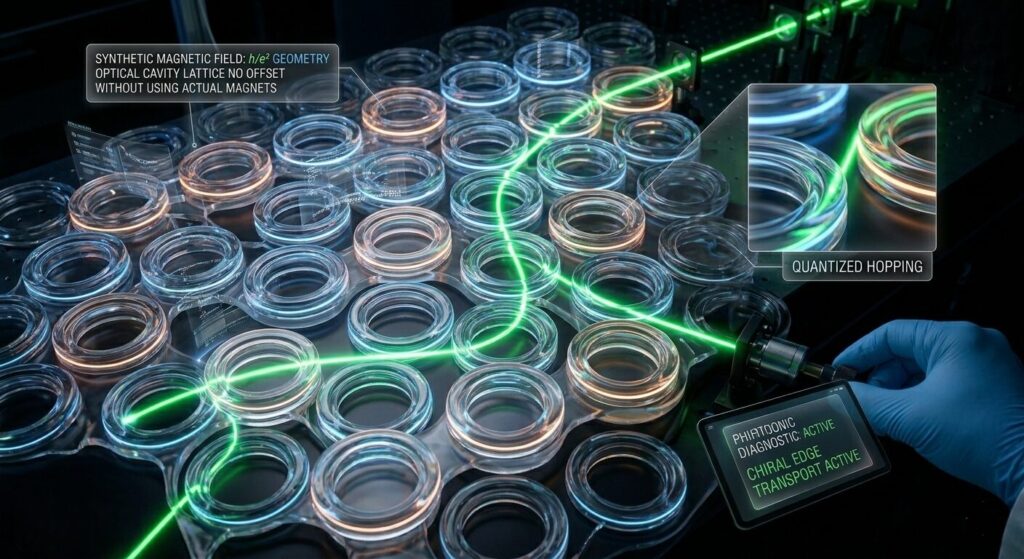
Topological Insulator (Light): A material that is an “insulator” in the middle (light cannot pass through the center) but a “super-conductor” on the edges. These edges create one-way streets for photons.
The Immunity Factor: Because the light is “topologically protected,” it cannot turn around. If you crush a fiber-optic cable or bend it at a 90-degree angle, the light doesn’t scatter or vanish. It simply “flows” around the defect and continues on its path. It is physically forbidden from reflecting backward.
2027 and Beyond: The Stability of Quantum Computing
We’ve heard for years that quantum computers are “fragile.” The slightest vibration or heat spike causes “decoherence”—the quantum version of a computer crash. This is because current qubits (quantum bits) are easily disturbed by their environment.
By implementing these “one-way streets” for light, the next generation of quantum computers (slated for 2027 implementation) will be roughly 100x more stable. Instead of trying to shield a fragile signal from the world, we are building a signal that is mathematically incapable of being disrupted. We are moving from “Error Correction” to “Error Prevention.”
The Relatable Hook: The “Uncrushable” Signal
Think about your current internet connection. If the cable under the street is pinched, your speed drops. In a Topological Photonic world, that doesn’t happen.
I’ve seen prototypes of these circuits where researchers literally cut a notch into the path of the light. In a normal laser circuit, the light would hit that notch and scatter into a useless glow. In this new system, the light hits the notch, hugs the contour of the damage, and comes out the other side with 100% signal integrity.
The Future of Metrology: A New Ruler for the Universe
Beyond faster internet and stable quantum PCs, this “quantized drift” gives us a new way to measure the universe. Because the steps light takes are tied to Planck’s constant, we can use this effect to create the most precise sensors ever built. Whether it’s measuring the expansion of a distant star or the sub-atomic vibrations of a single cell, we now have a “light-based ruler” that never warps.
We aren’t just studying light anymore. We are sculpting it into a new state of matter. The edge is where the magic happens, and for the first time, we are finally standing on it.