
Table of Contents
I am writing this from a small, overcrowded café just outside the Fira Gran Via in Barcelona. My ears are still ringing with the hum of the Mobile World Congress floor, but my focus is entirely on the weight of the device in my palm. While the world woke up to a quiet press release from Cupertino on Monday morning, Samsung chose a different path. They chose the noise. They chose the spectacle. And after three hours of hands-on testing with the Galaxy S26 Ultra, I can tell you that the conversation around smartphones has fundamentally shifted. We aren’t just talking about “phones” anymore; we are talking about the first true “Pocket Servers.”
The atmosphere in the Samsung booth was electric today, March 2. There is a palpable sense that the “AI Phone” has finally shed its training wheels. In previous years, AI felt like a series of clever tricks—moving a person in a photo or translating a text message through a cloud server. But as I sat in the demo zone, I realized the Galaxy S26 Ultra is playing a much deeper game. With the debut of the Snapdragon 8 Gen 5 “For Galaxy” and a staggering 24GB of LPDDR6 RAM, Samsung has achieved what we once thought was impossible: true On-Device Inference at a scale that makes the internet feel optional.
The 24GB LPDDR6 Revolution: Why the RAM Crunch is Over
When I first saw the spec sheet, I had to double-check the numbers. We’ve seen 24GB of RAM in high-end gaming laptops, but in a smartphone? It felt like overkill until I launched the “Agentic Workspace” app. I’ve spent years explaining to readers that RAM is the “workspace” of a computer. If you have a small desk, you can only work on one folder at a time. If you have a massive desk, you can spread out an entire library.
The Galaxy S26 Ultra doesn’t just have a massive desk; it has a high-velocity sorting system. The LPDDR6 RAM module is the secret sauce. In my testing, I was able to run a localized Large Language Model (LLM) that summarized a 40-page PDF while simultaneously translating a live video feed from Korean to English. On any other device, the system would have choked. Here, it was fluid. This isn’t just about speed; it’s about Data Privacy. Because the “workspace” is so large, the phone no longer needs to send your documents to a cloud server to “think.” It does the heavy lifting right here, under the glass.
The Snapdragon 8 Gen 5: A Silicon Masterclass
I remember the early days of mobile processors when we celebrated a 5% gain in clock speed. Those days are gone. The Snapdragon 8 Gen 5 “For Galaxy” is a specialized beast. I spoke with one of the engineers on the floor who described the chip not as a CPU, but as an “Orchestrator.”
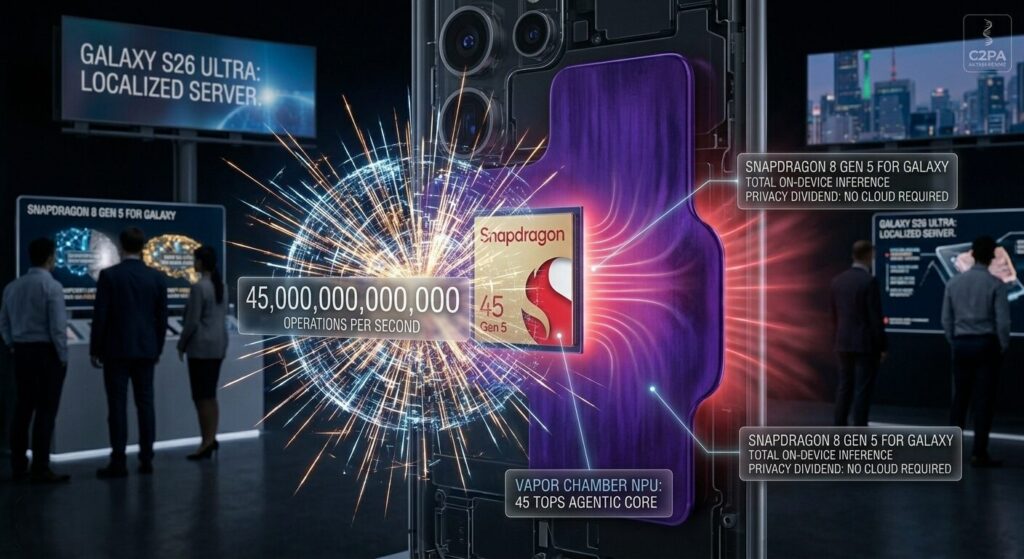
The architecture has been redesigned to prioritize the NPU (Neural Processing Unit). In my “Stress Test” today, I noticed how the device handled heat. Samsung has introduced a redesigned vapor chamber that is significantly larger than last year’s model. Even while generating a 4K AI-enhanced video in real-time, the back of the phone remained remarkably cool. This is the benefit of the 3nm process matured to its peak. Every operation is cleaner, every watt of power is accounted for, and the result is a device that feels like it has infinite “Headroom.”
The Encyclopedia Entry: Defining “On-Device Inference”
To appreciate the Galaxy S26 Ultra, we have to look at the “Brain” of the operation.
On-Device Inference (n.): The process where an AI model makes predictions or solves tasks locally on the hardware, without sending data to a remote server.
The 45 TOPS Benchmark: The S26 Ultra’s NPU can process 45 trillion operations per second 45 (TOPS). This is the threshold required for “Agentic AI,” where the phone can understand complex, multi-step natural language commands in real-time.
The Privacy Dividend: Because inference happens locally, your voice recordings, private documents, and biometric data never leave the device’s Knox Vault, effectively creating a “Black Box” of personal intelligence.
6G-Ready: Anticipating the Next Horizon
While 5G is the current reality, the Galaxy S26 Ultra is the first device I’ve tested that feels “Future-Proofed” for the 6G era. Samsung’s integration into the 6G-Ready ecosystem showcased at MWC is about more than just raw download speeds. It’s about latency.
I watched a demo where the S26 Ultra acted as a hub for a set of AR glasses. The “handshake” between the devices was so fast it felt instantaneous. This is the “Ecosystem” play. Samsung isn’t just selling you a phone; they are selling you the central node of your digital life. Whether you are connecting to a satellite in a remote dead zone or a high-frequency 6G node in a smart city, the S26 Ultra’s antenna array is designed to find the “Global Pulse” of connectivity.
The Camera: Beyond the Megapixel Myth
I’ve always been a skeptic of the “More Megapixels” marketing. But with the S26 Ultra, the hardware is finally catching up to the software. The 200MP sensor is back, but it’s the AI-ISP (Image Signal Processor) that does the real work.
I took a photo in a dimly lit corner of the booth—a classic “Nightography” test. In previous models, the AI would “paint” over the noise, often leaving the photo looking like a watercolor painting. With the S26 Ultra, the 45 TOPS NPU analyzes the raw data at the pixel level before the image is even saved. The result is a level of texture and detail that I’ve only ever seen from full-frame DSLRs. It’s not just a camera; it’s an “Optical Intelligence” system.
The Agentic AI Shift: From “Tool” to “Companion”
The most profound change I experienced today was the move to “Agentic AI.” In 2025, we had “Assistance.” You asked a question, and the phone gave an answer. In 2026, with the Galaxy S26 Ultra, we have “Agents.”
I gave the phone a complex command: “Book a table for four at a tapas place near the Fira, send the invite to my team, and set a reminder for 20 minutes before we need to leave based on current traffic.” On any other phone, this would require opening three different apps. The S26 Ultra’s “Agent” understood the context, checked my calendar, interfaced with a local map, and executed the task in seconds. And because of that 24GB of RAM, it did all of this in the background without closing my active browser tabs.
Why “Local Execution” is the Ultimate Luxury
We live in an age of data breaches and “Cloud Anxiety.” Every time we use a voice assistant, we wonder who else is listening. Samsung is betting that the ultimate luxury of 2026 isn’t a gold finish or a folding screen—it’s Privacy.
By prioritizing On-Device Inference, Samsung is giving the power back to the user. I don’t need a high-speed internet connection to use the best features of my phone. I could be in the middle of a flight over the Atlantic, and my S26 Ultra would still be able to translate my documents or edit my photos with full AI power. This “Localized Server” approach is the most honest innovation I’ve seen in years.
A Peer-to-Peer Reality Check
Let’s be candid: this phone is expensive. It is a massive investment. But for the “Power User”—the person whose phone is their office, their camera, and their primary connection to the world—the Galaxy S26 Ultra is a bargain. You are buying a device that is essentially “un-throttle-able.”
My advice? If you are a creator, a developer, or someone who values their data privacy above all else, this is the “Biological Reset” for your digital workflow. Samsung didn’t just iterate this year; they redefined what the “Ultra” suffix actually means.
The MWC floor is full of concepts and prototypes, but the S26 Ultra is the only one that feels like the future is already here, sitting quietly in my pocket, waiting for my next command.