
Table of Contents
I remember the exact moment the “old” world of skincare died for me. I was sitting in a high-tech clinic in Seoul’s Seongsu-dong district, watching a 3D render of my own forehead on a wall-sized screen. But I wasn’t looking at wrinkles or sunspots. I was looking at a thriving, microscopic jungle. Tiny, glowing clusters of Staphylococcus epidermidis were battling for space against a dry patch of Cutibacterium acnes. To the naked eye, I just had “combination skin.” To the AI scanner, I was a walking, breathing ecosystem in a state of civil war.
This is the reality of the Glow-cation. The era of the “one-size-fits-all” luxury facial is being replaced by something far more aggressive and scientific: the Biological Reset. Travelers are no longer flying to Korea to buy suitcases full of sheet masks; they are flying here to have their DNA sequenced and their skin microbiomes mapped. We are witnessing the birth of Precision Dermaceuticals, a movement that treats your skin not as a surface to be polished, but as a biological interface that needs to be recalibrated.
The “Glow-cation” Phenomenon: Why Seoul, Why Now?
For years, Seoul has been the laboratory of the world. But in the spring of 2026, the city has transitioned from a manufacturing hub to a “clinical pilgrimage” site. The “Glow-cation” trend—a portmanteau of glow and vacation—represents a fundamental shift in how Gen Z and Millennial travelers define “luxury.”
In the 2010s, luxury was a five-star hotel with a marble spa. In the early 2020s, it was a “longevity retreat” focused on diet. Today, luxury is data-backed physical transformation. Travelers, whom we now call “Glowmads,” are bypassing traditional landmarks like Gyeongbokgung Palace for “Super-Clinics” in Gangnam. They aren’t seeking relaxation; they are seeking a measurable increase in their “Skin Longevity Score.”
The reason Korea is the epicenter of this shift is simple: the integration of AI and biotechnology is seamless here. You can walk into a clinic at 10:00 AM, have a multispectral skin analysis that checks 120 biological markers, and by 2:00 PM, a “Bio-Identical” serum—tailored specifically to your microbiome’s current pH and bacterial density—is compounded in a lab upstairs.
The Encyclopedia Entry: Defining “Precision Dermaceuticals”
To understand why this is a revolution, we have to define the core technology driving it.
Precision Dermaceuticals (n.): A category of skincare and aesthetic treatments where formulations are created “on-demand” based on an individual’s real-time biological data. Unlike “bespoke” skincare of the past, which relied on questionnaires, Precision Dermaceuticals use:
- AI Microbiome Mapping: Identifying the specific ratios of bacteria, fungi, and viruses on the skin surface.
- Multispectral Imaging: Seeing “sub-clinical” inflammation and pigment deep within the dermis before it reaches the surface.
- Bio-Identical Compounding: Using ingredients like lab-grown exosomes, PDRN (salmon DNA), and fermented peptides that mimic the body’s natural repair signals.
This shift represents a move from “reactive” skincare (fixing a pimple) to “proactive” skin architecture (preventing the inflammatory signal that leads to the pimple).
The Scalp is the New Face: The 2026 Head Spa Evolution
One of the most surprising elements of my “Biological Reset” in Seoul was the focus on my scalp. In 2026, the “Head Spa” has moved from a luxury hair wash to a medical-grade follicular intervention.
I watched a technician use an IoT-enabled scalp scanner to map my “follicular health.” The AI pointed out that my scalp’s microbiome was trending toward a “dysbiosis”—an imbalance that leads to thinning and inflammation. Instead of a generic shampoo, I was prescribed a treatment involving red-light therapy and an ultrasound infusion of “microbiome exosomes.”
The logic is simple but profound: you cannot have a “glow” on your face if the skin on your head is in a state of chronic stress. The scalp and the face share the same vascular network. In Seoul, they treat them as a single, continuous organ.
The Microbiome Retreat: A 72-Hour Reset
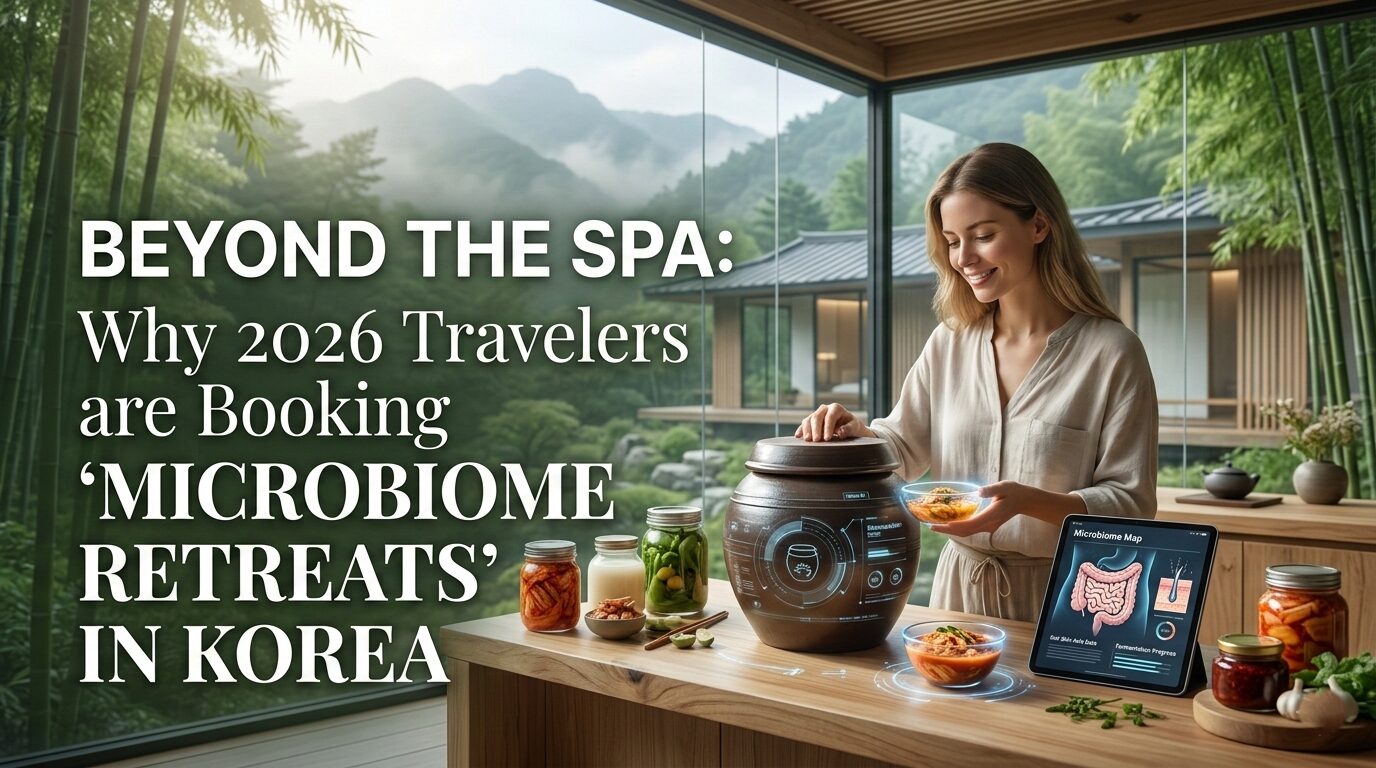
The “Microbiome Retreat” isn’t just about what you put on your skin; it’s about the “Gut-Skin Axis.” During my 72-hour stay at a specialized wellness center in Jeju Island, the experience was entirely data-driven.

- Day 1: The Bio-Audit. Blood work, microbiome swabs, and a 3D body scan to measure “metabolic heat.”
- Day 2: The Infusion. A customized regimen of “Postbiotic” meals designed to feed specific skin-positive bacteria, combined with “Cryo-Regulation” to drop systemic inflammation.
- Day 3: The Compounding. The final step is the creation of your “Skin Blueprint”—a digital profile that follows you home, allowing you to order bio-identical refills that adapt as your skin changes with the seasons.
Why the “One-Size-Fits-All” Model is Obsolete
I spent years buying “Best Seller” creams based on internet reviews. But as I learned in Korea, a “Best Seller” is mathematically unlikely to work for everyone. If your microbiome is dominant in Propionibacterium, a cream designed for a Staphylococcus-dominant profile might actually trigger a flare-up.
Skincare in 2026 is moving toward a “No-Guessing” model. We are using AI to eliminate the trial-and-error that costs consumers billions of dollars annually. When you have a “Skin Scan” that correlates with 4.2 million clinical datasets, the product you walk away with isn’t a hope; it’s a prescription.
The “Glowmad” Lifestyle: Return of the Expert
Perhaps the most refreshing part of the 2026 Korea trend is the return of the human expert, aided by AI. In a world of “influencer” skincare advice, the Seoul “Super-Clinics” rely on Board-Certified Dermatologists who interpret the AI data.
During my consultation in Gangnam, Dr. Kim explained that I had been overusing “gentle” cleansers, which were stripping my protective lipid barrier and preventing me from achieving “Glass Skin.” The AI showed my “Transepidermal Water Loss” (TEWL) was in the red zone. This insight—invisible to the naked eye—changed my entire routine. It wasn’t about adding more products; it was about adding the right signals.
The Future of the “Biological Reset”
As I flew home from Incheon, I didn’t have a bag full of duty-free perfumes. I had a QR code. That code links to my “Global Cellular Map”—a living document of my skin’s health that my Agentic Travel Assistant uses to recommend my next destination based on “Atmospheric Stress.”
For example, if air pollution levels in London rise this month, my app will automatically adjust my serum formula for the next shipment. This is the ultimate promise of the 2026 Microbiome Retreat: you don’t just leave the glow in Korea; you bring the infrastructure of the glow home with you.
We are no longer just tourists. We are “Biological Architects,” and Korea is providing us with the blueprints.