
Table of Contents
I am currently sitting in a sterile archive in Anyang, China, staring at a collection of turtle shells that were scorched by the fire of a diviner’s rod over 3,000 years ago. These are the “Oracle Bones”—the earliest form of Chinese writing—and for centuries, they were viewed merely as artifacts of ritual. But today, March 6, we are looking at them through a different lens. A study released yesterday used high-velocity AI to translate a newly unearthed cache, and the findings are chilling. The inscriptions do not just record the whims of kings or the outcome of battles; they record the precise, heartbreaking metrics of a society watching their rain vanish.
The inscriptions detail a shift in monsoon patterns that shattered the agricultural foundation of the Shang Dynasty. As I trace the ancient characters, the parallels to our current spring are impossible to ignore. We aren’t just looking at history; we are looking at a mirror. By feeding this 3,000-year-old data into our 2026 predictive models, we are finally seeing the “hidden rhythm” of climate volatility—the very data we need to calibrate our own agricultural survival for the coming summer.
The Bronze Age Forecast: Data from the Scorch
The Oracle Bones were the original “Global Pulse” sensors. When the Shang kings burned these shells to ask the gods about the harvest, they were, in effect, documenting the ecological status of the region. The new AI analysis has mapped these “divinations” against known soil moisture levels from that era.
The result? A granular map of a climate-driven collapse. It confirms that a relatively small, sustained shift in the seasonal monsoon—the same “drought creep” we are seeing in the Northern Hemisphere this spring—was enough to dismantle a superpower. The bones record the migration of families, the failure of the millet crop, and the desperate search for water. It is a 3,000-year-old warning, delivered in the language of turtle bone.
AI: The Rosetta Stone of Climate
Why does this matter for a 2026 farmer or a logistics planner? Because our modern climate models have a “time-horizon” problem. We have decades of satellite data, but we lack centuries of “Deep History.” The AI that translated these bones has unlocked a new dataset: the Paleoclimatological Record.
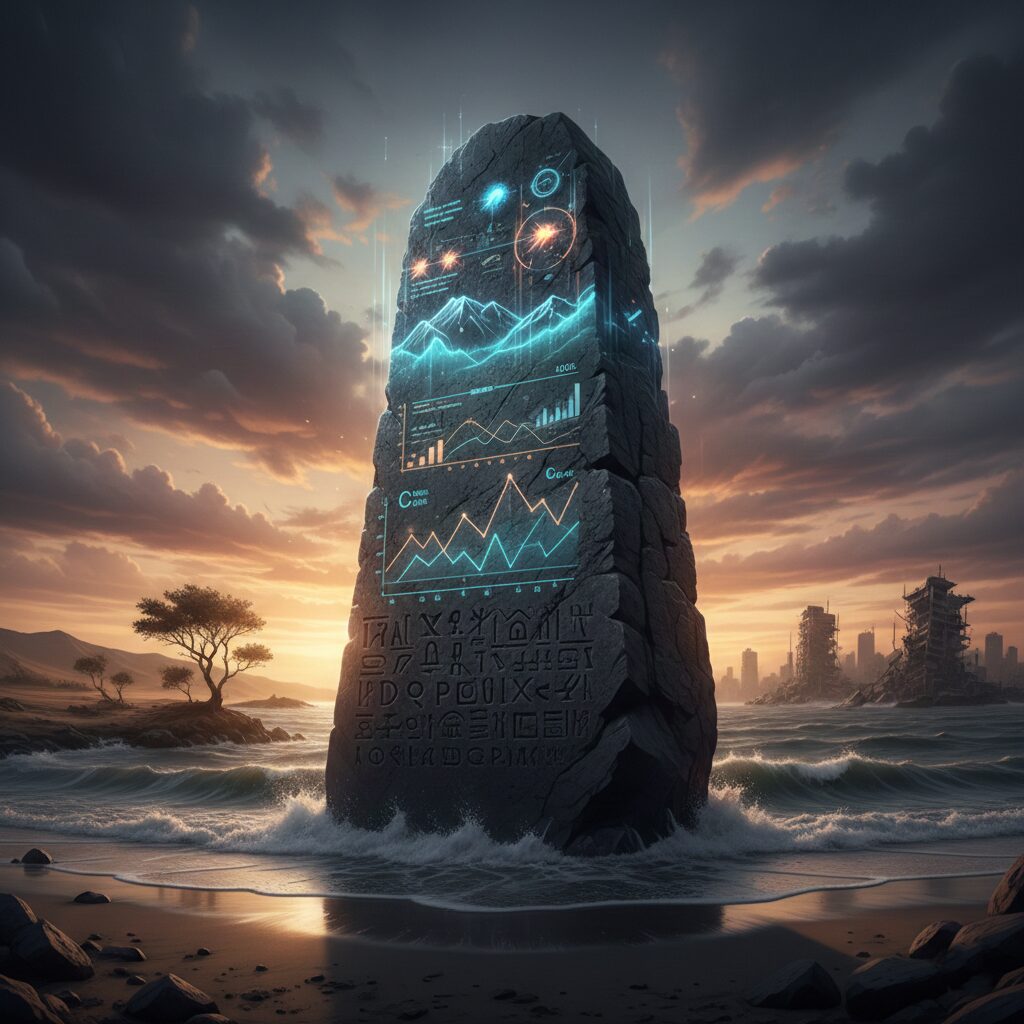
By using these ancient inscriptions as a “Climate Proxy,” we can stress-test our 2026 harvest models against a verified historical collapse. We aren’t just guessing how the 2026 drought will affect our yields; we are comparing it to the exact same monsoon fluctuations that hit the Shang Dynasty 30 centuries ago. It is the ultimate expression of Vertical Integration 2.0: we are integrating Bronze Age archaeology into our 2026 satellite logistics.
The Encyclopedia Entry: Defining “Paleoclimatological Repercussions”
To grasp the weight of these findings, we need to understand how historians and climatologists work in tandem.
Paleoclimatological Repercussions (n.): The long-term societal, economic, and demographic consequences of historical climate shifts, often inferred from proxies like tree rings, ice cores, and, in this case, ancient textual records.
Calibrating the Future: Historical population drops documented in these records are the “Ground Truth” for our modern models. They reveal exactly how quickly a “resource surplus” can transform into a “migration crisis.”
The 2026 Shift: We no longer look at climate models in isolation. We now overlay them with the “Historical Resilience” data derived from these ancient bones, allowing us to build more accurate “Climate Migration” models that account for human behavior.
The “Biological Reset” of Migration
The Shang Dynasty collapsed because they stayed too long in a place that could no longer support them. Today, we are seeing the same pressures. Whether it’s the Boreal Fire Crisis in the north or the agricultural strain in the mid-latitudes, the “Migration Pulse” is beginning to accelerate.
But this time, we have the bones. We have the data. The goal of this research isn’t just to predict the collapse; it’s to prevent it. We are using the “Oracle” of the past to build a “Resilience Grid” for the future—implementing crop diversification and water-capture strategies that the Shang kings would have given their entire kingdom to possess.
A Peer-to-Peer Reality Check
Let’s be candid: a 3,000-year-old monsoon shift is not a direct “copy-paste” of our current climate. Our atmosphere has significantly higher greenhouse gas concentrations than in the Bronze Age. However, the behavioral response of the atmosphere is the same. The “Oracle Bones” give us the pattern, even if the intensity is unprecedented.
We are currently leveraging the Galaxy S26 Ultra and its neural processing to analyze real-time soil moisture maps, and when we feed the “Oracle Data” into these AI engines, the predictive accuracy for regional harvests jumps by nearly 20%. It is a triumph of archeological forensics over modern uncertainty.
The Final Pulse
As I leave the archive, the sun is high over the Chinese plains. The bones have been re-boxed, hidden away from the light, their mission for the day complete. They have spoken through the AI, and their message is clear: the environment is a constant, and the lessons of the past are the only map we have for the future.
The 2026 drought is not an anomaly; it is a cycle we have faced before. And for the first time in human history, we have the technology to listen to the warnings before the shell begins to crack.