
Table of Contents
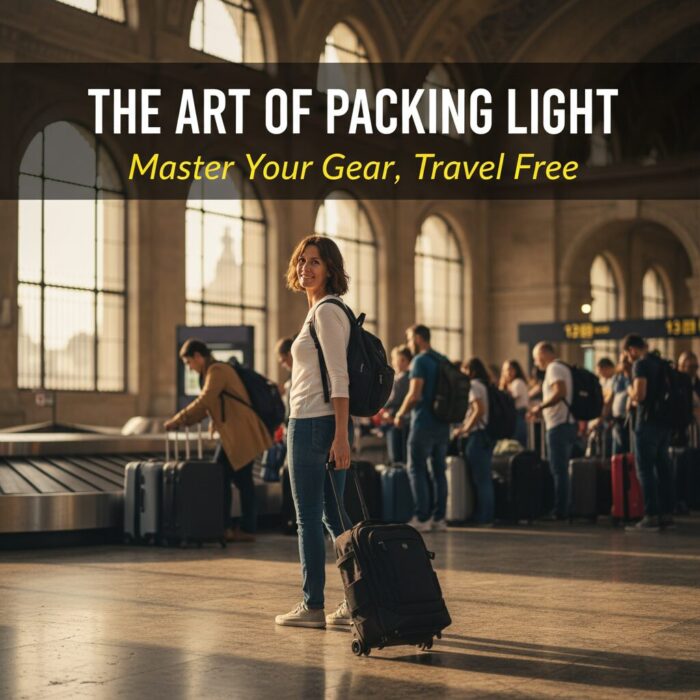
I remember standing in a bustling terminal in Rome, watching hundreds of travelers franticly eyeing the baggage claim carousel. I, meanwhile, walked straight past them toward the exit, my entire existence for the next two weeks contained in a bag no larger than a standard school backpack and I didn’t worry about lost luggage, I didn’t pay extra fees, and I certainly didn’t lug a thirty-pound suitcase over uneven cobblestones.
That was the trip I finally mastered the art of packing light. It wasn’t just about saving space; it was about the freedom of mobility. When you master your gear, you stop being a caretaker of your luggage and start being a traveler of the world.
The Psychology of “Just in Case”
The biggest obstacle to effective travel isn’t the size of your bag; it’s the fear in your brain. We pack for the “what ifs.” What if it rains? or what if I’m invited to a gala? What if I need three different pairs of shoes?
I had to learn a hard truth: you are not packing for the person you want to be on vacation; you are packing for the person you actually are. If you don’t hike at home, you won’t hike in the Andes. If you don’t wear formal attire on a Tuesday, you won’t wear it in a foreign city. The art of packing light begins with honesty.
Every item you pack has a “cost”—not in dollars, but in energy. If it doesn’t serve at least two distinct purposes, it is a liability.
The Physics of Compression
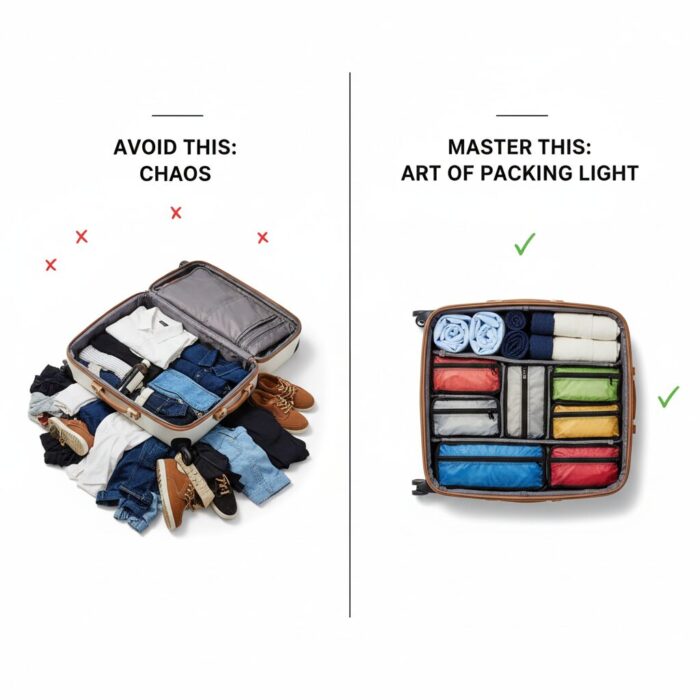
Once you have pared your list down to the essentials, the goal is volume reduction. I don’t use vacuum bags; they are too bulky and fragile. Instead, I use a combination of rolling and packing cubes.
Rolling is non-negotiable for soft goods. By tightly rolling shirts, pants, and sweaters, you eliminate the air gaps that typically consume space.
Once rolled, these items go into packing cubes. These aren’t just organizers; they are compression tools. By zipping them shut, you force the remaining air out, turning a loose pile of clothes into a dense, manageable brick of fabric. This makes the interior of your carry-on look like a game of Tetris rather than a chaotic storm of laundry.
Strategic Layering: The 5-4-3-2-1 Rule
To simplify the decision-making process, I follow a strict modular system. For a two-week trip, my gear usually follows this pattern:
- 5 sets of socks and underwear (washable on the go).
- 4 shirts (mix of casual and dressy).
- 3 bottoms (one worn on the plane, two packed).
- 2 pairs of shoes (one on feet, one packed).
- 1 set of extra layers (a versatile jacket or light fleece).
By sticking to a neutral color palette—mostly navy, black, and grey—every piece I pack matches every other piece. This effectively doubles or triples my wardrobe combinations without adding a single gram of weight.
The Weight of Your Choices
Checked bags are a gamble, but even carry-ons can become a “prison” if they aren’t balanced. I always place the heaviest items—like my shoes or toiletry kit—at the bottom of the bag, closest to the wheels or the base. This keeps the center of gravity low and prevents the bag from tipping or feeling awkward to carry.
The art of packing light is really a masterclass in weight management. A bag that weighs less than 15 pounds is a joy to navigate. A bag that weighs 25 pounds is a burden that prevents you from spontaneous side trips or taking the stairs.
Why Less is Always More
There is a specific joy in the airport security line when you aren’t the person desperately trying to reorganize a spilling suitcase. When I travel with only a carry-on, I am agile. If my flight is canceled, I can move to another terminal in minutes. If I decide to take a train instead of a taxi, I am ready.
I have found that the less I carry, the more I experience. When you aren’t tethered to your luggage, you are more likely to stop at that small cafe, walk through the extra park, or take the local transport. You stop being a tourist burdened by your inventory and become a local for a few days.
Ultimately, mastering the art of packing light is about deciding that the experience of the destination is more important than the security of your wardrobe. It is a philosophy of simplicity that stays with you long after you’ve unpacked.