
Table of Contents
Most travelers spend their vacations trapped in a loop of “first” and “second” places. Your hotel room is your “first place”—a private, transient base of operations. Your office (or, in this case, the major tourist attractions, museums, and landmarks) serves as your “second place”—the destination you are contractually obligated to visit based on your itinerary.
But if you want to understand the heartbeat of a foreign city, you need to look for a “third place.”
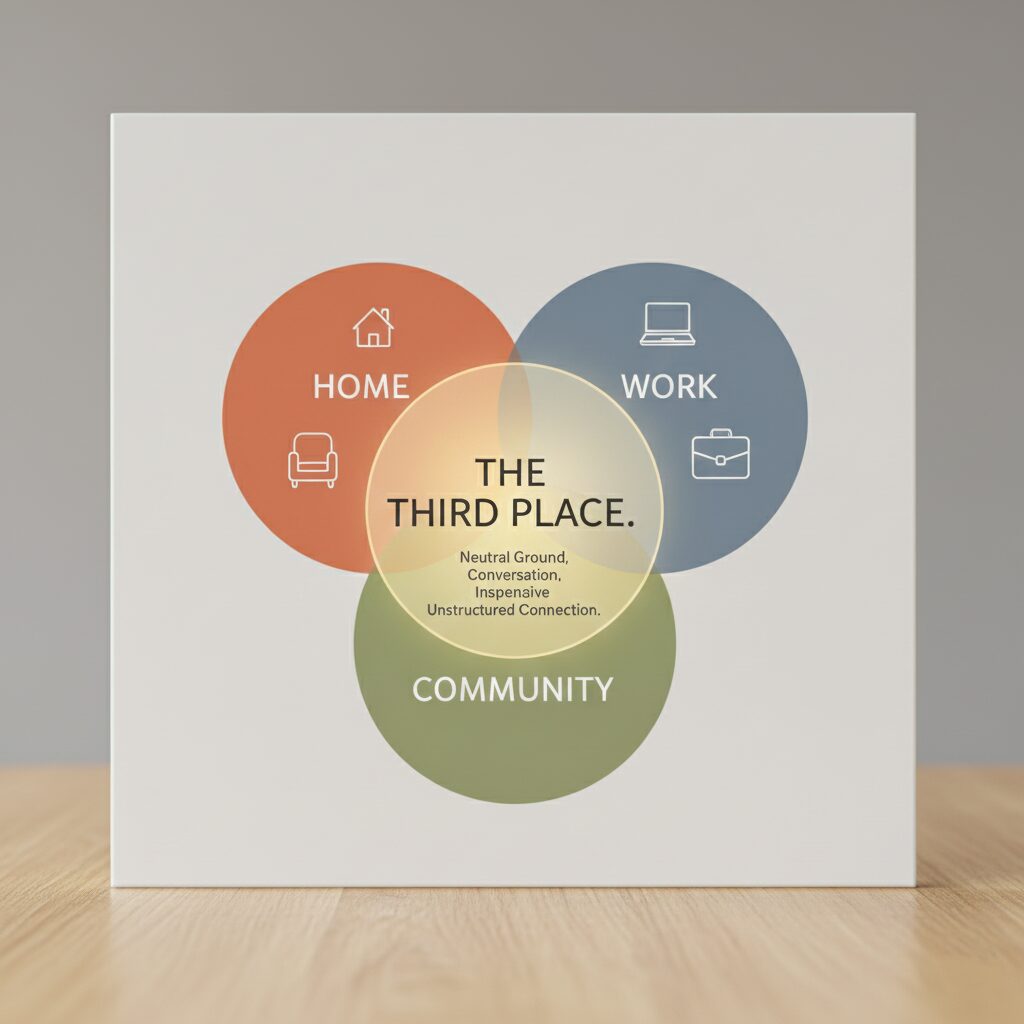
Sociologist Ray Oldenburg coined this term in his 1989 book The Great Good Place. A “third place” is a social environment separate from the two most important spaces in our lives: our home and our workplace. These are the physical anchors of community life. They are the spots where the locals actually live, where the conversation is casual, the access is easy, and the sense of belonging is tangible. When you find a third place while traveling, you stop being a tourist who observes the city from behind a camera lens and start being a temporary participant in its culture.
The Anatomy of a Third Place
What exactly makes a space a “third place”? Oldenburg identified several core characteristics that distinguish these environments from the sterile, transaction-heavy zones of tourism.
- Neutral Ground: You should be able to come and go as you please. You aren’t forced to stay, and you aren’t paying a premium for the “experience.”
- A Leveler: In a true third place, social status is left at the door. You aren’t defined by your job title or your bank account; you are defined by your presence.
- Conversation is the Primary Activity: The space exists to facilitate talk. Whether it’s a heated political debate, a lighthearted joke, or a quiet discussion about local history, the environment is built for human connection.
- Accessibility and Accommodation: It’s easy to get to, and it’s open during the hours when people actually have free time.
- A “Home Away From Home” Feel: The atmosphere is unfussy and welcoming. You don’t have to be on your “best behavior” as you would in a fancy restaurant or a luxury lobby.
Why We Are Losing Our Third Places
In modern urban planning, we have seen a gradual erosion of these spaces. We have optimized our cities for productivity and consumption rather than connection. Many public squares have been replaced by shopping malls—spaces that look like community hubs but are actually gated by the requirement to spend money.
When you travel, you often fall into the trap of visiting these “pseudo-third places.” A global coffee chain, for example, is designed to feel familiar, but it is not a third place. It is a commercial transaction zone. It is the same in Tokyo, London, or New York. By choosing to spend your time there, you are opting for comfort over genuine cultural immersion.
The Traveler’s Paradox: Why You Need a Third Place
Why should you bother hunting for a local third place when you only have three days in a city? The answer lies in the “Traveler’s Paradox.” The more time you spend at major tourist landmarks, the less you actually experience of the city’s reality.

Think about it: A museum is a curated display of the past. A tourist-trap cafe is a stage set for consumption. But a true third place—a neighborhood pub, a local library, a community garden, a barber shop, or a neighborhood park—is where the current, authentic narrative of that city is being written.
When you sit in a local park in Paris, watching families argue about where to get dinner, you are learning more about French culture than you would standing in line at the Louvre. You are observing the rhythm of daily life. You are seeing the city as a living, breathing organism, not as a static historical site.
How to Find Your Third Place
Finding a third place isn’t as simple as checking a “Top 10” list on a travel blog. In fact, if it’s on a “Top 10” list, it’s probably not a true third place anymore. Here is how you can find them:
- Follow the “Routine” Crowd: Watch where the locals go when they are clearly not working and not on a “special” night out. If you see people who clearly know the staff by name, or if you see people engaged in activities that aren’t for tourists (like playing chess, reading, or just sitting silently with a newspaper), you’ve found a potential site.
- Look for “Low-Friction” Entry: Avoid places that require reservations, dress codes, or intense security. A third place should feel accessible. If you feel like you are “intruding” or that you need to be a “customer” to exist there, keep looking.
- The “Morning Test”: A great third place is often busy in the morning hours. This is when the community is waking up, exchanging news, and preparing for the day. If a cafe is filled with laptop-bound tourists, it’s a coworking space. If it’s filled with elderly locals sipping espresso and talking, it’s a third place.
- Abandon the Itinerary: This is the hardest part. You must be willing to sacrifice a landmark to gain a connection. Set aside a two-hour block on your trip where you have absolutely no plan. Go to a neighborhood you know nothing about, find a bench, a park, or a local spot that looks interesting, and just be.
The Psychological Benefit of “Belonging”
There is a profound psychological benefit to finding a third place while traveling. Travel, by its nature, is a state of constant displacement. You are always an outsider. You are always asking for directions, struggling with the language, and navigating unfamiliar transit systems. This is cognitively exhausting.
A third place offers you a temporary “home base.” When you start to recognize the barista, or when you find a park bench that becomes “yours” for the week, your nervous system begins to settle. You are no longer just “passing through.” You have planted a small, temporary flag. This sense of belonging reduces travel anxiety and allows you to experience the city with a slower, more deliberate pace.
The Ethos of Respectful Observation
It is important to remember that as a traveler in a third place, you are a guest in someone else’s living room. The third place relies on a delicate balance of trust and familiarity. Do not try to “take over” the space. You are there to observe, to listen, and to participate quietly.
If you enter a local community center, don’t demand service or try to turn it into a tourist experience. Simply exist within the space. Allow yourself to become a part of the background furniture. The goal is to witness the local social fabric without unravelling it.
Bringing the Concept Home
The most beautiful thing about finding a third place while traveling is that it forces you to re-evaluate your life back home. How many of us live in a city for years and never actually develop a third place? We go home, we go to work, and we interact with the rest of the world through apps and screens.
By actively seeking out these spaces in foreign cities, you learn to value them in your own life. When you return home, you might start looking for that neighborhood coffee shop that isn’t a chain, or the park where the neighborhood regulars gather, or the local community center that hosts classes.
Travel should change you. But the best change is the one that lasts longer than the flight home. By embracing the concept of the third place, you aren’t just becoming a better traveler; you are becoming a more connected human being, capable of finding—and creating—community wherever you go.
So, on your next trip, do yourself a favor: skip the cathedral line, forget the souvenir shop, and go find a bench where you can watch the world go by. That is where the magic lives.