
Table of Contents
I remember when the “plastic problem” was something we visualized with a single, tragic image: a sea turtle entangled in a six-pack ring. It was an external crisis, a battle occurring “out there” in the gyres of the Pacific. We felt a pang of guilt, swapped our plastic straws for soggy paper ones, and assumed we were doing our part.
But yesterday—February 26—the conversation shifted from the ocean’s health to our own internal biology.
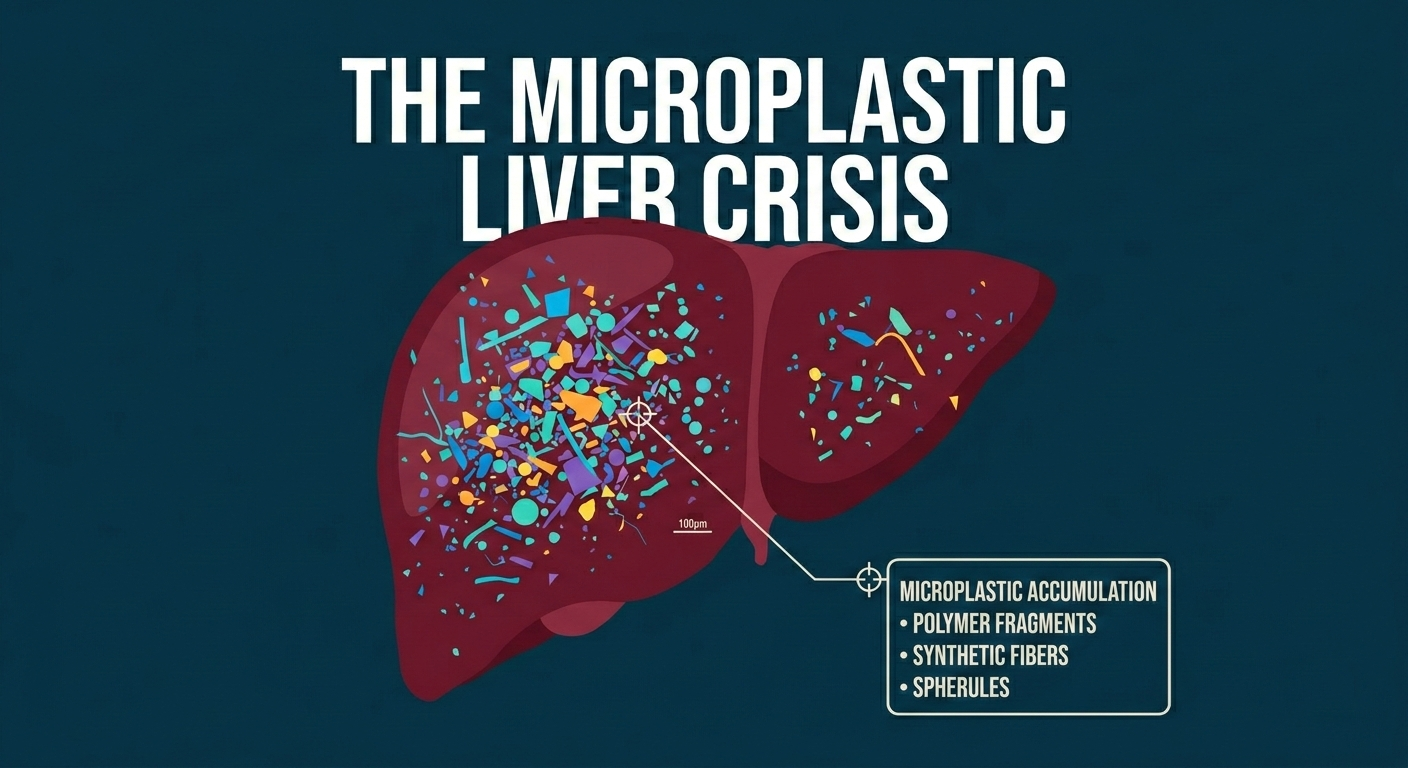
A groundbreaking study released by the University of Derby has officially brought the crisis home, specifically to the largest internal organ in the human body. Researchers, led by specialists in clinical biochemistry and toxicology, have proven that the microplastics leaching from our standard, everyday food packaging aren’t just passing through us. They are accumulating, and they are causing significant cell death in “mini human livers” grown in the lab. “Internal Bio-Accumulation”
We have moved beyond the era of “environmental concern” and entered the era of Internal Bio-Accumulation. The plastic isn’t just in the water; it is in our architecture.
The Derby Discovery: The “Mini Liver” Warning
For years, the scientific community struggled to quantify exactly what happens when we ingest the estimated 50,000 plastic particles the average person consumes annually. Most of these are excreted, but the ones that remain—the sub-5mm fragments and even smaller nanoplastics—have a specific destination: The Liver.
The University of Derby study utilized advanced 3D liver microtissues—functionally active models composed of primary human hepatocytes and Kupffer cells (the liver’s “gatekeeper” immune cells).
- The Low-Level Trap: Unlike previous studies that used massive, unrealistic doses of plastic, the Derby team used “low repeated doses” that mimic the actual exposure of someone eating three packaged meals a day.
- The Cellular Toll: The results showed widespread inflammation, a disruption of normal metabolic function, and, most crucially, apoptosis (cell death).
- The Pathology: The “mini livers” developed aberrant tissue structures, including dilated bile canaliculi and large lipid droplets inside the cells. Essentially, the plastic was inducing a form of “chemical fatty liver disease” without the presence of alcohol or high sugar.
The Relatable Hook: You Are What You Store
The liver is the body’s principal detoxification organ. It is the filter that stands between your bloodstream and the toxins of the world. But the liver isn’t designed to filter non-biodegradable polymers.
When you heat a plastic-wrapped meal in the microwave, or even when you drink water from a bottle that has been sitting in a warm car, you are facilitating Polymer Migration. These microscopic shards are so small they can cross the intestinal barrier, enter the portal vein, and lodge themselves in the liver’s macrophages.
The liver tries to “eat” the plastic to protect you. But the plastic is invincible. The immune cells become exhausted, they release inflammatory cytokines (like IL-6 and TNF-α), and the organ begins a slow, silent decline. This is why we are seeing a spike in liver dysfunction in demographics that traditionally have low-risk factors. It’s not the diet; it’s the delivery system. “Internal Bio-Accumulation”
The Encyclopedia Guide to Non-Polymer Living
We have reached the point where “reducing plastic” is no longer an environmental choice—it is a medical necessity. Fortunately, the market has finally caught up to the science. We are seeing a massive shift toward Bio-harmonious Kitchens, where packaging is designed to replenish the planet and the body, rather than pollute them.
The Actionable Entry: Material Innovation Comparison
| Material | The Science | Why Your Liver Loves It |
| Seaweed-Based (Notpla/Sway) | Uses algae-derived resins like TPSea™ that are 100% bio-based. | Completely microplastic-free. If ingested, it simply digests as fiber. |
| Mycelium Containers | Grown from the root structure of mushrooms and agricultural waste. | Naturally antimicrobial and insulating; leaves zero chemical residue. |
| HDRY Lamination | A new standard for high-performance barriers that blocks moisture without plastic films. | Eliminates the “internal lining” that usually leaches into dry goods. |
| Glass & Stainless | The “Forever Standard.” Non-reactive and infinitely reusable. | Zero migration of chemicals, even under extreme heat. |
Phase I: The Seaweed Solution
Seaweed is the current superstar of the non-polymer revolution. Companies like Notpla and Sway have successfully scaled production of seaweed-coated food containers and sachets.
- The Regenerative Edge: Seaweed grows at incredible speeds, captures carbon, and requires no freshwater or fertilizer.
- The Safety Factor: Seaweed-based films are often edible. When used to coat takeaway boxes, they provide a moisture barrier that is physically impossible to turn into a microplastic. If a microscopic shard of a seaweed box ends up in your liver, your body knows exactly what to do with it: break it down into simple sugars and move on.
Phase II: The Mycelium Kitchen
Mycelium—the “roots” of mushrooms—is being used to create rigid containers that are replacing Styrofoam and hard plastics.
- The “Living” Insulation: Mycelium is a natural insulator, making it perfect for cold-chain shipping of fresh groceries.
- End-of-Life Peace: Unlike plastic, which survives for 500 years, a mycelium container can be broken up and tossed into your garden. It becomes soil in 45 days, providing nutrients for the very food you’ll eventually eat. This is the definition of a “Circular Bio-Economy.”
Transitioning Your Home: The 3-Step “Plastic Purge”
You cannot fix your liver’s plastic burden overnight, but you can stop the accumulation today.
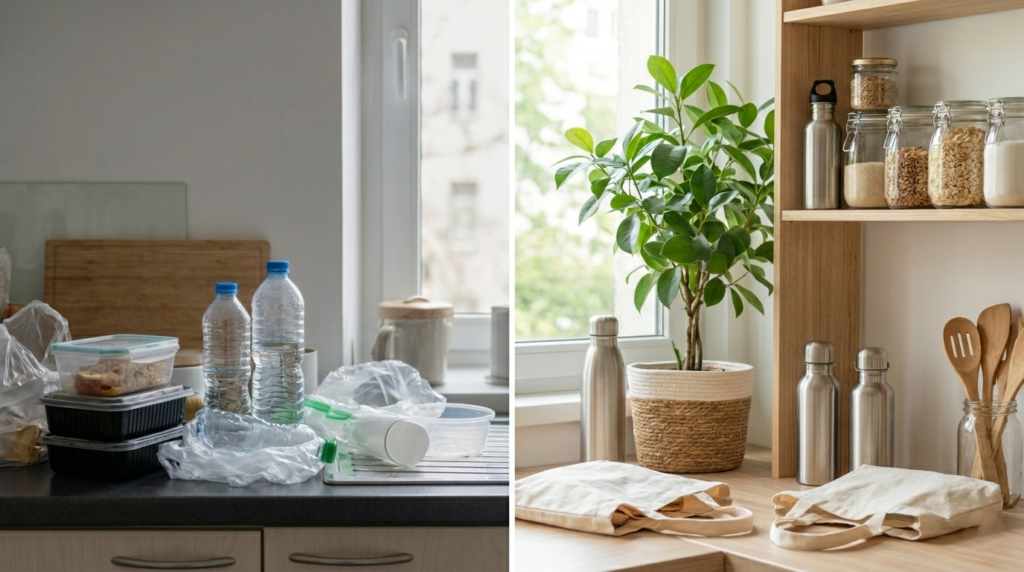
- Stop the Heat-Sync: Never, under any circumstances, microwave food in plastic. Even “microwave-safe” plastic releases millions of nanoplastics when heated. Transfer food to glass or ceramic.
- Audit Your Liquids: Swap plastic water bottles and “to-go” coffee cups (which are lined with a plastic film) for stainless steel. The heat of coffee is a major catalyst for polymer leaching.
- Support the “Bio-Resin” Brands: Look for the C2PA Authentication or “Plastic-Free” seaweed certifications on your grocery items. By choosing seaweed or mycelium-packaged goods, you are sending a market signal that the Liver Crisis must end.
The Long-Term Outlook: Cellular Resilience
As the University of Derby researchers noted, the liver is remarkably resilient—if it is given a break. By reducing our daily “plastic load,” we allow our hepatic immune cells to clear out existing debris and repair the inflammatory damage. “Internal Bio-Accumulation”
We are moving into a future where the kitchen of a health-conscious person looks very different. It is a kitchen of glass, metal, seaweed, and fungi. It is a kitchen that values Bio-harmony over the convenience of a polymer. The turtle in the ocean was our first warning; the mini-liver in the lab is our final one.
I’d love to hear from you: What is the most stubborn piece of plastic in your kitchen that you’re finding it hard to get rid of? Is it the “good” Tupperware, or maybe the convenient cling wrap?