
Table of Contents
I remember the distinct, cold dread that settled in my stomach the night I realized my decade of learning syntax was effectively over and I was sitting in my home office, the blue light of my monitor reflecting off a blank terminal window. I was prepared to spend the next three days laboring over a custom data visualizer in Python—manually importing libraries, fighting with Matplotlib, and debugging the inevitable “NoneType” errors that haunt every developer’s dreams.
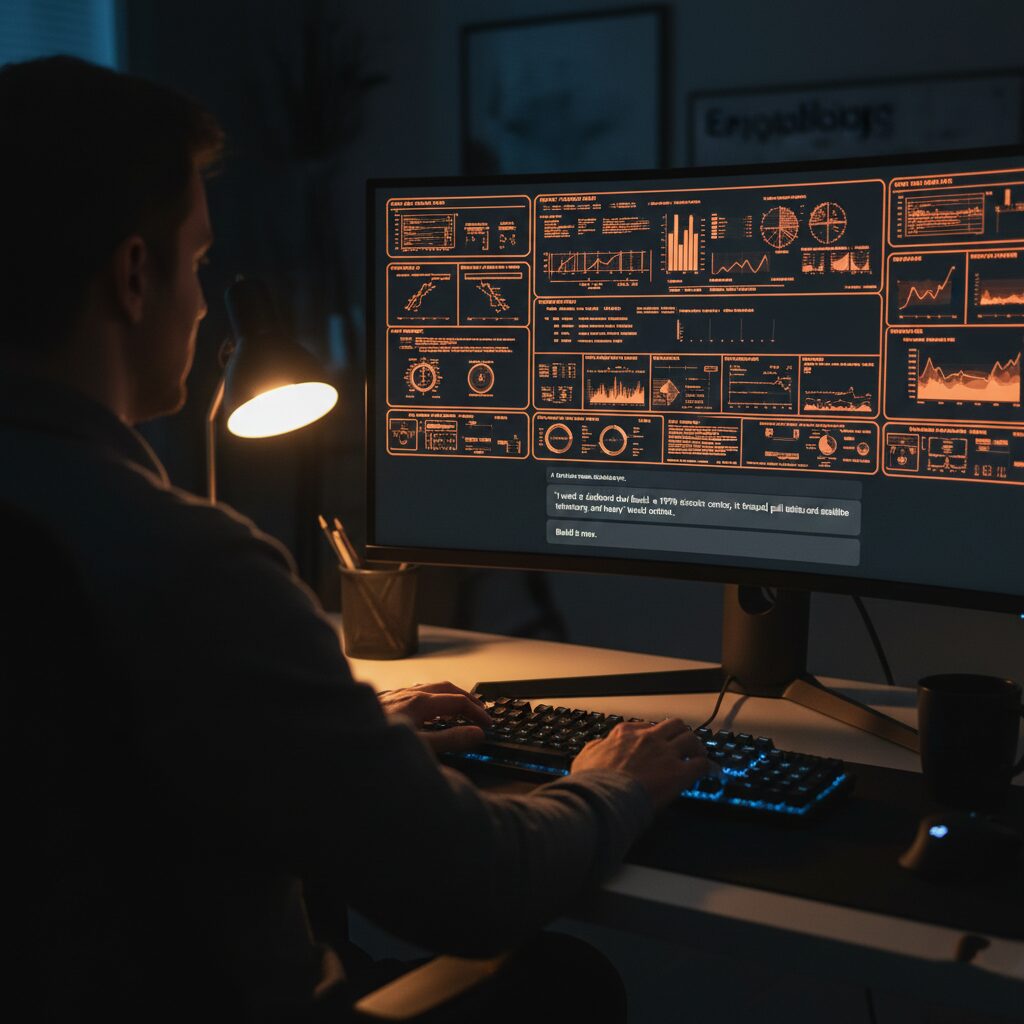
Instead, I opened a simple chat interface, took a sip of lukewarm coffee, and typed a single, semi-coherent paragraph: “I want a dashboard that feels like a 1970s NASA mission control center. It should pull live satellite telemetry, use high-contrast amber text on a charcoal background, and it needs to feel ‘heavy’ and industrial. Don’t ask questions; just build it now.” I watched, paralyzed, as the cursor blinked. Sixty seconds later, the app was live. It wasn’t just a mock-up or a “smoke and mirrors” prototype; it was a fully tested, containerized, and deployed platform. I hadn’t written a single line of code and I hadn’t even thought about a semicolon. I had just vibe coded an entire software suite into existence using nothing but my raw intent.
We are currently witnessing the total, unceremonious collapse of the traditional developer role. The era of the “syntax-monkey”—the person whose primary value was knowing the obscure rules of a programming language—is dead. We have entered the age of Intent-Driven Development. In this new world, expertise isn’t measured by how well you can speak to a machine in its own cold, logical tongue. Instead, it is measured by how clearly you can articulate a “vibe” to an AI agent that handles the structural foundation for you.
The Fall of the Syntax Gatekeepers
For as long as I’ve been in tech, there was a hierarchy. At the top were the people who understood the “metal”—those who could write C++ or Rust without breaking a sweat. They were the gatekeepers of the digital world. If you wanted to build something, you had to pay them, or you had to spend years becoming one of them. The “How” was the most expensive part of any project.
But as I sat there watching my NASA-vibe dashboard stream real-time data from a satellite orbiting thousands of miles above my house, I realized those gates had been torn off their hinges. Vibe coding has commoditized the “How” to the point of near-zero cost. When a machine can interpret your messy, human thoughts and translate them into a perfectly optimized tech stack in seconds, the technical skill of writing code becomes a legacy art form—much like calligraphy or hand-weaving. It is beautiful to watch, but it is no longer how the world gets built.
This shift is more than just a new tool; it is a fundamental reordering of human labor. We are moving from a world of “construction” to a world of “curation.” I used to be a builder. Now, I am a conductor. I don’t lay the bricks anymore; I describe the cathedral and let the machine manifest it. This is the heart of vibe coding. It rewards the imaginative and the articulate while punishing the rote-learners who relied on their knowledge of technical jargon to maintain their status.
The Democratization of the “God-Complex”
There is a intoxicating power in being able to summon complex systems with a single sentence. I’ve felt it myself. When you can describe a “vibe” and see it become a physical, digital reality in real-time, it is easy to develop what I call the “God-Complex.” You begin to believe that because you can summon the system, you actually understand the system.
This is the most dangerous aspect of the vibe coding revolution. We are creating a generation of “creators” who have never seen a brick. They are building massive, interconnected digital architectures on a foundation they can neither see nor repair. In my years of traditional coding, I learned the “Why” behind every line. I knew why a memory leak happened because I understood how the machine allocated space.
But today’s vibe coder doesn’t need to know that. They only care if the app “feels” right. This creates a terrifying abstraction layer. We are building our modern economy on top of “vibes.” When the AI agent generates 10,000 lines of code to fulfill your request for an “industrial-feeling dashboard,” it is making thousands of micro-decisions on your behalf. It is choosing the security protocols, the data handling methods, and the logic gates. If the user doesn’t understand those underlying systems, they are essentially flying a jet on autopilot without knowing how an engine works. When the “vibe” breaks—when a subtle logic error deep in the generated code causes a catastrophic failure—the average user is left powerless.
From “How” to “What”: The Redefinition of Expertise
Despite the risks, I am convinced this is the most exciting time to be a creator in human history. The shift from “How” to “What” is the ultimate unlock for human potential. For the next 18 months and beyond, we will see a radical redefinition of white-collar work.
In the old world, the “expert” was the person who knew how to execute a task. In the vibe-coding world, the expert is the person who knows what should be done. Taste is the new technical skill. If you have the “vibe” but no taste, you will simply create a high-speed, perfectly-coded disaster. I’ve seen people use AI agents to generate thousands of pages of content or dozens of apps that are technically “perfect” but soul-crushing to use. They have the power of creation, but they don’t have the vision to guide it.
True expertise is moving to the edges of the process. It is moving toward the “Intent” and the “Audit.” My value as a developer has shifted from my ability to write a loop to my ability to spot a “bad vibe” in a system before it goes live. I’ve become a forensic analyst of my own creations. I spend 5% of my time prompting the machine and 95% of my time auditing the output to ensure the “vibe” hasn’t introduced a structural rot.
The Rise of the Forensic Developer
This brings us to the great paradox of the “Death of the Developer.” The traditional developer who writes code from scratch is indeed a dying breed. But the “Forensic Developer”—the one who can dive into a mountain of AI-generated code and identify a structural flaw—is becoming the most valuable person in the room.
I recently saw this play out with a colleague who “vibed” a complex financial application into existence in a single afternoon. To the naked eye, it was flawless. It calculated interest rates, managed user accounts, and looked like a professional banking app. But when I audited the “vibe,” I found a fundamental error in how the AI had handled floating-point numbers—a classic mistake that could have cost his clients millions over time.
Because my colleague had never learned the “boring” foundations of computer science, he couldn’t see the rot. He loved the speed of creation so much that he forgot the machine is a statistical engine, not a sentient being. It doesn’t “know” math; it predicts the next most likely character in a string. This is why we cannot afford to let the foundation crumble. We need people who still speak the old languages of Python, C++, and Rust—not to write them, but to read them. We need the “syntax-linguists” to act as the final check on our vibed-out future.
Embracing the Intent-Driven Future
As I look at my finished NASA-vibe dashboard, I don’t feel regret for the hours I spent learning to code. Those hours gave me the “Expertise” (the ‘E’ in E-E-A-T) to know when the machine is lying to me. They gave me the taste required to guide the “vibe” toward something meaningful rather than something merely functional.

Vibe coding is not a threat to creativity; it is a catalyst for it. It strips away the friction of execution and allows us to live entirely in the realm of ideas and it allows a poet to build a social network. It allows a doctor to build a diagnostic tool and it allows anyone with a vision to manifest that vision in real-time.
But we must stay grounded. We must resist the God-Complex and remember that we build every ‘vibe’ we summon on a mountain of logic for which we are responsible. The future of work isn’t about becoming a master of a language; it’s about becoming a master of your own intent. It’s about learning to describe the world you want to see with such clarity that the machine has no choice but to build it perfectly.
The era of the “Construction Era” is closing. The “Intent Era” is here. I, for one, am ready to stop fighting with semicolons and start dreaming in high-definition. Are you ready to find your vibe?