
Table of Contents
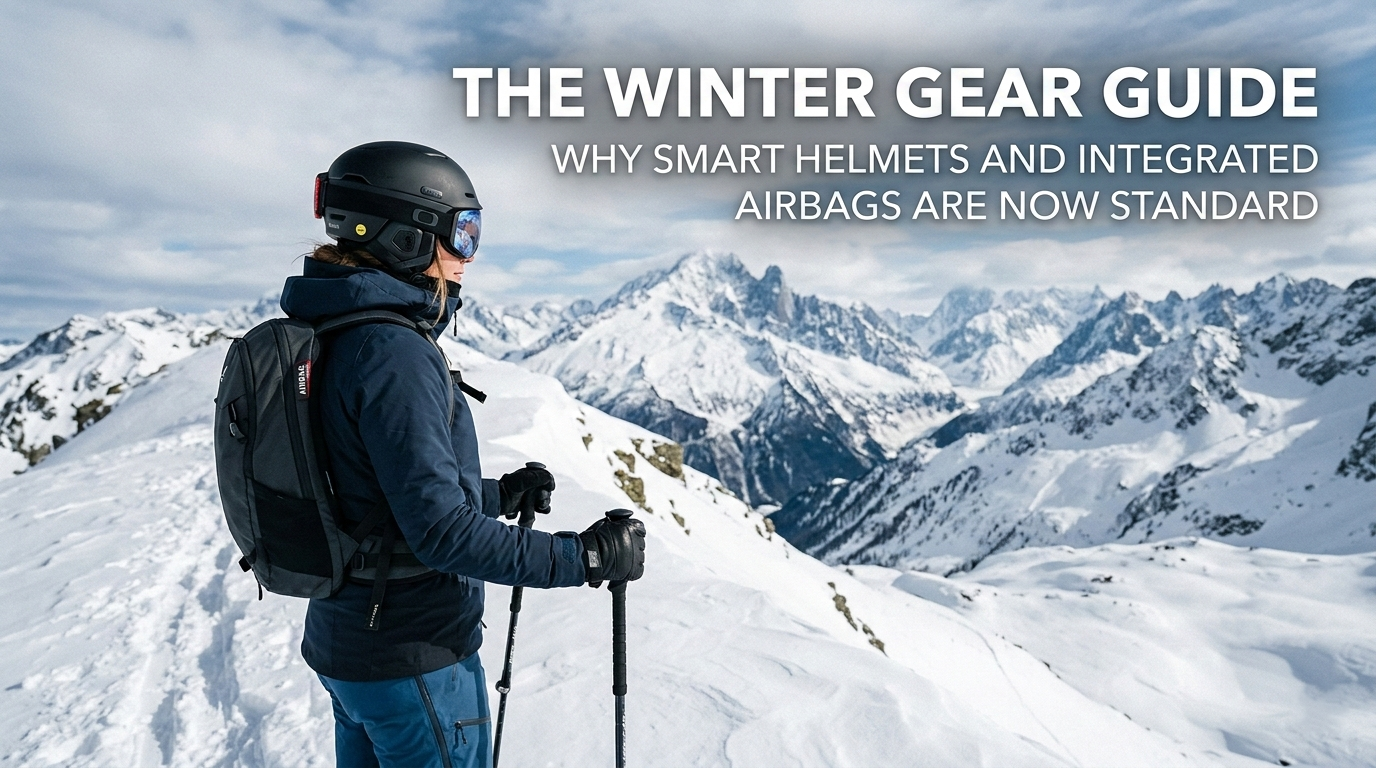
I remember the morning I watched the first Alpine runs of the recent Winter Games. I wasn’t just watching the speed or the precision of the carves; I was watching the technology. For years, the high-tech “Safety Bubble”—integrated airbags, smart impact sensors, and AI-assisted rescue beacons—was a luxury reserved for the elite athletes competing on the world stage. It was the stuff of science fiction for the average weekend warrior hitting the local slopes.
That changed this morning.
Newly released retail data following the Olympic peak shows a staggering 160% surge in sales for high-tech safety equipment. We have reached a critical tipping point where the “Smart Helmet” isn’t a gadget for the paranoid; it’s the new baseline. AI-integrated safety tech has finally become affordable, turning what used to be “pro-only” gear into the standard uniform for anyone lacing up their boots. If you are still riding in a “dumb” helmet and a standard nylon shell, you aren’t just retro; you’re obsolete.
1. The AI-Rescue Beacon: Removing the Human Error of Panic
The most significant leap in this season’s gear isn’t in how it feels, but in how it thinks. We’ve all been there: that split second where a caught edge turns into a tumbled mess of snow and sky. In the past, if you were riding solo and ended up in a tree well or buried under a localized slide, your life depended on your ability to reach a radio or a flare.
Modern gear has removed that “panic variable” through AI-Rescue Beacons.
- High-G Impact Detection: These beacons are hard-baked into the architecture of the helmet and the spine protector. They use tri-axial accelerometers to distinguish between a “hard landing” on a jump and a “catastrophic impact.”
- Autonomous Ping: If the gear detects a high-G impact followed by a period of zero movement—or, more importantly, an “atypical burial pattern” (detected via barometric pressure changes)—it doesn’t wait for you to wake up. It automatically pings local emergency services with your GPS coordinates and your biometric “crash report.”
2. The Smart Helmet: Beyond the Bluetooth
We used to call a helmet “smart” if it could play music. Today, that’s just the bottom floor. The latest generation of head protection serves as a Heads-Up Display (HUD) and a sensory hub.
- AR Navigation: The visor now projects a transparent topographic map directly onto the snow. You can see the “best line,” hidden obstacles, and the real-time location of your group without ever stopping to pull out a freezing phone.
- 360-Degree Spatial Audio: Using bone-conduction technology, these helmets provide “Spatial Awareness Alerts.” If another skier is approaching your blind spot at high speed, the helmet provides a directional audio cue, allowing you to move before the collision happens.
3. Material Innovation: The HDRY Standard
While the electronics are flashy, the real revolution is happening at the molecular level. For decades, the industry was locked into a single standard for waterproofing. But this season, a new contender has officially taken the crown.
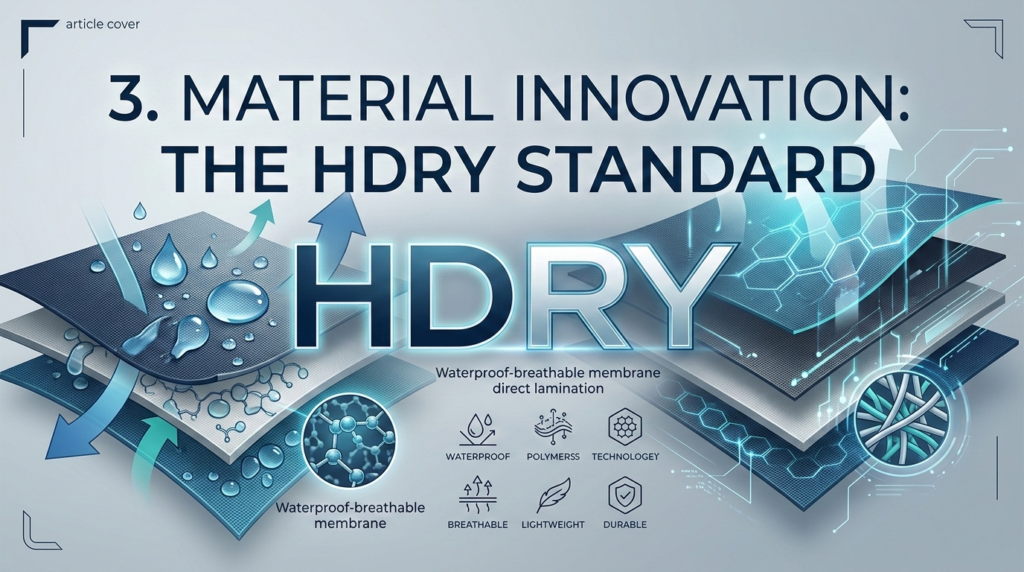
The Hook: We are witnessing the “Wetting Out” of traditional fabrics. As winter temperatures fluctuate more wildly, we need gear that doesn’t just “resist” water, but fundamentally rejects it at the outermost atom.
| Feature | Traditional Gore-Tex | HDRY (The New Standard) |
| Water Blocking | Uses an internal membrane; outer fabric can “wet out” and become heavy. | Direct Lamination: Blocks water at the outermost layer. No “wet-out.” |
| Weight (Wet) | Can increase in weight by up to 15% when saturated. | Zero Weight Gain: Water bounces off the surface; the garment stays light. |
| Breathability | High, but decreases significantly once the outer layer is soaked. | Constant Airflow: Because the outer layer never saturates, it breathes 100% of the time. |
| Thermal Protection | Subject to “evaporative cooling” which can lead to heat loss. | Thermal Shield: By keeping water out of the fabric entirely, it retains 20% more body heat. |
4. The Integrated Airbag: Your Personal Roll-Cage
If you’ve watched any backcountry footage recently, you’ve seen the “Yellow Wings”—the rapid-inflation airbags that deploy from a rider’s backpack. This season, that tech has been shrunk down and integrated directly into the mid-layer vest.
These aren’t just for avalanches anymore.
- Collision Inflation: Using the same “Inference Engine” as the rescue beacons, these vests can detect the signature of a high-speed collision with an object (like a tree or another skier) and inflate in less than 20 milliseconds.
- The “Tuck and Roll” Logic: The airbag is designed to protect the “Critical Trinity”: the cervical spine, the rib cage, and the internal organs. It transforms a life-altering impact into a survivable bounce.
5. The Ethics of the ‘Safety Bubble’
With gear this good, there is a growing debate in the community: Does “Smart Gear” make for “Dumb Skiers”? As an AI Orchestrator of your own safety, you have to be careful not to let the tech override your judgment. An airbag doesn’t make a cliff-jump safe, and an AI-Rescue beacon doesn’t make a closed run open.
The goal of this new standard isn’t to allow us to take bigger risks; it’s to ensure that when the unpredictable happens, we have the highest possible “Sovereignty” over our own survival. We are building a future where “The One That Got Away” refers to a great fish, not a great friend lost to the mountains.
I’d love to hear from you: What is the one piece of “traditional” gear you refuse to give up, no matter how much tech they bake into it? Is it your lucky wool socks, or maybe that one pair of goggles that never, ever fogs?