
Table of Contents
For years, whenever I looked up at the night sky, I felt like I was looking at a puzzle with half the pieces missing. In the world of astronomy, we have always had a “neighborhood problem.” According to everything we knew about gravity, the galaxies surrounding our Milky Way should be behaving like a tight-knit family, huddling together. Instead, they have been drifting away, behaving as if they were trying to escape a room we didn’t even know we were in.
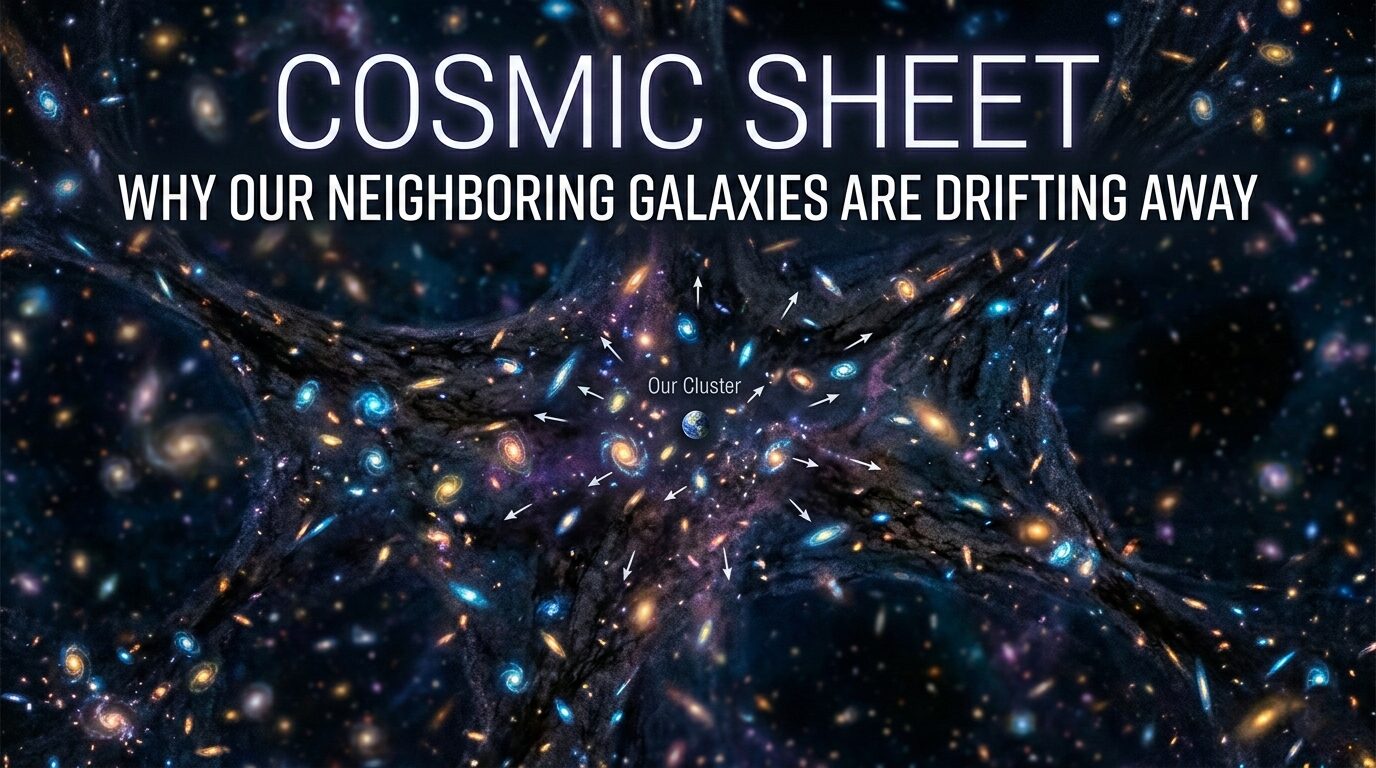
I have spent countless hours analyzing galactic motion, and the math simply didn’t add up—until now. We have finally discovered the “floor” of our local universe: a massive, flat structure known as the Cosmic Sheet. This isn’t just a fun piece of trivia; it is the structural scaffold that explains why our neighborhood looks and moves the way it does.
The Mystery of the Drifting Neighbors
To understand why this matters, you have to imagine the Milky Way as a powerful magnet. Because of our immense mass, our gravity should be pulling nearby smaller galaxies toward us. For decades, however, we observed a strange “drift.” Galaxies that should be falling inward were instead speeding outward.
Explore
This discrepancy suggested that there was an outside force—something massive and invisible—counteracting our own gravitational pull. It turns out we aren’t just floating in a random void. We are embedded in a gigantic, flat wall of dark matter and gas that acts like a cosmic level, balancing the gravitational forces of the entire region.
What is the Cosmic Sheet?
When I describe the Cosmic Sheet, I like to use the “pancake” metaphor. While most people think of the universe as a series of spheres or clumps, the large-scale structure of the cosmos is actually quite flat in certain regions.
The Cosmic Sheet is a vast, two-dimensional arrangement of dark matter. Because dark matter doesn’t emit light, we couldn’t see it directly. We had to wait for advanced simulations to show us how it dictates the motion of everything it touches. Our Milky Way sits right in the middle of one of these sheets. This sheet provides a gravitational “tug” that perfectly explains the outward drift of our neighbors. It is the invisible architecture of our home.
Voids and Filaments: The Cosmic Web
To truly grasp our place in the neighborhood, we have to look even further out. The universe is organized into what astronomers call the Large-Scale Structure. This isn’t a chaotic mess; it is a highly organized “Cosmic Web.”
In this web, there are three main components:
- Filaments: Long, thin “highways” of dark matter where galaxies congregate.
- Nodes: Where filaments cross, creating massive clusters of thousands of galaxies.
- Cosmic Voids: Enormous, empty bubbles that contain almost no galaxies at all.
Our Cosmic Sheet is the boundary between these massive voids. Imagine a soap bubble—the galaxies live on the thin film of the bubble, while the “void” is the empty air inside. We are living on the skin of a cosmic bubble, and that skin is what provides the gravitational balance for our local group.
Dark Matter: The Structural Scaffold
I often hear people describe dark matter as a mysterious, ghostly substance. While that’s true, it is more helpful to think of it as the “rebar” in a concrete building. You can’t see the steel beams once the walls are up, but without them, the building would collapse.
Dark matter motion is the primary driver of galactic evolution. It creates the valleys that galaxies “roll” into and the walls that they “stick” to. By understanding the shape of our local Cosmic Sheet, we are finally seeing the blueprint of our own house. It explains why the Andromeda galaxy is on a collision course with us, while others are being pushed away toward the edges of the local void.
Why This Changes Our Map
For a long time, our maps of the universe were like ancient seafaring charts—mostly “here be monsters” and empty space. Now, we are filling in the topography. We are learning that the motion of galaxies isn’t random; it is a response to the geometry of the space they inhabit.
This discovery settles a debate that has lasted for my entire career. It proves that the “void” isn’t just empty—it is a pressurized environment shaped by dark matter. The outward speed of our neighbors isn’t an anomaly; it is the natural result of living on a Cosmic Sheet.
A New Perspective on Home
Knowing that we sit on a cosmic scaffold changes how I feel when I look at the stars. We aren’t just drifting aimlessly. We are part of a grand, structured architecture that spans billions of light-years. The Milky Way has a floor, a ceiling, and neighbors that are all following the same invisible map.
As we continue to refine our simulations, we will likely find even more layers to this cosmic cake. But for now, we finally know why our neighbors are in such a hurry to leave: they are simply following the curves of the sheet we all call home.