
Table of Contents
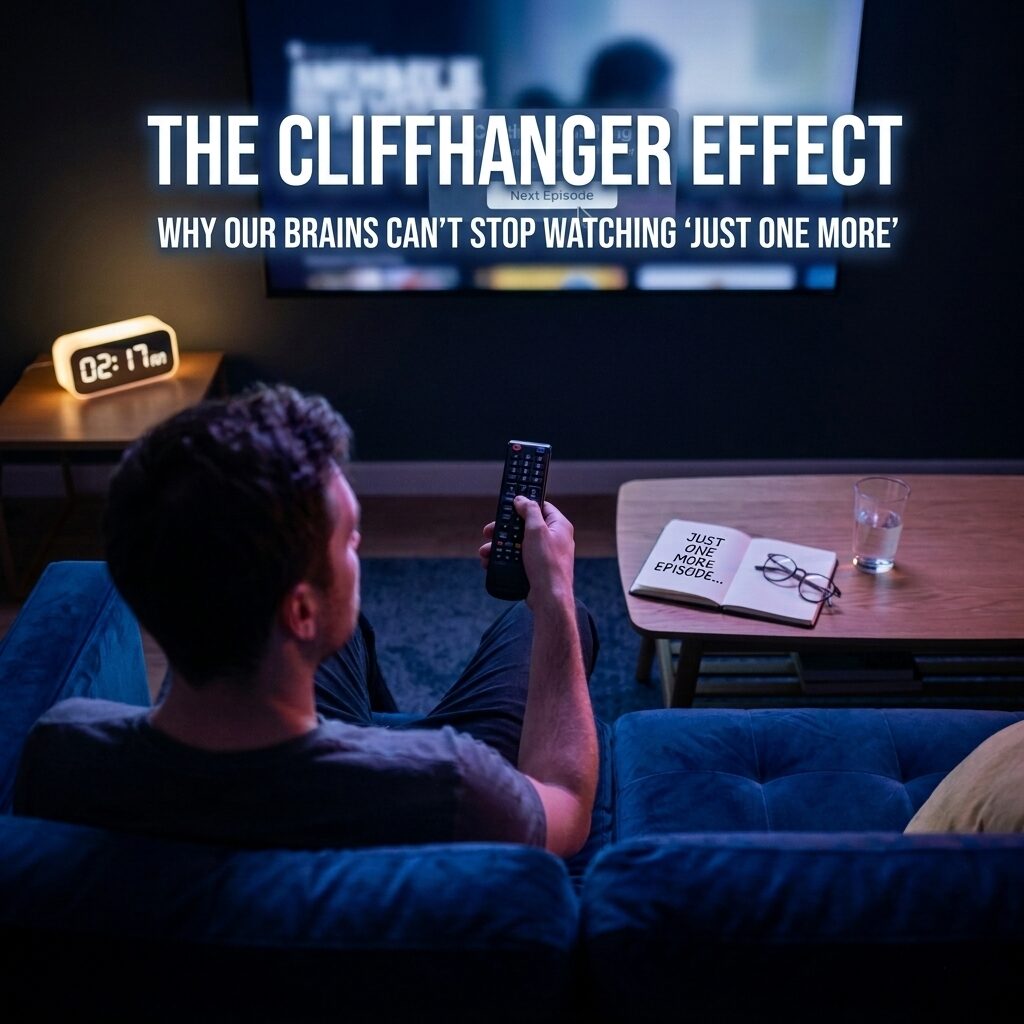
It’s 2:00 AM. You have a critical meeting at 9:00 AM, your eyes are burning from blue light exposure, and the logical part of your brain is screaming at you to go to bed. Yet, as the credits roll and that little timer in the corner of the screen counts down from five, you don’t reach for the remote. You sit there, paralyzed by anticipation, and let the next episode play, you aren’t lazy and you aren’t “weak-willed.” You are a biological victim of a powerful psychological phenomenon known as the Zeigarnik Effect. We like to think of ourselves as the architects of our own choices, but when it comes to modern streaming, we are often just passengers in a system designed to exploit the very way our brains process information.
The Science of the “Open Loop”
The story of why we binge begins in a busy Berlin restaurant in the 1920s. A Soviet psychologist named Bluma Zeigarnik noticed something peculiar about the waiters. They could remember incredibly complex orders perfectly as long as the bill was unpaid. However, the moment the transaction was completed and the “loop” was closed, the waiters could no longer recall a single detail of what the customers had eaten.
Zeigarnik’s subsequent research revealed a fundamental truth about human cognition: our brains remember uncompleted or interrupted tasks much better than completed ones. When a story ends on a cliffhanger, it creates an “open loop” in your mind. This creates a state of cognitive tension. Your brain views that unresolved plot point as a task that needs to be finished. Until you know if the hero survived the explosion or if the couple finally got together, your brain remains in a state of high alert. Watching the next episode isn’t just entertainment; it’s a biological “closing of the loop” that provides immediate neurological relief.
The Dopamine Reward Loop
While the Zeigarnik Effect creates the tension, dopamine provides the fuel. Dopamine is often misunderstood as the “pleasure” chemical, but it is more accurately described as the “anticipation” chemical. It’s about the chase.
Streaming platforms have mastered the art of the “micro-cliffhanger.” By placing a revelation or a high-stakes question at the very end of an episode, they trigger a dopamine spike. Your brain predicts that the “reward” (the answer to the mystery) is just minutes away. This creates a feedback loop: the tension of the open loop makes you seek the answer, and the dopamine makes the seeking feel rewarding. By the time you’ve closed one loop, the next episode has already opened two more.
The Architecture of the “Auto-Play”
It isn’t just the writing that keeps us hooked; it’s the interface design. This is where psychology meets user experience (UX). Before streaming, television had “natural stopping points.” You had to wait a week for the next episode, or at the very least, you had to physically change a DVD. These were “stopping rules”—moments that forced you to make a conscious decision to continue.
Modern streaming platforms have effectively removed the “stopping rule” by introducing Auto-Play. By making “watching” the default action and “stopping” the active choice, platforms take advantage of our natural cognitive bias toward inertia. When you are tired at 2:00 AM, your “Executive Function”—the part of the brain responsible for impulse control—is depleted. Making the decision to turn off the TV requires more mental energy than simply letting it continue. The platforms aren’t just giving you what you want; they are outlasting your willpower.
The Erosion of “Forced Reflection”
There is a hidden cost to the “Just One More” culture: the loss of reflection. Historically, when we had to wait a week between episodes, our brains spent that time processing the themes, debating theories with friends, and letting the emotional weight of the story sink in. This is called “elaborative rehearsal.”
When we binge, we bypass this process. We consume information so quickly that the brain doesn’t have time to move the content from short-term to long-term memory effectively. This is why you can binge an entire eight-hour season on a Saturday and struggle to remember the characters’ names by the following Thursday. We are “eating” the content, but we aren’t “digesting” it.
The Narrative “Zeigarnik” in Daily Life
The Cliffhanger Effect doesn’t just apply to Netflix. It’s the same psychological trick used in clickbait headlines (“You won’t believe what happened next!”) and social media threads. By giving you a piece of the puzzle but withholding the final picture, creators create a “curiosity gap.”
Once that gap is opened, the brain feels a physical discomfort until it is filled. Understanding this is the first step toward reclaiming your time. When you realize that your “need” to watch the next episode is actually a triggered biological response, you can begin to build “circuit breakers” into your routine.
How to Architect a “Hard Stop”
To beat the Zeigarnik Effect, you have to introduce manual “stopping rules” back into your environment. Here are three science-backed strategies to reclaim your sleep:
- Stop Mid-Episode: This sounds counterintuitive, but it is the most effective way to beat a cliffhanger. If you stop during a lull in the middle of an episode—when no loops are currently open—you won’t feel the same biological pull to continue.
- Disable Auto-Play: Force yourself to make a conscious click to start the next episode. This small “friction” gives your executive function a chance to kick in and ask, “Do I really want to do this?”
- The “Pre-Commitment” Rule: Set a sleep alarm on your phone that is physically out of reach. When that alarm goes off, you have to stand up to turn it off. Once you are standing, the inertia of the couch is broken, making it much easier to walk toward the bedroom.
Reclaiming the Third of Your Life
As we discussed in our article on The Science-Backed Routine for Perfect Sleep, sleep is the ultimate performance enhancer. When we let the Cliffhanger Effect steal our rest, we aren’t just losing hours; we are losing cognitive clarity, emotional stability, and long-term health.
The goal isn’t to stop watching great stories. Stories are essential to the human experience. The goal is to become the architect of your entertainment rather than its victim. By understanding the Zeigarnik Effect, you can enjoy your favorite shows without letting them compromise your life. Tonight, when the countdown starts, remember: the loop can wait until tomorrow.
We’ve all been there—the sun is coming up and you’re still hitting ‘Next Episode.’ What is the one show that completely broke your willpower and kept you spiraling into a 3:00 AM binge? Drop the title below so we can all avoid (or join) the obsession!