
Table of Contents
I stood at the boarding gate, heart hammering against my ribs, watching a traveler two spots ahead of me get turned away. He had his passport aslong as his boarding pass. He even had a smile for the gate agent. But he didn’t have the one thing that actually matters anymore: a digital “handshake” with the country he was trying to visit.
I watched him scramble with his phone, trying to navigate a government website on spotty airport Wi-Fi, but it was too late. The doors closed. That was the moment I realized the old way of traveling—just showing up with a suitcase and a dream—is officially dead.
Today, I want to walk you through how I navigate this new world. I’ve spent the last year crossing borders that feel more like digital membranes than physical lines. To be a “Frictionless Traveler,” you need to master what I call the Digital Trio, understand the magic of biometric speed, and embrace a new way of picking where to go.
The “Digital Trio”: My Survival Guide to the New Borders
When I used to pack for a trip, my biggest worry was whether I’d remembered my toothbrush. Now, my “packing list” starts weeks before I even touch my suitcase. You see, a passport is no longer a golden ticket; it’s just a piece of ID. The real power lies in your digital authorization.
In my travels, I’ve had to balance three major systems. If you’re planning to see the world, you’ll likely meet them too:
- The ETA (Electronic Travel Authorization): This is the one that nearly tripped up my friend in London. It’s a mandatory digital link to your passport. Without it, the airline’s computer literally won’t let them print your bag tag.
- The ESTA (Electronic System for Travel Authorization): I learned this the hard way during a layover in New York. Even if you are just passing through an airport for two hours, you need this digital permit. It’s a background check that happens in the cloud while you’re still at home.
- The ETIAS (European Travel Information and Authorisation System): This is the newest player. I remember the first time I applied for this; I was sitting in a coffee shop, and it took me ten minutes. But those ten minutes were the difference between me enjoying a croissant in Paris and being stuck at the check-in counter in tears.
I keep a digital folder on my phone with the “approval” emails for all three. Even though they are linked to your passport, having that PDF backup has saved my sanity more than once when a system was “slow” at a remote border crossing.
My “Invisible Border” Checklist
Whenever I book a flight now, I follow a ritual. I call it my “Pre-Flight Digital Scrub.” I never leave it to the last minute because some of these permits can take up to 72 hours to process. Here is the checklist I use every single time:
- Check the Expiry (of the Permit, not the Passport): Many people don’t realize that while your passport might be valid for ten years, your ESTA or ETA usually expires much sooner. I once realized my permit had lapsed while I was in the Uber to the airport.
- Verify the Official URL: I’ve seen so many “scam” sites that look like government portals but charge quadruple the price. I always make sure I’m on a
.govor official national domain. - The Name Match: I once saw a traveler get flagged because their middle name was on their passport but not on their digital permit. In the age of AI-automated borders, computers don’t understand “close enough.” It has to be a perfect match.
The Magic of Biometrics: No More Lines
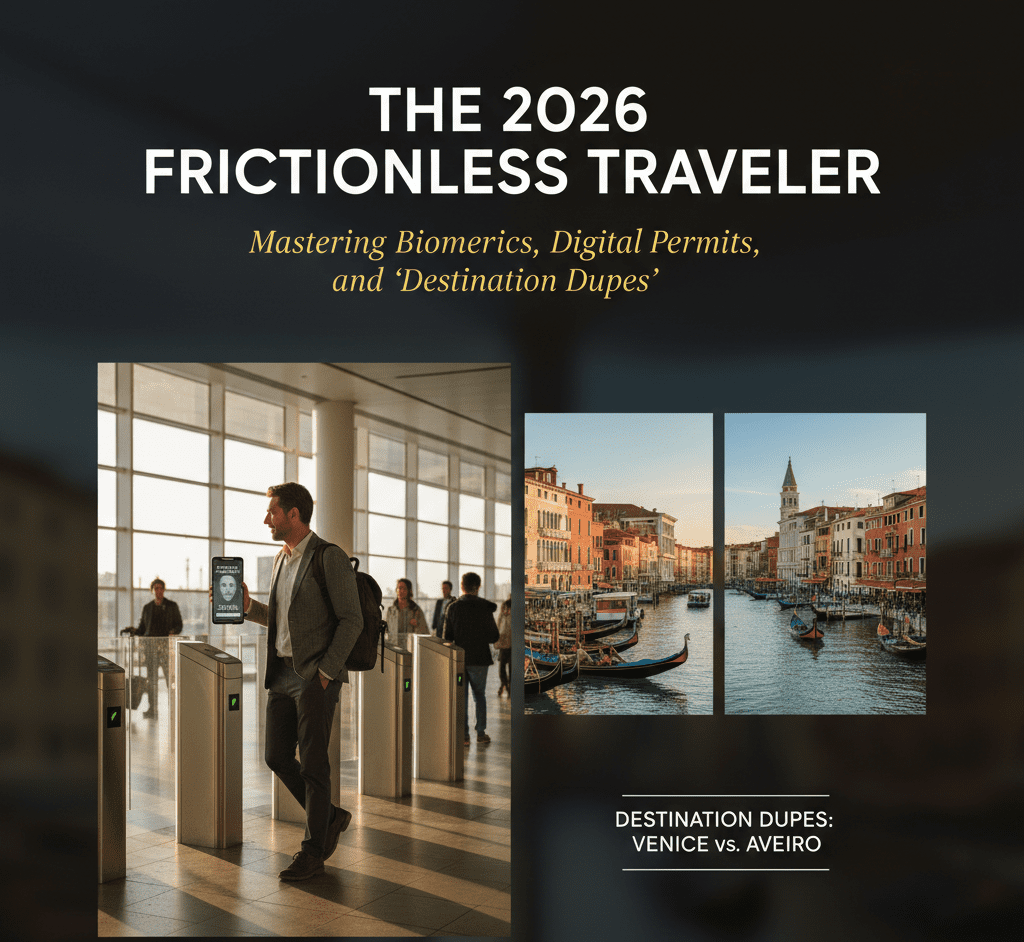
The best part of being a frictionless traveler is the feeling of walking past a 200-person line. I’ve started opting into biometric programs whenever they are offered. Last month, I walked through an entire international terminal without taking my passport out of my pocket once.
A camera scanned my face, matched it to my digital permit and my passport photo in the cloud, and the gate simply swung open. It feels like living in a sci-fi movie. If you’re offered the chance to “enroll” your biometrics at a kiosk, I highly recommend it. It turns a two-hour ordeal into a ten-second stroll.
The Rise of ‘Destination Dupes’
Beyond the tech, my travel philosophy has shifted. I used to go where everyone else went. I’d fight the crowds in Venice or wait three hours for a photo in Santorini. But lately, I’ve been hunting for “Destination Dupes.”
A “dupe” is a place that gives you the same soul-stirring feeling as a famous landmark but without the “tourist trap” friction. Instead of the overcrowded canals of a famous Italian city, I found a small town in the Netherlands with the same water-side charm and half the cost. Instead of the packed beaches of the Mediterranean, I found a stretch of coast in Albania that felt like a private paradise.
By using the money I save on these “dupes,” I can afford the premium digital services and faster flights that make the journey feel like a vacation instead of a chore.
Wrapping Up the Journey
Traveling today is a high-tech game, but it’s one you can win. When I look back at that guy at the gate who didn’t have his digital permit, I feel for him. He was a traveler from a different era.
But you? You’re going to be the one already at the lounge, sipping a coffee, because your “Digital Trio” is ready, your biometrics are synced, and your destination is a hidden gem that nobody else has found yet.
Tell us now, have you ever had any bad experience at the airport reguarding a passport or any type of identification methods? if so tell us what a nightmare it was.