
Table of Contents
I remember the exact moment I realized I was “leaking” my life away. It was a Tuesday evening, around 10:00 PM. I had been sitting on my sofa for three hours, scrolling through an endless feed of strangers’ vacation photos and 15-second comedy clips. My neck was stiff, my eyes felt like they were coated in sand, and despite having “relaxed” all evening, I felt more anxious than when I finished work. Neuro-Haptic Flow
I was a digital ghost—existing in a world of pixels, notifications, and abstractions. I had lost the connection between my brain and my hands.
The shift happened a week later when I walked into a community pottery studio on a whim. The smell hit me first: damp earth and mineral-rich clay. Within twenty minutes, I was covered in grey sludge, hunched over a spinning wheel. I wasn’t thinking about my emails. I wasn’t worrying about my mortgage and i wasn’t even thinking about what I looked like. For the first time in years, the “background noise” of my brain had gone silent.
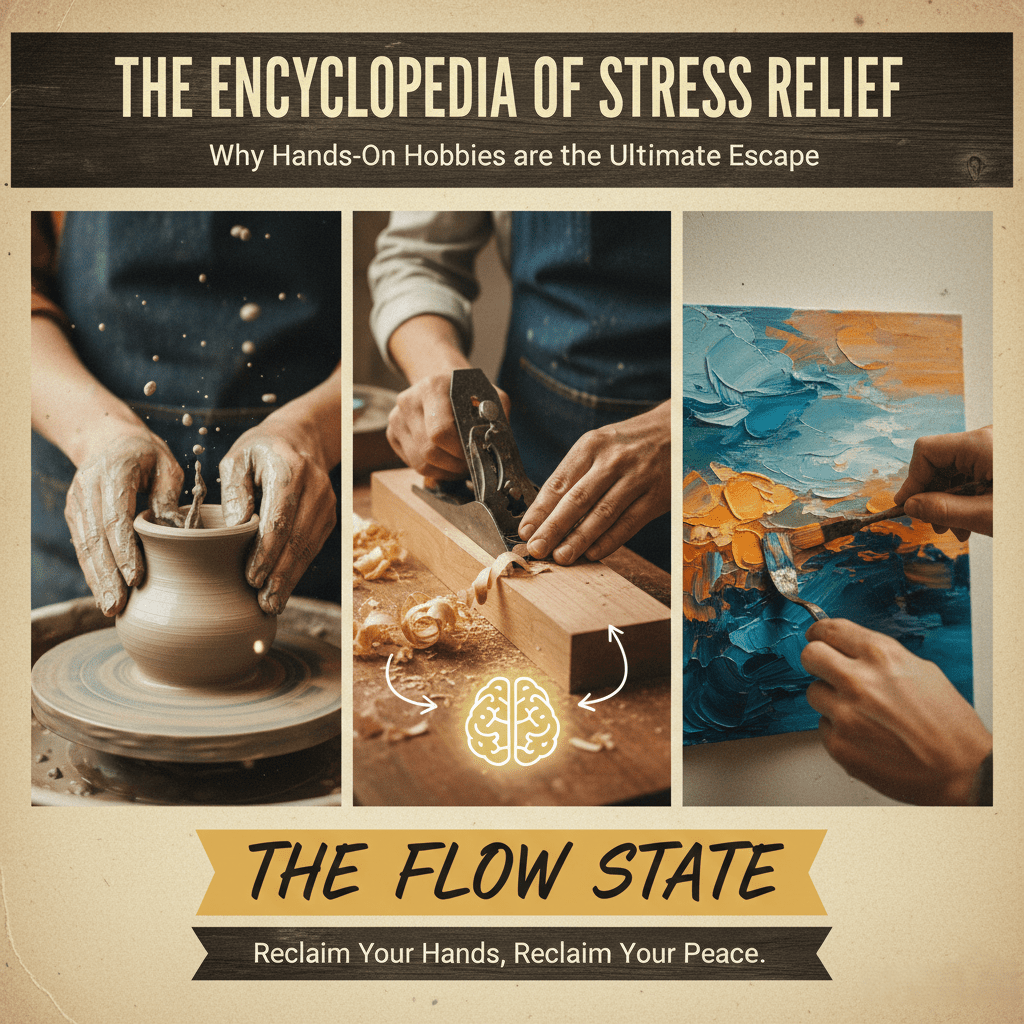
I had found The Flow State.
What is “Flow” Exactly?
In psychology, “Flow”—a term popularized by the researcher Mihaly Csikszentmihalyi—is that state of mind where you become so utterly immersed in an activity that time seems to warp. You forget yourself. You forget your hunger and you are simply doing.
I used to think Flow was reserved for elite athletes or master surgeons. But I discovered that the most accessible gateway to this state isn’t a high-stakes competition; it’s a hands-on hobby. Whether it’s woodworking, painting, or gardening, these activities provide the perfect “Flow” cocktail: a clear goal, immediate feedback, and a balance between challenge and skill.
The Sensory Anchor: Why Our Hands Matter
We evolved to use our hands. For thousands of years, the human brain developed in tandem with our ability to shape stone, wood, and clay. When we spend all day tapping on a glass screen, we are using a tiny fraction of our neurological potential.
When I started woodworking in my garage, I felt a strange sense of “coming home.” There is something deeply grounding about the resistance of wood against a saw, the scent of cedar shavings, and the physical weight of a finished stool.
The Psychology of “Groundedness”
Hands-on hobbies provide what psychologists call “sensory grounding.” When you are painting, you aren’t just thinking about color; you are feeling the drag of the brush against the canvas.
- Tactile Feedback: Your brain receives constant data from your fingertips, which anchors you in the present moment.
- The Death of Multi-tasking: You cannot check your phone while your hands are covered in oil paint or wet clay. The physical barrier forces a “monotasking” environment that our brains crave.
- Tangible Proof of Existence: At the end of an hour of scrolling, you have nothing. At the end of an hour of knitting, you have three inches of a scarf. That physical progress is a powerful antidepressant.
3 Hobbies That Are “Flow” Powerhouses
While any hobby can trigger Flow, I’ve found that three specific paths offer the most direct route to mental stillness.
1. Pottery (The Ultimate Surrender)
Pottery is a lesson in humility. The clay has a mind of its own. If you push too hard, it collapses. If you don’t push enough, it wobbles.
- Why it works: It requires “micro-movements.” You have to be so attuned to the pressure of your thumbs that there is simply no room left in your consciousness for stress.
- The Lived Lesson: I learned that I couldn’t “force” the clay to be a bowl. I had to listen to it. This taught me to let go of the control I try to exert over my daily life.
2. Woodworking (The Logic of Creation)
Woodworking is about precision and patience. You have to measure twice and cut once. There is a clear sequence of events: plane, sand, join, finish.
- Why it works: It engages your spatial reasoning. You are solving a 3D puzzle in real-time. This cognitive load is just heavy enough to block out ruminating thoughts.
- The Lived Lesson: There is a specific “hum” when a chisel is sharp enough to peel wood like butter. In that moment, the boundary between me and the tool disappears.
3. Painting (The Freedom of Expression)
Painting is different because it’s less about “winning” against the material and more about exploration.
- Why it works: It triggers a “visual-spatial” flow. You stop seeing “objects” and start seeing shapes, shadows, and light.
- The Lived Lesson: I used to be terrified of a blank canvas. But I realized that the “Flow” isn’t in the finished painting—it’s in the act of mixing the perfect shade of sunset orange.
How to Reclaim Your Hands (and Your Peace)
If you’re feeling the “digital itch”—that restless, hollow feeling that comes from too much screen time—here is how I transitioned back to the physical world.
Start Small and “Ugly”
My first clay pots looked like lumpy ash-trays. My first birdhouse was crooked. The goal is the process, not the product. If you focus on making something “perfect,” you’ll trigger your inner critic and kick yourself right out of the Flow state. Allow yourself to be a beginner.
Set a “Digital Moat”
I have a rule: no phones in the workshop. I leave it in the kitchen. If I can hear it buzz, my Flow is broken. I protect my hobby time like it’s a sacred ritual, because for my mental health, it is.
Follow the “Goldilocks Rule”
To get into Flow, the task must be “just right.” If it’s too easy (like coloring a very simple book), your mind will wander. If it’s too hard (like trying to build a grandfather clock as your first project), you’ll get frustrated. Find the middle ground where you feel slightly challenged but capable.
The Long-Term Benefit: Resilience
The most surprising thing about my hands-on journey wasn’t just the stress relief—it was the resilience. When I successfully fixed a wobbly table leg I had made, I felt a surge of “agency.” I realized that I could change my environment. I wasn’t just a passive consumer of the world; I was a creator within it.
In a world that is becoming increasingly automated, the act of making something with your hands is a quiet act of rebellion. It’s a way to say, “I am here, I am real, and I can create beauty from the dust.”
When you’re stressed, do you prefer a hobby that is Structured and Precise (like woodworking or knitting) or Messy and Expressive (like abstract painting or pottery)?
Share your stories of getting your hands dirty in the comments below!