
Table of Contents
If you turn your eyes to the digital heavens tonight, you will witness one of the planet’s most spectacular atmospheric phenomena. High above Churchill, Manitoba—the undisputed “Polar Bear Capital of the World”—the Northern Lights are putting on a masterclass in luminescence. Millions of people are currently logging into live streams to watch ribbons of emerald green, violent purple, and ghostly white dance across the Arctic sky. It is a breathtaking display of solar winds colliding with our atmosphere, a celestial ballet that feels almost otherworldly.
But while our gaze is directed upward at the cosmic light show, the true drama of the Arctic is unfolding directly beneath the snow.
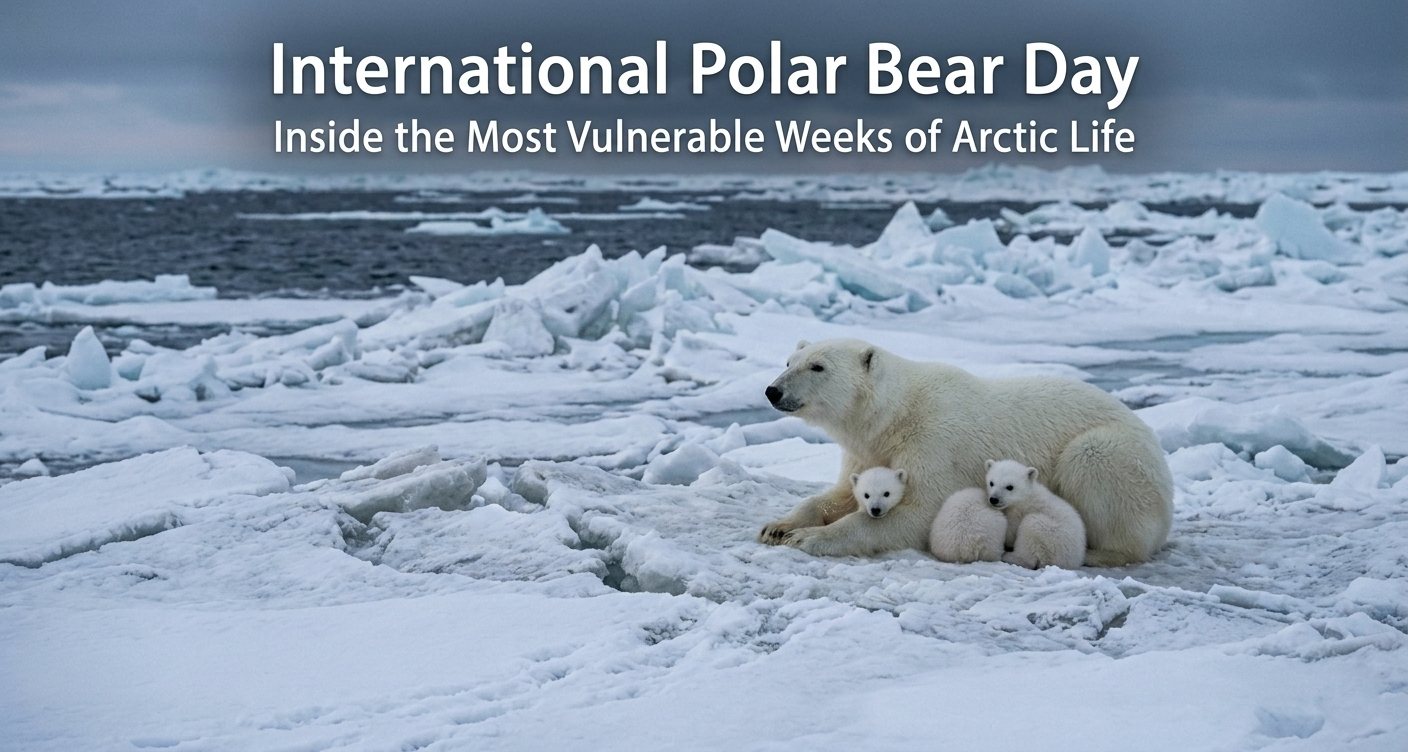
Today is International Polar Bear Day. It is a day dedicated to the apex predator of the ice, a creature that has become the reluctant poster child for a warming world. However, the timing of this day is not random; it coincides with the most critical, delicate, and dangerous biological window in a polar bear’s entire life cycle. Right now, in the pitch-black silence of subterranean ice caves, polar bear mothers are beginning to stir. They are preparing to break through the icy crust of their winter dens and introduce their newborn cubs to a blinding, freezing, and unforgiving world.
We are moving past the era of simply admiring these animals from afar. Today, we are stepping into a new age of wildlife biology. By looking at the intersection of extreme survival and cutting-edge sensor technology, we can finally begin to understand—and protect—the most vulnerable weeks of Arctic life.
The Sky Above and the Snow Below: The Churchill Hook
Churchill, Canada, sits on the edge of Hudson Bay, serving as a frozen crossroads for migrating bears. Every autumn, the bears wait here for the sea ice to form so they can hunt ringed seals. But for pregnant females, the journey is entirely different. Instead of heading out to the ice, they retreat inland. They dig deep into snowbanks, creating maternity dens where they will spend the darkest, coldest months of the year completely buried.
As you watch the Northern Lights live stream tonight, consider the profound contrast. Above ground, the aurora pulses with energy. Below ground, just a few feet beneath the snowpack, a mother bear is engaged in a brutal marathon of endurance. She entered that den in late autumn. She gave birth around New Year’s Day to cubs that were blind, deaf, and no larger than a stick of butter.
For months, she has not eaten a single bite of food. She has not drank a drop of water. She has survived entirely by metabolizing her own fat reserves, converting her own body mass into the rich, heavy milk needed to grow her cubs from fragile, rat-sized infants into twenty-pound bundles of fur capable of surviving sub-zero temperatures.
As they prepare to emerge this week, the clock is ticking. The mother is practically starving, but she cannot leave the den until the cubs are strong enough to make the perilous trek to the sea ice.
The 50% Survival Coin Toss
The weeks immediately following emergence are a statistical nightmare. Historically, up to 50% of polar bear cubs do not survive their first year, and the vast majority of those casualties occur during the trek from the den to the sea ice.
Why is this window so lethal?
- Maternal Starvation: If the mother’s fat reserves run out before the cubs are ready to walk, she faces a biological ultimatum: abandon the cubs to save herself, or stay and starve to death with them.
- Harsh Elements: Spring storms in the Arctic can drop temperatures to lethal levels. If a cub gets wet or separated in a blizzard, hypothermia sets in within minutes.
- Predation: Newborn cubs are highly vulnerable to Arctic wolves and, tragically, adult male polar bears, who will kill cubs to bring the female back into estrus (mating condition).
- The Climate Gap: As the Arctic warms, the sea ice is forming later and melting earlier. The distance between the maternity dens on land and the hunting grounds on the ice is growing, turning a difficult trek into an impossible marathon.
Protecting these dens is no longer just a matter of conservation; it is an absolute necessity for the survival of the species. But to protect a den, you first have to find it. And finding a white hole in a white landscape during a whiteout is one of the hardest tasks in modern biology.
Encyclopedia Entry: Denning Research
Denning Research: The specialized field of wildlife biology focused on locating, monitoring, and analyzing the maternity dens of Arctic predators. Because polar bears do not reuse the same dens year after year, and because the dens are entirely obscured by shifting snowdrifts, tracking them requires highly advanced, non-invasive surveying methods.
The Technological Shift: Historically, researchers relied on Forward Looking Infrared (FLIR) cameras to detect the body heat of the bears through the snow. However, recent studies proved FLIR misses up to 55% of dens because snow is a near-perfect thermal insulator. Today, the field is being revolutionized by non-invasive drone-mounted radar technology that can physically “see” through the snowpack without disturbing the sleeping family inside.
The Science of “Seeing” Through Snow
For years, the standard operating procedure for denning research was thermal imaging. The logic made sense: a 500-pound mammal radiates heat, so we should be able to see a glowing red spot on an infrared camera. But snow is essentially nature’s Kevlar against heat loss. By trapping millions of tiny pockets of air, a thick snowbank prevents the mother’s body heat from reaching the surface. To the thermal camera, the den looks exactly like the empty snow around it.
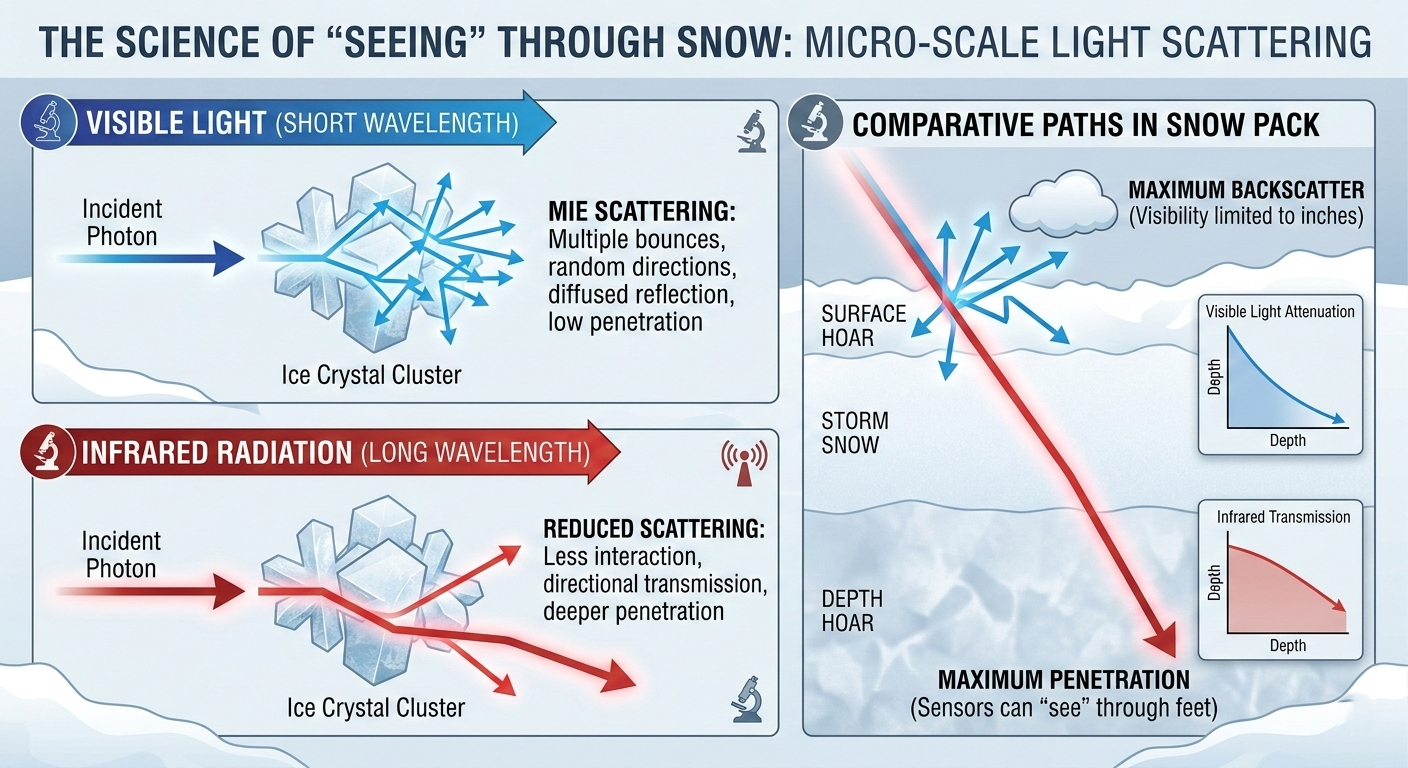
This failure rate of 55% was unacceptable, especially in regions like the North Slope of Alaska, where industrial ice roads and heavy machinery for oil exploration operate in the exact same areas where bears are denning. If a tractor accidentally drives over an invisible den, the roof collapses, often crushing the family inside.
The Intersection of Industry and Empathy
This technological leap is fundamentally changing the way humans operate in the high North. With the integration of AI-assisted radar analysis, conservationists can now survey vast tracts of land days before industrial ice-road construction begins.
If an anomaly is detected and an AI model confirms the signature of a maternity den, a one-mile buffer zone is immediately established. The ice road is rerouted. The heavy machinery is diverted. The mother bear, resting in the dark with her cubs, never even knows that a 40-ton bulldozer just bypassed her nursery.
This is what modern conservation looks like. It is not just about protesting or putting up fences; it is about using elite-level data science and physics to create a symbiotic operational map where human industry and vulnerable wildlife can navigate the same harsh terrain without lethal collisions.
The Human Element: The Maternal Fast
Beyond the radar equations and the thermal dynamics lies a story of profound biological dedication. It is easy to look at a polar bear and see only a massive, terrifying predator. But during these late-winter weeks, the female polar bear is the ultimate symbol of maternal sacrifice.
When a human mother gives birth, she requires immense caloric support. We understand the physical toll of nursing and recovery. Now, imagine doing that in a pitch-black cave at forty degrees below zero, having not eaten for over two hundred days. The female polar bear literally dissolves her own skeletal muscles and leaches calcium from her own bones to ensure her cubs have the dense, fat-rich milk they need to survive.
When she finally punches a hole through the icy crust this week, blinking against the blinding glare of the spring sun, she will be a shadow of her former self. She may have lost up to half of her total body weight. Yet, her first instinct will not be to sprint toward the ocean to feed. Her first instinct will be to patiently wait by the den opening, coaxing her wobbly, snow-blind cubs out into the open, fiercely guarding them from the wind, and teaching them how to walk in the snow.
The True Meaning of Polar Bear Day
As we celebrate International Polar Bear Day, we must shift our perspective. The narrative can no longer just be about saving ice; it must be about saving the process of life that depends on that ice.
The integration of advanced radar technology means we are finally removing the blindfold. We are no longer guessing where these critical nurseries are; we are pinpointing them. We are drastically reducing that devastating 50% mortality rate by ensuring that the greatest threat to a newborn cub isn’t the tire of an industrial truck, but simply the harsh reality of nature itself.
So, if you log onto the Churchill live stream tonight to watch the Northern Lights, take a moment to look past the neon green auroras. Look down at the endless expanse of white. Somewhere out there, beneath the frozen crust, a mother is waking up, a cub is taking its first breath of cold air, and a new generation of the Arctic’s greatest predator is preparing to meet the world.
I’d love to hear your thoughts: When you look at conservation, do you believe the burden lies more on developing better technology (like den-finding drones) to mitigate human impact, or should we focus entirely on restricting human access to these wild areas altogether?