
Table of Contents
I used to pride myself on getting “enough” sleep. Eight hours, religiously. Yet, most mornings, I’d wake up feeling like I’d wrestled a bear, not rested. My alarm was a rude intrusion, and the first hour of my day was a blurry struggle for coherence. I’d chug coffee, convinced I just needed “more” sleep, when the real secret wasn’t quantity, but quality—it was all about understanding the science of sleep cycles.
It wasn’t until I started delving into chronobiology that I realized my problem wasn’t the amount of time I spent in bed; it was how my brain was navigating its nightly journey. I wasn’t optimizing my sleep architecture, and it was costing me my energy, my mood, and my focus.
Beyond the Hour Count: The 90-Minute Rhythm
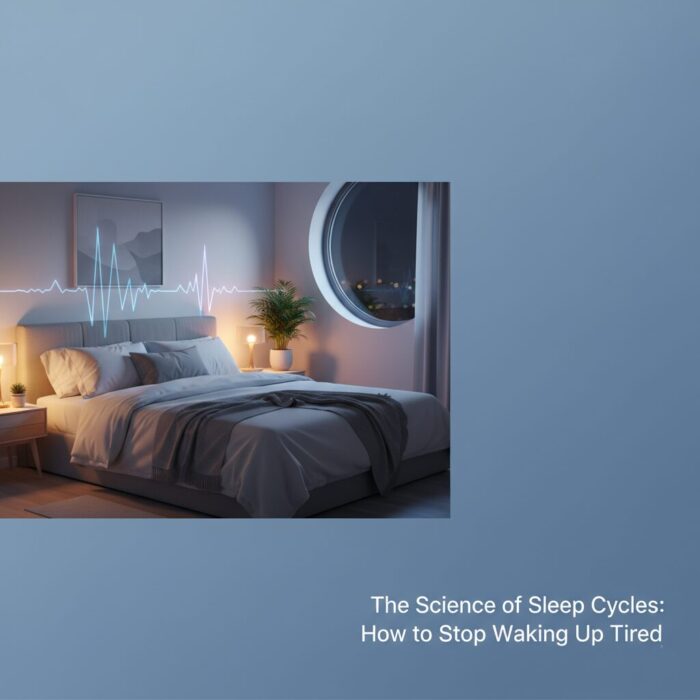
We often think of sleep as a single, uninterrupted block, but it’s actually a series of distinct stages that repeat throughout the night. Each complete journey through these stages—from light sleep to deep sleep to REM sleep—typically takes around 90 minutes. This is the fundamental unit of the science of sleep cycles.
Imagine your night as a series of 90-minute “laps.” You want to wake up at the end of a lap, not in the middle. If your alarm jolts you awake during deep sleep, that’s when you feel that groggy, disoriented sensation known as sleep inertia. My problem was that my rigid 8-hour schedule often meant I was interrupting a crucial phase of a cycle. By shifting my bedtime and wake-up time to align with these 90-minute increments, I started waking up naturally, feeling refreshed, even if the total time in bed was slightly less.
The Architect of Your Rest: NREM and REM
The science of sleep cycles breaks down into two main types: Non-Rapid Eye Movement (NREM) and Rapid Eye Movement (REM).
- NREM (Stages 1-3): This is where you first drift off (Stage 1), then move into light sleep (Stage 2), and finally, the restorative powerhouse of deep sleep (Stage 3). Deep sleep is critical for physical repair, immune function, and flushing metabolic waste from the brain. It’s when your body heals and grows.
- REM Sleep: This is our dream state, where the brain is highly active, consolidating memories, processing emotions, and engaging in creative problem-solving. It’s the mental clean-up crew.
In a typical night, you’ll cycle through NREM stages, dip into REM, and then start over. Early in the night, you get more deep sleep. Later in the night, closer to morning, your REM stages become longer. Understanding this “architecture” is key to optimizing when you wake up.
The Circadian Cue: Light as Your Master Key
While the 90-minute cycles run autonomously, they are still under the influence of your overarching circadian rhythm, which we discussed in the morning sunlight article. This is why light exposure is so critical.
I realized that even if I nailed my 90-minute cycles, if my internal clock was out of sync, I was fighting an uphill battle. Getting that early morning light signals to my brain that the day has begun, initiating a cascade of hormonal events that will make me sleepy 14-16 hours later. Without this strong light signal, my brain’s natural rhythm drifts, making it harder to initiate the sleep process at the right time.
The blue light from screens late at night also plays havoc with this. It tells my brain it’s still daytime, suppressing melatonin and delaying the onset of those crucial deep sleep cycles. I’ve found that dimming lights and using blue-light filters in the evening is just as important as stepping outside in the morning.
Sleep Environment: Your Sacred Space
My bedroom used to be a multi-purpose room: an office, a gym, and a place to binge-watch TV. It was anything but a sanctuary for sleep. The science of sleep cycles taught me that the environment plays a huge role in supporting these delicate rhythms.
- Darkness is King: Even a tiny LED light can disrupt melatonin production. I invested in blackout curtains and covered every glowing gadget. It needs to be pitch black.
- Cool is Crucial: Our body temperature naturally drops to initiate sleep. A room temperature between 60-67 degrees Fahrenheit (15-19 Celsius) is ideal. I found that if my room was too warm, I’d wake up in lighter stages of sleep more frequently.
- Quiet is Non-Negotiable: Unexpected noises can pull you out of deep sleep. If you live in a noisy area, consider white noise or earplugs.
Transforming my bedroom into a “sleep cave” dramatically improved the depth and continuity of my sleep cycles.
Napping with Purpose: A Cycle in Miniature
I used to think naps were a sign of weakness. Now, I see them as a powerful tool for cognitive enhancement, provided they are structured according to the science of sleep cycles.
A 20-30 minute “power nap” can refresh you without sending you into deep sleep, making it easy to wake up. This is because you mostly stay in NREM Stages 1 and 2. Longer naps, like 90 minutes, can complete a full cycle, offering deeper restoration. The key is to avoid napping for 45-60 minutes, which often leaves you waking up in the middle of a deep sleep stage, feeling worse than before.
I’ve found that a well-timed 20-minute nap in the early afternoon acts like a “mental reset,” improving my focus and creativity for the rest of the day.
The Evergreen Secret to Waking Up Refreshed
The human body’s need for structured sleep isn’t a fad; it’s hardwired into our biology. The science of sleep cycles is an evergreen truth that has guided life on Earth for millennia. By understanding these rhythms—the 90-minute architecture, the NREM and REM stages, and the external cues of light and environment—we can stop fighting our bodies and start working with them.
I no longer feel like I’m “wrestling a bear” in the mornings. Instead, I wake up naturally, often just before my alarm, feeling truly rested. This mastery over my sleep has cascaded into every other area of my life, from my productivity to my emotional resilience. It’s not about trying harder; it’s about sleeping smarter.
What’s the one thing in your ‘sleep cave’ that changed the game for you—are you team blackout curtains, white noise machine, or something else entirely?